




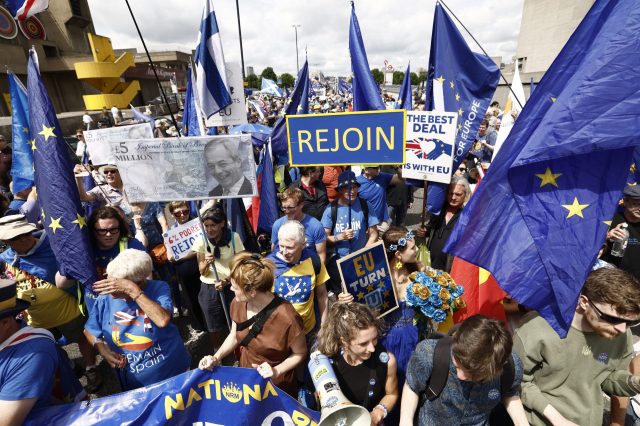
They won't let it lie.(Credit: Brook Mitchell/Getty)





In the lead-up to the Brexit referendum, Remainers deployed Project Fear to scare the living daylights out of anyone considering voting to Leave. Their statistical projections of an economic Armageddon were so absurd that they proved a monumental own goal, deemed sensationalist scaremongering. Ten years on, still smarting from the result, Rejoiners are peddling just as fantastical calculations of what the past decade would have been without Brexit: let’s call it Project Smear. But the smarter element of those who would have us return sense another defeat and so are trying something slightly different. Their cunning new strategy is aiming, instead, to foster a different fear: the idea that, perhaps, the European Union is now… too good for them!
The idea is deliciously fiendish. Combined with Project Smear’s fake numbers, which insist that Brexit has robbed them of much-needed wealth, the public is encouraged to view the EU as an institution that has reached new heights of sophistication — in part thanks to Britain’s absence. The implied message is that poor, ruined old Blighty is unworthy of the transformed bloc. The hope is that if this narrative gains traction, the good burghers of Britain may be spurred into action — if only to prove that they are worthy of higher things.
Will this new tactic work? Almost certainly not. So, why am I wasting your time, dear reader, to alert you to it? Well because, though it will fail, the new tactic is still capable of causing a great deal of damage. In prolonging this clapped-out, regressive, evidence-free debate on whether or not to rejoin the EU, the already much delayed discussion of how to make actual Brexit work for the many is delayed further.
So let us take a closer look at Project Smear, and deconstruct the statistical falsities underpinning claims that Brexit dealt a massive macroeconomic shock that impoverished the nation. Chief among these is a report entitled “The Economic Impact of Brexit”, published by the US National Bureau of Economic Research, but authored by British and European economists. Its gist is that, a decade after the Brexit referendum, the British economy is 6% smaller than it would have been had voters opted to remain in the EU.
It is interesting to note that a hypothetical has replaced any actual measurement. The argument has shifted from Project Fear’s prediction of recession (which the alert reader will have noticed never happened; indeed, during the 2016-2025 period, the UK outgrew France, Italy, and Germany) to suggest that Britain would have grown 6% faster over the past 10 years had it stayed in the EU. Of course, this is a hypothetical that, sadly, economists can never test since we lack a time machine to return to 2016 and start again sans Brexit. Still, economists insist that they have the next best thing to a time machine: econometric models that can simulate hypotheticals.
As a trained econometrician, I can tell you that the only real utility of these is to make astrologists look respectable. But don’t take my word for it. Look under the bonnet of “The Economic Impact of Brexit” — the report that the BBC, The Guardian and so on have endorsed chapter and verse. What you will find here is an attempt to identify a group of countries that, during the decade preceding the Brexit referendum (2006-2016), were following more or less the same growth trajectory as Britain. By analyzing the economic fortunes of this cohort, the report assesses whether, in the decade following Brexit, Britain’s economic path followed or diverged from that reference group and draws its ill-fated conclusions thereupon.
It sounds like a reasonable method for assessing, not so much Brexit’s impact but at least whether the year 2016 coincided with what economists refer to as a “structural break”. Until, that is, you discover which eight countries the authors selected as the British economy’s doppelgangers. The country they gave the largest weight (60.5%) to is the United States. It is difficult to imagine a more indefensible choice. For 2016 was the year of Trump 1.0, with huge tax cuts following his election. This was followed, in 2020, by Biden’s gargantuan stimulus program. With or without Brexit, the UK’s economy (indeed, any European economy) could never have come even close to America’s post-2016 growth rate. Nonetheless, this study comes to the manifestly illegitimate “conclusion” that Brexit was the reason the UK lagged the US after 2016.
As if the comparison with the US were not silly enough, guess which country was given the second-largest weighting: Greece! That’s when my initial suspicion that the authors had crossed the line from mere incompetence to intentional fraud turned into a near certainty. If these reference countries were meant to track Britain’s growth trajectory between 2006 and 2016, then Greece should have been disqualified immediately. Having shed at least 25% of its national income between the Great Financial Crisis of 2008 and 2016 (in sharp contrast with UK national income which fell by a mere 1% for only a year before it rebounded), Greece was a terrible reference country. Not only was its pre-2016 path nothing like the UK’s, but it was always going to perform, around 2016, what financiers callously refer to as a “dead cat bounce” — a temporary rebound that even a dead cat would make if dropped from a great enough height — something the UK economy was never going to emulate, thus inflating further the mis-measured Brexit effect.
And then there is the small matter of Ireland’s inclusion. Seriously? Do these people not know that Ireland’s national income, its GDP, is a hallucination? Did they forget that America’s Big Tech companies monstrously inflate Ireland’s GDP by booking their global revenues in Dublin for tax minimization purposes? Could m’learned colleagues have missed the simple point that, given Big Tech’s remarkable rise after 2016, comparing Ireland’s post-2016 growth rate with Britain’s would always make the UK look like a laggard for reasons that have nothing to do with Brexit?
But then, setting aside these risible national income comparisons, “The Economic Impact of Brexit” goes on to bolster its assessment that Brexit was an unmitigated economic calamity by focusing on the miserable fate of 7,000 UK companies. This, in fact, is the most interesting segment of their report. For it discovers a massive fall in UK productivity — something corroborated by Britain’s Office for National Statistics. Unfortunately, though, as Ambrose Evans-Pritchard has pointed out, this fall took place before 2016 and, if anything, it petered out around the time of the referendum.
In short, Project Smear was founded on non-credible data. It cannot, like Project Fear before it, withstand even the most cursory of rational analyses. This, then, is why the smarter Rejoiners felt the need to roll out their new psychological approach: the illusory truth effect. Infuse into the public’s consciousness the belief that the EU has, in their absence, become a different, a better beast — one that Britons could no longer hope to join, even if they wanted to.
Mujtaba Rahman, the European director of Eurasia Group, most recently deployed this tactic. In a piece for the Guardian (where else?) he argues that since Britain’s departure, Europe has been spared London’s constant vetoes. Thus, the bloc was able to simulate many of the benefits of a federation without having to waste time debating a federal constitution or taking chances with member-states’ national sovereignty. This continental consolidation, that Britain has allegedly missed out on, supposedly encompasses four areas.
First, following the pandemic and the formation of the EU’s Recovery Fund (officially known as NextGenerationEU), common borrowing now allows the EU to operate like a fiscal union that is better able than individual member-states to finance things the union needs: like investments in post-Covid recovery, all sorts of stabilizing fiscal transfers, even €90 billion to be gifted to Ukraine. Second, a new common security and defense agenda worth hundreds of billions is in place that extends a protective umbrella over member-states. There is also now a much needed joint industrial policy that transcends naïve free-trade notions and gives European producers a leg-up across the union. And finally, the bloc has a capacity to do that which lone countries, such as the UK, can ill afford to even try: become more assertive vis-à-vis the United States and China.
It all sounds pretty impressive, doesn’t it? Even a cosmopolitan Briton, or even a Leave voter, could be forgiven for feeling a little miffed at being left out. But each of these examples of Europe’s “continental consolidation” is nothing but smoke and mirrors. In fact, together they reflect developments which are excellent reasons for the UK to remain outside the EU.
I have been a staunch advocate of a European fiscal union for 40 years, including common borrowing in the form of eurobonds. However, the common borrowing which is now practiced in Brussels is anathema to any sensible advocate of a fiscal union. Its first faux pas is who borrows: not some common Treasury, but the European Commission, an outfit that has no power to tax or even to roll over previous debts, relying for its funds on fiscally stressed member-states that lack a central bank willing and able to support them. Is it any wonder that financiers do not take the bonds Europe uses to procure its common debt seriously, referring to them as sub-sovereign and charging the EU suitably inflated interest rates in the process?
Then there is the question of what the EU does with the jointly borrowed money. A quick glance at how the EU divvied up the €750 billion recovery fund after the pandemic is enough to send shivers down anyone’s spine: our leaders gathered in a room and haggled for a few hours over how to distribute the spoils, which were then handed out to the oligarchs back home. As I wrote six years ago:
“Imagine the sheer awfulness if parliament had to debate how much would be transferred to Cumbria, to Norfolk or to north Wales from Surrey, Sussex and west London. Britain would be wrecked by divisions that make Brexit look like an amicable affair. And yet this divisiveness has been baked into the EU recovery fund, complete with country allocations drawn up even before we know the effects of the recession on each region. It is almost as if the whole thing were designed by a cunning Eurosceptic.”
It’s the same with Europe’s current rearmament and industry policies. Long meetings, with scant oversight from parliaments or public scrutiny, take place to discuss how the borrowed billions will be distributed between German, French and Italian weapon manufacturers, and which companies’ products will be part of the “Buy European” directives, whose workers will be protected from Chinese imports, how much of the borrowed money should be sent to Ukraine and so on. The culture of oligarchic merriment which is funded in this opaque manner raises inequality, within and between member-states, to ever greater heights.
As for the claim that the EU would, at least, offer some protection from the vagaries of Donald Trump and a resurgent China, it sounds persuasive in theory — a version of safety in numbers. But in practice? Was it not Ursula von der Leyen, the President of the European Commission, who bent the knee in front of President Trump, in his Scottish golf club of all places, giving him everything he asked for (including a pledge for $700 billion of European investments in the United States which was not in her gift to make)? Is the EU not riven by squabbles between German car industry representatives, who are resisting tooth-and-nail more tariffs on Chinese exports, while their French counterparts are gung-ho about them?
Even the most ardent europhile can’t ignore the slow and sure disintegration at work here. The building up of unsustainable sub-sovereign debt won’t yield productive investments capable of repaying themselves, but will need to be financed by an already stressed EU budget that spendthrift member-states are working furiously to diminish, not to bolster. Evidently, this is a disaster in the making, not the sensible continental consolidation over which envious Britons should drool.
None of the above, of course, means that Brexit has been a spectacular success — quite the opposite, in fact. But what it does mean, however, is that Britain’s stagnation will not be reversed by rejoining a hopelessly stagnant, indeed a deindustrializing, Europe. Nor will the UK’s low productivity, low-wage, diminishing prosperity equilibrium be transcended by Andy Burnham’s justified lamentations about how neoliberalism vandalized British industry under Thatcher and Blair. The time for thinking about what a New Deal for the UK entails, undistracted by the “Europe question”, is now.
Yanis Varoufakis is an economist and former Greek Minister of Finance. He is the author of several best-selling books, most recently Raise Your Soul! A personal history of resistance.
 yanisvaroufakis