




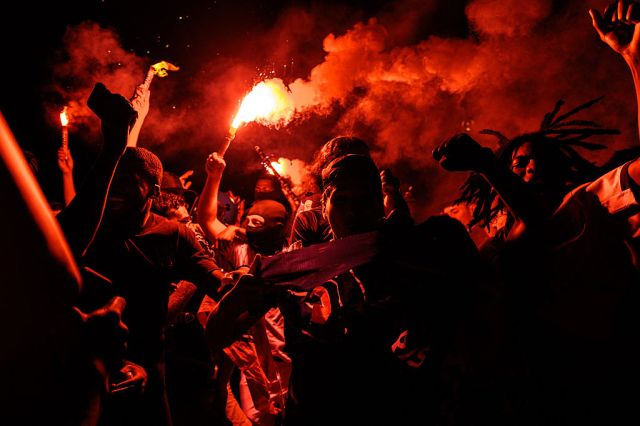
Last month's Champions League final was followed by violence in the French capital. (Gauthier Bedrignans / Hans Lucas / AFP via Getty)





As France gears up for the World Cup, the French police are preparing for more violence on the streets, whatever the results brought home by the French team. Les Bleus’ first game, which takes place in New York tonight, is against Senegal: a particularly piquant tie. Senegal is a former French colony, and Senegalese immigrants to France also make up the largest number of sub-Saharan Africans in France. Most of them live in the banlieues, the wretched suburbs of the Ile-de-France region of which Paris is the center.
Parisian police officers might take some hope from the fact that relations between France and Senegal have never been as fractious and bitter as those between France’s former colonial possessions in North Africa. Indeed, Senegal achieved independence without a bloody war of the kind that has scarred Algeria. But the Senegalese in France have high rates of unemployment and poverty, and as such form a central part of the marginalized populations of the banlieues.
This is the same population that brought havoc to Paris only two weeks ago, in the aftermath of the Champions League final between Arsenal and PSG. Once again, battle lines were drawn in the glamorous heart of the French capital between the riot police and so-called casseurs — meaning “wreckers” — the name given by the media and politicians to the nihilistic hooligans who so regularly enjoy a fight.
Within minutes of the end of the Champions League match, the French news channel BFM had already switched its coverage from a football match to the center of Paris, where you could watch in real time bins being set alight, youths dancing on burning cars, hire bikes on fire, shop windows being smashed and shops being looted. Bare-chested youths were flinging their arms open wide, goading the police to attack, while their comrades fired an onslaught of acid-filled bottles, fireworks and homemade mortars, often launched at police lines from cars or scooters in full flight.
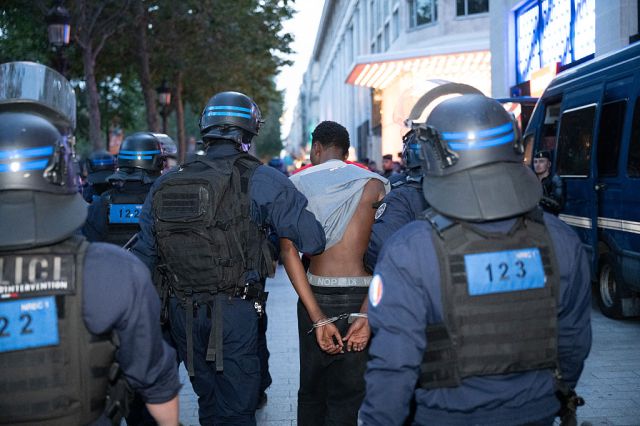
It was not the first time that a PSG victory in the Champions League had led to riots — last year’s triumph over Inter Milan had led to similar scenes. But on this occasion the police were prepared. On the morning of the final, the police had deployed 8,000 officers in central Paris and 14,000 more officers throughout France. In the event, there were 890 arrests — 45% more than last year — with 178 police officers injured, some of them seriously. One officer was badly burnt by a mortar firework and another run over by a stolen car.
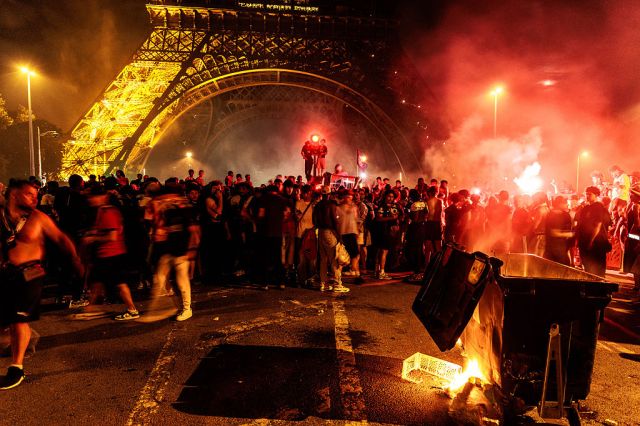
These scenes were not confined to Paris. More than 71 cities, towns and villages reported “violent incidents” through the night across France. If you did not know that this was in the name of a football match which had just taken place in another, distant country, you might have thought that France was in the throes of full-scale insurrection. As President Emmanuel Macron greeted the victorious footballers at the Elysée Palace on Sunday, he was moved to add a comment on the riots in his congratulations. “We are sick of it,” he said. Certainly, by midnight on Saturday, to most viewers this was less a celebration of a football victory than it was a scene from a war zone.
That was also the immediate reaction of Marine Le Pen’s Rassemblement National (RN), whose leaders were quick to condemn the violence. First to attack the government’s handling of the riots was Julien Odoul, an RN spokesman from Burgundy who decried the “unpunished hordes” and accused Macron of leading a government in “fire and blood”. The President of the RN, Jordan Bardella, was quick to follow up, using the same language, and denouncing “scenes of a near-civil war” in Paris and the provinces. On Monday morning, Bardella also made it clear that “there is obviously a clear link between our 30-year failure to manage immigration and the conflicts in question”.
The response from the Left was less incendiary, less accurate and less honest. The Left-wing newspaper Libération barely mentioned the violence, preferring to devote its first six pages on Monday morning to the death, at the age of 104, of the distinguished Leftist sociologist and philosopher Edgar Morin (who was, a rarity amongst French intellectuals, a football fan). At the same time, throughout France, representatives of Jean-Luc Mélenchon’s La France Insoumise (LFI) were arguing lamely about poor “police mismanagement” of the “celebrations”, with lightly veiled accusations of police heavy-handedness. Clémence Guetté, Vice-President of the LFI in the Assembly National, went one step further and explicitly accused the police of “arresting people for no reason, firing grenades at families and young people simply because they had come together in a crowd”. Guetté said that there was a need for more “fan zones” and “better planning” to avoid future conflicts.
This was at best disingenuous, and amounted to a slur on those officers — publicly thanked by Macron at the Elysée alongside the triumphant team — who had literally been in the front line against an out-of-control mob of some 20,000 people on the Champs-Elysées. Understandably, the police argued strongly against the LFI’s version of events. In the pages of the conservative Le Figaro, Yoann Maras, the spokesman for the police union, said that it was too easy to launch “a witch hunt” against the police. “We refuse to accept the growing gap between official discourse and the reality lived by our colleagues on the ground,” he said. He went on: ‘There was not a single incident in Budapest (where the Champions League took place). We have this only in France.” The question Maras left hanging in the air was why this should be so.
There is in fact no easy answer to this. What was clear to the police, however, who had been following encrypted messages on social media for weeks before the Champions League final, was that most of the casseurs on the Champs-Elysées were not city-center-dwelling Parisians but had flooded into Paris from the banlieues, which have fast, direct links to Charles de Gaulle Étoile, the vast metro station beneath the Arc de Triomphe. The common theme on social media was that the casseurs were planning to “bouffer les flics” (“devour the cops”). Many of them had little or no football affiliation. “I’m not really that into football,” said Raphaël D., arrested for drunkenness and insulting the police. “I’m more into basketball,” he said to a reporter from Le Parisien outside his court hearing. But he had come with his mates anyway for the ruckus. The same applied to Hichem S., an Algerian normally resident in Barcelona, who had also been arrested. Hichem S. presented himself in court as an unconvincing PSG supporter, having traveled from Spain to “kick up some trouble” with his mates in Paris.
Alain Bauer, a professor of criminology at the Conservatoire National des Arts et Métiers, compared the phenomenon of street violence in France with British football hooliganism. The British problem had been solved, he wrote in Le Parisien, only by “extreme repression”. This, he said, was the only solution. For Bauer, the violence was therefore a problem of policing rather than a political issue.
Nobody in France, on the Right or Left, really agrees with Bauer: his is a quite simplistic form of wishful thinking. Rather, it has been clear for several decades that the make-up of the French population has changed, partly due to mass immigration and the reluctance, generalized in most EU countries, to tackle this issue head-on. Immigration is only part of the story, however. The real political issue is that there is a substantial part of the population which hates the French Republic and which likes to take this hatred out on the most visible part of the Republic: the police.
One of the paradoxes here is that the French team is largely made up of players from an immigrant background. The tough training grounds of the French banlieues produce some of the best players in the world. Certainly most of Senegal’s best known exports to France and Europe are made up of footballers, including Sadio Mané, formerly of Liverpool, and Benjamin Mendy, formerly of Manchester City.
On recent form, the French team, partially made up of players from the banlieues, are already looking like they could win the World Cup again. They have a formidable attacking force, not just with the speed of Kylian Mbappé but also with the likes of Ousmane Dembélé, Rayan Cherki and Michael Olise — who scored a hat-trick in the recent friendly with Northern Ireland — all looking to make their mark.
Each of those players, being of immigrant heritage, are part of what the LFI is now calling “the new France”. It is a term first used, and sometimes still used, to describe the French colony of Quebec, but it has been reinvented by Mélenchon, who also speaks hopefully of the “creolization” of France. Mélenchon is enthusiastic about this strategy because he sees it as a genuinely new “revolutionary” strategy to transform France. His own family background — he was born and raised in post-Independence Tangier — is also a factor in determining his sympathy for the Arabic-speaking Muslim vote. (Mélenchon himself speaks a workable street Arabic.) For Mélenchon, “the new France” describes the hybrid demographic of the banlieues, a demographic whose votes the LFI are deliberately targeting as part of a campaign of “infiltration”: taking the voting system into areas which traditionally have a low voting record.
This strategy is perhaps laudable, at least from the point of view of making democracy more accessible and even necessary to a disillusioned and disenfranchised section of the population. The RN, too, would like to court these votes, if only to break the deadlock which prevents them finally taking power at each successive presidential election.
The stumbling block here, however, is that the RN is less prone to denial and euphemism. The Left likes to talk about les jeunes du quartier, as if they were a sparky group of teenagers rather than coked-up rioters; the RN talks about voyous — criminal hooligans. This language naturally sets them at odds with the voters in the banlieues, who often feel stigmatized and angry.
Yet the “old France”, so despised by Mélenchon and his party, has not yet gone away. The political fall-out from the violence after the Champions League final — an almost universal howl of outrage from all parts of the center and the Right — proves as much. It remains to be seen, however, how long this low-key civil war in France between the “old” and the “new” can last before the current proxy war between the banlieues and “official France” becomes real — and therefore ever more vicious. Such a development would deepen the fractures in an already fragmented and damaged country.