




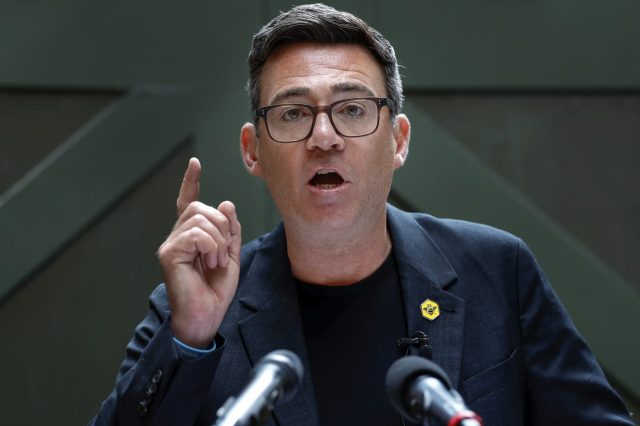
'Andy' is not shy of exaggerated displays of cultural Northernness. (Jeff J Mitchell/Getty)





What can be said of British politics over the 10 years precisely separating Brexit and Burnham’s Makerfield ascension? It has been, for those wishing reform of Britain’s sclerotic and increasingly despised institutions, a wasted decade; yet even still, the years of permanent crisis have spurred a rapid evolution of our politics, with the country caught between the electorate’s desire for total change and Westminster’s inability to undertake reform. To say that the country is ungovernable was seen as exaggerated contrarianism only two years ago: now it is the commonplace consensus of the liberal center, waving away its own unpopularity as the product of an irrational political climate. Winning an election, even by a landslide, is now no guarantee against total and instant rejection by a British public that has never before been in such a volatile and revolutionary mood. Summer ethnic riots, previously a generational shock, have rapidly become a routine problem of governance. In consequence, Nigel Farage has evolved into the dominant figure in British political life, around whom, in fear or expectation, all else revolves.
And so, yet another failed leader has been sacrificed as an offering to the British public, as Labour carries out an internal coup to stave off an electoral revolution. But even as the Lancastrian usurper secures his hold on Westminster, disbursing sinecures to his faithful retainers, there is no particular reason to believe he will be any more successful in office than Starmer. After all, many of those today celebrating his successful coup were just as feverishly exultant, two years ago, over the coming Starmerite golden age. If they were better judges of the country’s mood, we would not be here today.
Like an incoming headmaster turning around a failing school, Burnham told us Westminster is “broken” in his landmark devolution speech, using language apparently no longer the preserve of Right-wing populists. But will future historians characterize him as a continuity figure, carrying out necessary reforms to save a failing system from itself, or as an agent of total change? His manifesto-by-proxy, The Productive State, which aims to flesh out his much-invoked but nebulous Manchesterism as a program for governance, claims him for the latter role. As it states, the public “ask now for only what is obvious: major, even fundamental changes in British society” to cast off “the meanness and frustration of long years of stagnation and decline”, unabashedly adopting a “declinist” framework still mocked as a Right-wing fantasy by backwards-looking elements of the Labour Left. Indeed, the paper notes, “Labour have hitherto not delivered on that demand. If that feeling does not change, the electoral consequences will be severe and lasting.” That much is true. Yet what is perhaps more interesting than the structural economic reforms the paper suggests, is that its writers frame their socialist ends in postliberal terms, quoting Polanyi and appealing to national sovereignty and state resilience to make arguments postliberals were condemned for a decade ago.
As the foreign policy writer Lily Lynch recently observed, “Most commentators on foreign affairs acknowledge that the liberal order is in trouble, dying, or perhaps even already dead. There was a time when this would have been treated as some kind of fringe Duginist conceit; now it’s approaching mainstream consensus.” The same may be said of the domestic political and economic order so drastically reshaped to fit the vanished dreamworld of globalized liberal capitalism. And so, The Productive State observes, “in an era of weaponized interdependence — where access to energy, critical minerals, and essential supply chains has become a tool of geopolitical pressure”, the question of ownership of vital infrastructure “is a strategic one, which cuts to the heart of live debates about sovereignty in an increasingly geopolitically unstable world”. National sovereignty, state capacity and resilience in a world of global competition rather than co-operation, in which Westminster failure “wears down the basic democratic expectation that public institutions can identify the needs of the public they govern and act to meet them”, eroding the state’s legitimacy: these are Lexiteer arguments of a decade ago, now championed, perhaps too late, by those who would in 2016 have scorned them.
For in economic terms, there is very little, in The Productive State’s condemnation of neoliberalism as the agent of national decline, that could not be said, or has not already been, by Reform’s planner-in-chief and prominent postliberal intellectual, Danny Kruger. That there is such an overlap between The Productive State and postliberal arguments is hardly surprising, given British postliberalism’s intellectual descent from socialism. Even still, it is of note that Burnham’s only open challenger, so far, is the Blue Labour-endorsed candidate Al Carns, standing on a platform of industrial renewal through sensible energy policy in the service of national security. Even if Farage has shied away, recently, from his tentative support of nationalization for key infrastructure, postliberalism already appears to dominate the economic argument, ahead of the next election.
But the arguments for national sovereignty, domestic reindustrialization, energy security and a strengthened state have been won by the deteriorating security environment rather than the esoteric pronouncements of post-liberal commentators: both the former Thatcherite Farage and the Labour soft-left now converge on them for the credibility to advance their own projects. Reform’s Zia Yusuf publicly threatens the prime beneficiary of actually existing British neoliberalism, the outsourcing giant SERCO, for its insufficient zeal in carrying out future mass deportations. The postliberal Labour MP Jonathan Hinder declares, “Put cheap energy before clean energy. Drill for our own oil and gas in the North Sea. Back British industry, by scrapping self-harming Net Zero policies. Seriously start to rebalance our economy away from London. Stop the boats.” The next election will be fought on firmly postliberal territory, quite divorced from the ineffective theorizing of the movement’s intellectuals.
For we live, now, in the unmanaged postliberal order brought about by liberal hubris. A decade ago, Brexit offered Westminster the breathing space to break with liberal nostrums in a controlled and sober way, listening and acceding to the democratically-expressed demands of the electorate. Instead, the Brexit vote was treated as the mindless revolt of unlettered proles, manipulated by social media algorithms and a malign network of populist demagogues. Back in the heady days of Brexit discourse — and I have cause to remember this well — to argue that liberal fantasies of enlightened cosmopolitan governance had seen the capacity and legitimacy of individual states dangerously weakened, threatening the basic political order itself, was reviled as something akin to fascism by those who have only latterly awakened to reality.
Again too late, the very same commentators who, only a year ago, mocked the inter-ethnic violence predicted to result from mass immigration as the product of rightwing fever dreams, introducing the “nightmare” prospect of “hardened borders,” now panickingly declare that “we cannot simply dismiss the violence as just another outburst of a hardened racist few… because to do so would seem to leave us destined to regular summer bouts of pogromist violence”. This crisis is apparently no longer a hard-Right fantasy: through gritted teeth, the writer comes to the conclusion, presented as novel, that “the sight of unvetted young men landing on the beaches of Kent and Sussex is such a glaring signal of state failure that something must be done to stop it”. A year is, evidently, a long time in British political commentary. We cannot, perhaps, ever expect Britain’s liberal Left commentariat to admit that they were wrong, even as they belatedly adopt positions their social standing once rested upon condemning. But Burnham’s ideological malleability — delicately phrased — is such that he can easily adopt much of Reform’s message of a broken, dysfunctional Britain in renewing an establishment consensus he affects to despise.
One obvious danger for Reform is that Burnham, not shy of exaggerated displays of cultural Northernness, will cast them as the party of arrogant, spoiled Southeast England. Early trial versions of this approach, such as moving part of his Prime Ministerial court to Manchester, seem designed more to inspire a kneejerk reaction from his foes than to tangibly improve British governance. But it is difficult to extrapolate too much from his Makerfield win: Burnham is genuinely popular in the Northwest, and simply presented the fastest route to ousting Starmer. Hanging a general halfway through a war is rarely a sign of impending victory; even still, for Reform, the path ahead is uncertain. Running a prominent national-populist intellectual failed in Gorton and Denton; but so did running a no-nonsense local plumber in Makerfield, where a strategic section of the Red Wall has been found electorally wanting. Should Reform now lean into its end-of-pier, ITV1 Red Wall aesthetic, or attempt to woo the middle classes, among whom it has rapidly become the default party of the Right?
It is perhaps in pursuit of a newly radicalized middle-class audience that Farage has begun to write on Substack, focusing on territory simply untouchable to Labour. The Burnhamite manifesto declares that “Reactionary politics… is fundamentally a politics of shrinkage and exclusion: drawing the circle of belonging tighter, withdrawing provision from those deemed undeserving, turning scarcity into a weapon that disciplines and divides,” positing instead a program of mass abundance rolled out by a revitalized British state. Farage’s message is simpler and clearer. As he asserts, the effect of current social housing policy “has been to redistribute the nation’s stock of social housing away from the White British populations who originally inhabited these areas”. Indeed, as he writes, extending Reform’s critique of mass immigration further back in time than has lately been deemed acceptable, “When Labour and Conservative politicians opened Britain’s borders after the war, it would have been simple to maintain a basic principle: the British people paid for these homes, should be housed in them, and newcomers will have to be patient as they earn their way in.” Perhaps addressed at a downwardly mobile, younger middle class, the dangled prospect of redistributing prime urban real estate may yet outweigh fashionable moral poses.
Here, on the once-perilous ground of immigration, is the obvious dividing line at the next election, between parties with otherwise converging economic worldviews. As Burnham’s first headache, the spat between his future ministers over Indefinite Leave to Remain (ILR) reforms, shows, immigration is a source of internal conflict within Labour, caught between an awareness of the public will and its own internal morality, while it is Reform’s very reason for being. To win over his party, Burnham may, as he has hinted, be inclined to abandon Starmer and Mahmood’s ILR reforms, intended to quietly disperse what even the BBC now calls the Boriswave. Yet as clear-eyed, Blue Labour-adjacent commentators like the Labour Realists observe, “the Labour Party cannot transfer the costs of a Conservative mistake on immigration policy onto the British people and win the next election”. It is, simply, in Reform’s greatest interest for the Boriswave to become, as soon as possible in the public’s eyes, the Burnhamwave. Reform’s pitch on the Boriswave, already the Party’s prime line of attack against Burnham, is clear, as Zia Yusuf writes: “If Burnham tries to make the Boriswave permanent, we will reverse it: abolishing ILR, rescinding residence rights of those dependent on the state, and reforming the immigration system so that no Government can ever behave so recklessly again.”
The logic for Reform in the coming election — which we may now expect at any date from Burnham’s formal coronation — is therefore to go further, and harder, on immigration than would have been imaginable even two years ago. There is little ground on which Burnham can fight — on housing, on the NHS, on crime — in which his party’s near-religious sympathy for mass immigration has not poisoned the well. Every new social housing development Burnham promises can, and will, be presented as a source of local danger. The future of British politics, long-delayed, is finally upon us.
For Labour, there will never be a better time for an election than now — but for Reform the attractions are less clear. The Party’s declarations of the urgency of new elections do not fully convince, given its recent electoral setbacks and still nebulous program for government. Yet for both the calculation will be the same: the longer the country has to experience the operation of a Labour government, the more attractive a Faragian reformation will seem. With both parties deploring the dysfunctional brokenness of Westminster politics, victory will come to whoever can more convincingly capture the revolutionary mood. Burnham wants a decade to complete his project: but so did Starmer. Like the violent storms attending Starmer’s downfall, Britain’s decade-long, suffocating political climate now seems ready for dramatic resolution, clearing the air for years to come. The heavens are opening up over Westminster: even in his Manchester fiefdom, Burnham is unlikely to escape the flood.
