




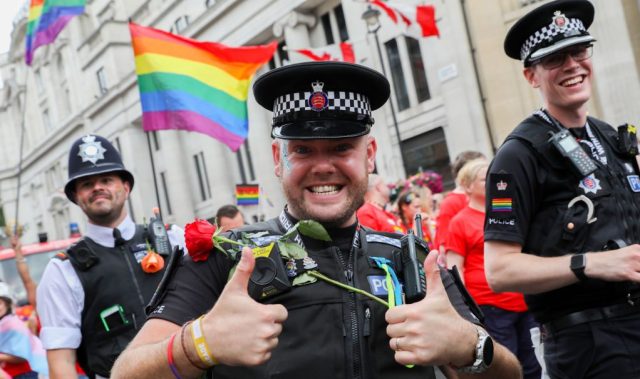
A new Section 28? (Tristan Fewings/Getty Images for Pride in London)





The Labour Party is waging war on gay people. As one of Keir Starmer’s parting shots, his government is about to introduce the single most anti-gay piece of legislation since the Labouchere Amendment of 1885, which criminalized consenting sexual acts between men. Even the Conservatives’ infamous Section 28 of 1988, with its “prohibition on promoting homosexuality” in schools, didn’t go anywhere near as far.
The law in question is the “Conversion Practices Draft Bill”, published this week and which ostensibly outlaws attempts to force an individual to change his or her sexual orientation or “gender identity”. The trouble with this framing is that it conflates two entirely antagonistic concepts. As ever with culture war discourse, regressive measures are being smuggled through under the guise of progressive language. As counter-intuitive as it sounds, a ban on “trans conversion therapy” amounts to state-sanctioned gay conversion therapy.
To understand why, it’s worth outlining the difference between what the bill claims to propose and its actual ramifications. Gay rights in this country were secured because of a growing recognition that a minority of any given population are inherently attracted toward their own sex. Gender identity ideology posits that biological sex is irrelevant to sexual orientation, and that a sexed essence — or “soul”, as gender activist Helen Webberley puts it — should be the determining factor.
The key problem here is that there is no evidence for this pseudoscientific belief and, thanks to the current genderist orthodoxy, same-sex orientation has routinely been misinterpreted as a mismatch between soul and body. In other words, “gender-affirming care” is often a fig leaf for an attempt to “fix” gay and bisexual people who fail to align with heterosexual frameworks and traditional sex stereotypes. Under the new law, anyone who does not automatically affirm someone’s belief that they are “born in the wrong body”, or who questions the notion of “transgender identity”, could be accused of “conversion practice” and sentenced to up to five years in jail.
The statistical evidence of the risk to gay people is clear. Data published by the Tavistock’s Gender Identity Development Service (GIDS) — the NHS pediatric clinic that was shut down in March 2024 after it was determined by the Cass Review to be providing treatment that was unsafe and unevidenced — showed that an overwhelming majority of its adolescent patients were either gay or bisexual. In 2012, this amounted to around 90% of females and more than 80% of males. By 2015, the proportions had declined but remained a majority, with 70% of females and 60% of males falling within this category.
Homosexuality is not the only factor that can lead to confusion over “gender”. In her book Time to Think, journalist Hannah Barnes outlined in meticulous detail how the vast majority of children referred to GIDS for gender-related distress also presented with a range of other difficulties, including depression, self-harm, anxiety, histories of abuse and dysfunctional families. Roughly a third of patients were suffering from Autism Spectrum Disorder (ASD) as compared to only 2% of the country as a whole.
Yet it is impossible to ignore the disproportionate impact on same-sex attracted individuals. For years now, gay rights groups have been explaining the problem, but have been routinely shut out by ministers. The most recent statement by LGB Alliance puts it plainly: “The old conversion therapy told gay people to change their sexuality. The new version tells them to change their bodies.” The Government’s bill “risks making it harder for those young people to receive the time, conversations and exploratory support that have helped generations of same-sex attracted people understand and accept themselves”.
Labour ministers such as Olivia Bailey are claiming that the bill would only apply to “abusive” conduct, but the draft itself says something very different. It defines “conversion practice” as “conduct carried out by a person towards an individual” with the intention of “causing the individual (i) to have to not to have, (ii) to believe that they have or do not have, a transgender identity or a particular transgender identity”. The language is so broadly drafted as to incorporate those who simply deny the existence of a gendered soul at all.
Moreover, the criterion could be as simple as causing “serious alarm or distress”. As criminal barrister Dennis Kavanagh has pointed out, this “begs the question of where this act leaves writers, commentators, political charities and standard companies. Given the offense can be ‘any conduct’ could that be a book? A passionately written article? Could it be a speech? I think so”.
Though the bill contains an explicit exemption for healthcare professionals, it does not protect parents who wish to reassure their children that they have not been “born in the wrong body” — and, whether they be an effeminate boy or a masculine girl, should learn to be happy as they are. Studies have repeatedly shown that gender nonconformity in youth is one of the most reliable predictors of homosexuality in later life. But if a child claims to be neither male nor female, for a parent to deny this could land them in prison.
Indeed, the very notion of a “nonbinary identity” is seemingly protected by the new bill, even though it does not exist as a category in UK law. It states that the “circumstances in which an individual has a transgender identity” include gender reassignment, transsexuality and if “the individual identifies as neither male nor female or as not solely male or female”. Yet in spite of the common misunderstandings around intersex conditions (congenital differences of sex development that occur in males or females) there is no such thing as a third sex or an absence of sex in human beings. For a parent to point this out to a child who identifies as “nonbinary” but is probably just gay — a reality check that might well cause “alarm or distress” — could now result in a criminal prosecution.
The nebulous nature of the bill means it can also be weaponized against feminists and gender-critical campaigners. As lawyer Sarah Philimore has noted, it is likely that “those claiming a trans identity will assert that even mild mannered online posts which do not 100% ‘affirm’ the reality of a trans identity, will be claimed to cause immediate and very significant harm”. The new law is not only smuggling self-identification onto the statute books, it provides a legal cudgel to beat anyone who rejects the premise.
The bill relies on the rhetorical and incendiary ramifications of the term “conversion therapy”. Most members of the public will assume it refers to the “corrective rape” of lesbians, or else the gay men who were subjected to torture, electric-shock treatment and even castration in an effort to “cure” them of their homosexuality. This is why the bill conflates orientation with identity. It means that sensible forms of therapy for those struggling with their sexuality are elided with the inarguable evil of the gay-conversion practices of the past.
But these practices are already illegal under existing law. The bill offers no new protections for gay people, but rather puts them at risk of medicalization for their orientation under the guise of “gender-affirming care”. Whereas not a single person was ever prosecuted under Section 28, Labour’s new law might not only see concerned parents in prison, but would also create the conditions by which gay people are subjected to irreversible medical interventions to see them “heterosexualized”. The Iranian government has been promoting “sex changes” as a remedy for homosexuality for years. By insisting that transgender identity ought to be automatically affirmed — an approach that has led to the prescription of puberty blockers, cross-sex hormones and even surgery for gay people — the UK government is now following suit.
Given that activists have so successfully muddied the waters through the redefinition of language, it is tempting to give Labour the benefit of the doubt. Surely, we might ask, its ministers do not wish to harm gay people and are simply ignorant of the policy they are supporting? Yet the Government’s dogged refusal to listen to campaigners on this issue suggests at the very least a flippancy about the erosion of gay rights if it means that its ideology can be upheld.
Consider the evasive behavior of MP Tris Osborne when challenged by journalist Jo Bartosch. Faced with the accusation that his party’s bill is homophobic, Osborne simply deferred to the judgment of ideologically captured organizations: “The UK’s leading health, counseling and psychotherapy bodies (including the Royal College of GPs, British Association of Counsellors and Psychotherapists, Royal College of Psychiatrists) have, since 2015, agreed to a Memorandum of Understanding (MoU) making it clear that conversion therapy in relation to gender identity and sexual orientation is unethical, potentially harmful and is not supported by evidence.”
At no point does Osborne address the fact that not one of these organizations has satisfactorily defined “gender identity”. It could hardly be otherwise, since the concept cannot be defined without resorting to circular appeals to “gender”. What all of these groups have in common is an assumption that “gender identity” exists without explaining what it is or providing evidence for its ontological basis. The Government is now legislating on the basis of what is essentially a faith-based position.
Nor does Osborne address the key point that the legislation he supports is fundamentally anti-gay. Whether its architects are motivated by hatred or disgust for same-sex attracted people is beside the point; the ideology it promotes is in direct opposition to gay rights, irrespective of their intentions. One suspects that ministers are dodging this point because they must know by now that they are putting gay people in jeopardy without any moral or scientific justification. Bev Jackson of LGB Alliance, who has rightly branded this “Labour’s Section 28”, directly asked Osborne the pertinent question: “Can you really not see how profoundly homophobic this is?” Answer came there none.
This refusal to listen to critics seems to be the party line. As MP Olivia Bailey said in a recent interview: “We are going to see through on this ban. We’re going to work at pace through our pre-legislative scrutiny process. It’s really important to get a diversity of views into that legislation, and then we’re going to crack on with legislating for this”. The implication, that scrutiny of the bill is a mere formality, is hardly surprising. The Government is now openly positioning itself as an enemy of its gay citizens, and it is unlikely to be deterred.
