




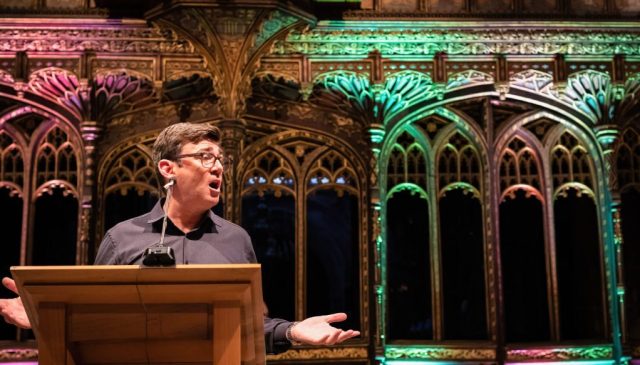
'Burnham’s cultural Catholicism adds to his carefully constructed image.' (Andy Barton/LightRocket/Getty)





Patriotic Englishmen used to be terrified that their country was ruled by Roman Catholics. Nothing could better rouse them to action than the story, real or imagined, that Popery had infiltrated politics at the highest level. Yet for all the rioting and revolting, for all the burnt Guy Fawkeses and executed Jacobites, eventually those Englishmen lost. In the two centuries that followed Catholic Emancipation in 1829, the worst fears of the Anti-Papists have gradually been realized. Last year, the King and the Pope prayed side by side in the Sistine Chapel. For the first time since the 16th century, Catholics in Britain could soon outnumber Anglicans. And, before the year is out, Britain might even have only its second-ever Catholic prime minister: Andy Burnham. Worst of all, no one seems bothered. Save perhaps a handful of fanatics in Northern Ireland, no one so much as bats an eyelid at England’s Catholic conquest.
Perhaps England’s beleaguered Protestants have just become inured. Already in the Nineties, Tony Blair was a crypto-Catholic leader, straight out of the pages of 17th-century polemic. As with the Stuart monarchs, or King Ahab, it was the wife what got him. Everyone knew that Cherie took her Catholicism seriously, and that the children were being raised in her faith. But Blair himself, across his 10 years in office, purported to conform to the established Church. He converted just months after leaving Downing Street and one needn’t be Titus Oates to suspect that he had been moving in that direction for a long time. When he prayed on the eve of the Iraq invasion, might he have been thinking unreformed thoughts?
Blair’s reticence on spiritual matters prevented him from claiming the distinction of Britain’s first Catholic prime minister. The distinction is genuinely significant, given that Britain was — and still officially is — a Protestant nation, forged in the crucible of confessional controversy. No, the accolade of being Britain’s “Catholic Obama” descends upon, of all people, Boris Johnson. He cut a different kind of early-modern figure to Blair, a reverse Henry VIII. Baptised a Catholic, he entered the Church of England while at Eton, presumably as part of the High Tory shtick he was then busy cultivating. His first two marriages were not officiated in the Catholic manner. Canon law thus exonerated him on the adultery charges; technically, in the eyes of the Vatican, the two-time divorcé was a lifelong bachelor. Reverting to his childhood faith, he was thus permitted to marry Carrie, his Anne Boleyn, at Westminster Cathedral in 2021.
And now Britain, which has never knowingly elected a Catholic Prime Minister, might soon have another. Andy Burnham was an altar boy. His power base in the Northwest always was a hotbed of Romanism. In the 17th century, Thomas Fuller described the people of western Lancashire as “Popishly affected”. When Sir Henry Spiller went to inspect the county in 1621, he found no fewer than 1,800 recusants. Far from the gaze of Protestant London, it was fertile ground for Jesuits. One priest — a cousin of Guy Fawkes — wrote in 1600 that “Catholics are so numerous that priests can wander through the villages and countryside with the utmost freedom”. Manchester, for its part, was a Jacobite stronghold; it provided the only English regiment in the 1745 rising. The Catholic identity of this part of England was bolstered further in the 19th century by an influx of Irish immigration. Even today, the Northwest remains England’s most Catholic region. If Burnham pulls off the long march from Makerfield to Westminster, he will succeed where Guy Fawkes and Bonnie Prince Charlie failed.
Though he might have lost out on being the first Catholic Prime Minister, Burnham will be the first to be meaningfully shaped by the religion, and the first to enter Downing Street with a strong British Catholic identity. A decisive personality in his formative years was Derek Worlock, the liberal, anti-Thatcher, ecumenically-minded archbishop of Liverpool. Burnham once remarked that the “political implementation” of Worlock’s teaching was the Labour Party, which he signed up aged 15. Burnham’s politics and his Catholicism were thus always closely linked.
Burnham, like many on the Left, has nonetheless had his difficulties with the Church. In 2015 he confessed that he was struggling with its “obsession with sexuality”. He waxed nostalgic about the Catholicism of his childhood, of Archbishop Worlock and John Paul II, who visited Liverpool when he was a boy. The Church that he had grown up in was “quite forgiving… quite humane, humorous, irreverent”. Things began to sour in 2005, when Cardinal Ratzinger became Benedict XVI and brought a “more judgemental mode” to the papal chair. Yet even Ratzinger’s conservatism could not dent Burnham’s long-held belief that the purpose of the Labour Party was to do God’s work on earth. “The basic tenets of the Labour Party and socialism”, he declared during his first leadership bid in 2010, “are one and the same with those of Christianity”.
There, he was giving voice to a longstanding position within British Catholicism. Thanks to the Irish connection, a general feeling of being outsiders, and a traditional suspicion of liberal and capitalist excesses, British Catholics have tended to lean Left. Catholics have broken for Labour in almost every postwar general election. In fact, it is quite surprising that Labour has never had a Catholic leader (putting aside the special case of Blair). Several have come close: Roy Hattersley, the son of a lapsed priest, wrote a history of the Catholics in Britain; John McDonnell, though now an atheist, speaks about the impact of his Catholic upbringing on his worldview. Yet there is a tendency within Labour to view religious Catholics with suspicion. In 2020 Rebecca Long-Bailey landed in some hot water when it became known that she harbored personal views about abortion, rooted in her Catholic faith, which were at odds with those of the Party. Catholic identity — especially an Irish Catholic identity — might go along well with the modern Labour Party; Catholic beliefs, however, generally do not.
Burnham Country was not only the most Catholic part of England; it was also one of the last parts of England where religion continued to matter. It was the region of England most prone to sectarian violence. Liverpool, the city of Burnham’s birth, was the closest England had to a Glasgow or Belfast. In 1819, an Orange procession in the city caused a riot; 90 years later a Catholic procession culminated in hundreds of injuries and 50 arrests. The only Irish Nationalist MP sent to Westminster from a non-Irish constituency was Liverpool’s T.P. O’Connor. These divisions were still festering when Burnham was born. When his non-Catholic father first met the family of his Catholic mother, he was worried that confessional divides would prove an issue. Thankfully, they were able to find common ground in their shared support for Everton FC.
Football, to use that cliché about modern Britain, and Liverpool especially, is really Burnham’s religion. In 2023, reconciled with the Church of his childhood, he beamingly presented the football-mad Pope Francis with a Manchester United shirt, signed by the Argentine center-back Lisandro Martínez. His campaigning material in Makerfield makes much more reference to football than God. Burnham once said that the most important things in his life, apart from family, were “Everton FC, the Labour Party and the Catholic church — in that order”.
Is it significant that Everton is traditionally regarded as the “Catholic team” in the Merseyside derby? The idea that the rivalry between Everton and Liverpool mirrored that between Catholic and Protestant — an English “Old Firm” — seems to be a myth. Both teams can be traced to a Methodist congregation in the later 19th century; Everton’s first club president was an Orangeman. Still, the myth was widely believed when Burnham was growing up, and he subscribes to it.
The sectarianism that supposedly once clung to the Merseyside derby, Burnham has said, may have “gone with the mists of time”: but still he has never met a Catholic priest who was a Red. The Eighties, the decade of Thatcher and the Hillsborough disaster, witnessed the formation of Burnham’s worldview, based upon a distinct Northwest identity. “In the 1986 final at Wembley” — Liverpool v. Everton — “everybody sang ‘Merseyside’”. His part of England, though divided by football and religion, finds it must unite against a common enemy: “the London media, Thatcher, the establishment”.
All this serves to give the Northwest a Left-wing, anti-establishment identity, which Burnham taps into. This identity is closely linked to the region’s historic Catholicism; and hence, Burnham’s own cultural Catholicism adds to his carefully constructed image. Cilla Black remarked in 2002 that “in Liverpool… most Protestants were Conservative and most Catholics were Labour, just as Everton was the Catholic team and Liverpool the ‘Proddy-Dog’ one”. The second of those ideas might be a fiction; the first definitely isn’t. It was due in part to strong Protestant (and anti-Catholic and anti-Irish) feeling that Liverpool was solidly Tory for much of the 20th century. When Burnham speaks as though the Northwest is uniformly Left-wing, and that Left-wing values are intrinsically Manchester (or Liverpool) values, really he is appealing to a Catholic history and identity.
Either way, England’s Protestant patriots can breathe a sigh of relief: if the Catholic conquest comes, it will not bring with it much by way of doctrine. Indeed, due largely to the triumph of social liberalism within the Labour Party, British Catholics are no longer even a reliable Labour bloc. They struggle to reconcile their conservatism with Labour policy: Long-Bailey’s struggles aside, Stella Creasy’s successful push for the partial decriminalization of abortion, and Kim Leadbeater’s unsuccessful one for the legalization of assisted suicide, were never likely to keep them red. Burnham abstained on euthanasia when he was an MP, but he appears now to lean in favor. If, as prime minister, he reopens that can of worms, we could witness something similar to various episodes from the Biden presidency, where a socially liberal Catholic leader gets into awkward public conflict with the authorities of his own Church. We might then find that a Catholic Labour prime minister does nothing to arrest the trickling away of British Catholics from the Party. The political implications here will, in any case, be narrowly intra-Catholic ones. They will be of no interest to the non-Catholic and non-religious majority. Once a Roman Catholic prime minister would have been met with cries of “No Popery!”; the striking thing today is how little anyone cares. We have become men, and put away childish things.
