




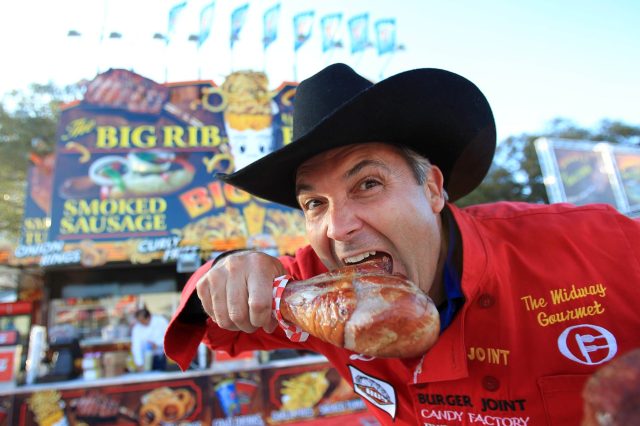
'America is our coarse, corpulent cousin and we envy him anyway.' (Houston Chronicle/Hearst Newspapers)





The first Englishman to reach the New World brought home chips and fags. Or so we were told: many of us will remember primary-school lessons on Sir Walter Raleigh, fresh from Virginia, presenting Elizabeth I with potatoes and tobacco. In particularly colorful versions, his servants chuck the tubers and cook the poisonous leaves, or a gardener burns the plants only to discover edible potatoes. While these accounts may be little more than Victorian folklore — conquistadors probably brought these products to Europe decades earlier — it is nice to imagine the British getting their priorities straight from the start.
Today thousands are following in Raleigh’s apocryphal footsteps as they journey west for the World Cup. About 65,000 Brits are expected to enter the US for the tournament, with the Tartan Army terrorizing Boston and Miami and the English shamefully yelling grim sexist chants in Dallas bars. Along the way they are encountering the delights of American consumer culture — the land of UHT milk and high-fructose corn syrup honey — and posting relentlessly about how supersized, sugary and surreal the American diet can be. They are agog, nay aghast, at the offerings in Walmart and Costco, polluting X and TikTok with wide-eyed content that may as well be from the queue of the first McDonald’s in Moscow. You’d think they’d never seen a side of fries before.
Football is an apt context for this culinary “cultural exchange” to be playing out in. The European game defines itself against American sports by imagining itself to be anti-commercial; equivalent basketball or NFL leagues in the US are unabashedly the opposite, often being entirely designed around ad breaks. The congressman Jack Kemp told the House in 1983 that while American football was about “democratic capitalism”, “soccer” was “socialist”. Plus ça change: the furor over the frequency of “hydration breaks” in this year’s tournament is partly about the sly insertion of extra ads and the showing-off of branded sports beverages — but it strikes me that a sport which has already been transformed by acquisition by broadcasters, sponsorships, gambling companies and sovereign wealth seems unlikely to be ruined by a 20-second Tostitos slot. Football’s delusions about itself seem particularly ready to be punctured over the course of an American away-day, where tickets come at eye-watering price points and stadia are structured to upsell you on refreshments. In England, sports often involve warm cans on the train, then inedible pies; in the US, it has jumbotrons, fan zones, fireworks and half-time entertainment. The jury’s out on which is more “real”; are we yet ready to admit which is more enjoyable?
About football, I am indifferent. Food is a different matter. I have lived in America for 13 months now, and I get it. In the first five, I must have gained a stone. But what first shocks is a different kind of scale: here, soft drinks come in 48-ounce vats. Then there’s the dizzying variety of American supermarket fare: the wall of powdered and boxed macaroni; the squirty cheese in aerosol cans; the cereal aisle with the dimensions of a municipal library. Here they sell pickles in buckets as if for army bivouacs; white bread flavored like “birthday cake”; 500-calorie hot dog sausages condemned to rotate under a 7-Eleven heat lamp until gobbled down the gorge of a 500lb teaching assistant. It can be scary, all this abundance. But what really unsettles us latter-day settlers isn’t the size, the processing, or even the mysterious abstraction in food marketing itself — what is a glacier-flavored Gatorade supposed to taste like? — it’s the sense of meanness it confers on us.
The austerity of continental Europe has for a long time been flatteringly repackaged as good taste. How many British holidaymakers have let “refreshingly easygoing locals” off for malfunctioning lifts, or wafted away the criminal lack of air conditioning as civilized? Shops that shut at lunchtime are humane; outrageously rude waiters are authentic. In reality, this is the infrastructure, and these are the holidays, that we can afford. To pretend that smallness, inconvenience and froideur are in fact born of sustainability, civility or character is absurd; really, these things relate to expense and enshittification.
I can see how tempting it must be for the sniffy German or the pouting Hollander to frame American consumer habits as vulgar or decadent, but that steering-wheel-sized pretzel must taste awfully bitter in the mealy mouth of a hypocrite. Having coffee with 12 pumps of caramel syrup is hardly ascetic, but neither is it a moral failing. In the Fifties, indulgence, scale and convenience were understood as signs of American confidence and success, and these things remain largely true — even if Ozempic has tamped down pop culture’s ability to stomach fatness.
When these principles collide with culinary culture, the result may not be ideal: values like seasonality and regionalism are trounced by a megatruck infrastructure designed around a country 2,800 miles wide. This fact is difficult for Old Worlders to get our coiffed heads around: American dining was optimized for a different civilization entirely, one of long drives, huge supply chains and workaholism. Charming terms like terroir wither on the vine here. Needless to say, some American food is exceptional — but that’s beside the point. The lie we tell ourselves is that we’re huffing about obesity and low-quality food by posting videos of Dunkin’ Donuts drinks the size of babies; really, our objection is that America is our coarse, corpulent cousin and we envy him anyway. The inconvenient truth is that while you are sipping Hobgoblin and tutting at the ad breaks, he is slinging back Bud Lights and cheese balls, enjoying the Hollywood-quality commercials. He is happier. And Bud Light is actually fine.
If all the intrepid fans making their way to the home of the brave have to cling on to is some garbled conception approaching “scarcity chic”, then we are in a sorry state indeed. My social-media feeds are plagued by videos in which wide-eyed Italians hold oversized drinks and exclaim, verbatim: “I ask medium size! Che medium! Madonna! My entire family can drink from here for one month!” seemingly ventriloquizing Fawlty Towers’s Manuel. But Americans experience this excess not as decadence but hospitality. Free refills, ultra-attentive waiting staff (motivated by tipping culture) and the normalization of “to-go” boxes are little civic sacraments. They may seem disturbing to those of us used to being ignored by the often poisonous service workers of Western Europe, but after a little time living here I began to accept the kindness of staff without suspicion.
For other European nationals in America, this country’s supersized culinary confidence offends some vestigial sense of refinement; for Brits, it’s about shared shame. In gastronomic transgressions we recognize ourselves. After all, who has been more criticized for their food than the land of cheese, tuna and beans? It’s worth remembering that as in the World Cup, in a competition of cuisine we are unlikely to come out on top; perhaps our desire to broadcast horror at our transatlantic brethren is about family embarrassment. It’s also a surefire way of sticking the knife into a nation which seems always to be telling us that British society is going down the tubes; relentless interventions by JD Vance have rattled our sense of identity over the course of this second Trump presidency. I understand the appetite to get the Yanks where it hurts: the improbable size of their hoagies.
Those tall tales about Raleigh’s servants not realizing the potential of the potato seem beautifully resonant for my intrepid compatriots taking in the New World for the first time. Then, the cooks on his estate may have inspected that tuber with narrowed eyes; now, we venture back to its home to eat them swamped in cheese sauce with bacon bits, or deep-fried as tater tots, or cushioning quarter-pounders as potato rolls. Then, as now, the arc of Anglo-American civilization bends towards the French fry. It may be occasionally grotesque, but don’t pretend that’s the problem here: enough with your snarky TikToks. We know you’re stuffing your face with Taquitos as you write your captions.
