




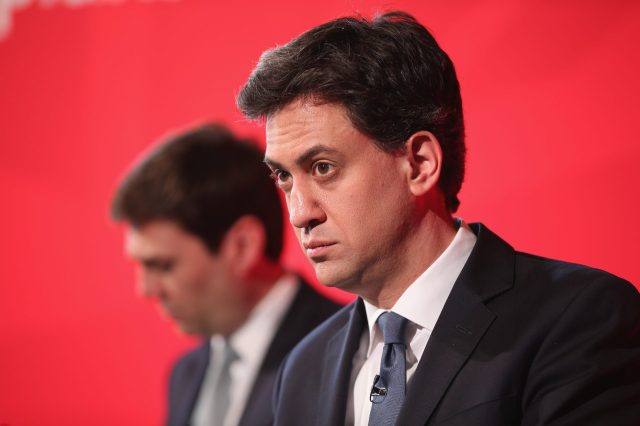
Ed Miliband: 'Nigerian military dictator'?(Christopher Furlong/Getty)





Last I checked, Ed Miliband was not the kind of politician to show a fondness for sunglasses, army epaulets and armored cars; yet this was the image Kemi Badenoch attempted to conjure yesterday, when she likened the energy minister to a “Nigerian military dictator”. Sadly for Britain’s decrepit Armed Forces, who come some way below cycle lanes in Miliband’s spending priorities, Badenoch said the comparison was specifically about statism and its consequences for the economy. Still, absurd though her remarks may have been, it was revealing that the Leader of the Opposition singled out Miliband for her most scathing attack on the same day that Labour’s cherished dauphin, Andy Burnham, was telling the country what he will soon be doing as prime minister.
Miliband, of course, occupies a uniquely hated position in the imagination of the British Right, akin to that held by Nigel Farage for the Left. But that is in large part because Miliband has been the most radical and effective minister in Keir Starmer’s otherwise pallid regime. And chances are, if Burnham’s government stands any chance of being as transformative as he has promised, Miliband will be the driving force behind it.
Over the past two years, Miliband has been unmatched in terms of political will and competence at working the levers of power. On two occasions, he fended off efforts by Morgan McSweeney, Starmer’s powerful chief of staff, to have him reshuffled to another department. Miliband not only persuaded the PM to soak up the criticism of his policies, but extracted large sums from a cautious Treasury to implement his energy revolution. He has overseen hundreds of thousands of solar energy installations, and commissioned hundreds of new wind turbines; he has loaded households and businesses with the costs of rapidly upgrading the electricity grid, and held open the door for Chinese EVs to flood the British market; he has subsidized new nuclear power and sunk money into developing carbon capture technology. It seems the notoriously difficult machinery of Whitehall poses few problems for Miliband.
Now he is reportedly helping Burnham’s team prepare for power. Though Burnham yesterday tried to dampen speculation about his pick for chancellor, his speech illustrated why Miliband is regarded as the favorite. Burnham’s stated goals of a massive social housing buildout, bringing down the costs of essential utilities, bringing those utilities under greater state management, and striving for “equivalent living conditions in all parts of Britain” are all consonant with Miliband’s politics. As for welfare reform, Miliband is likely the only candidate with the legitimacy among Labour MPs and the broader Left to see it through.
Above all, though, there is a yawning gap between Burnham’s pledge of “the biggest change in our lifetimes in the way the country is run” and the very broad, thin brushstrokes of his own political vision. The erstwhile Manchester mayor has so far relied in an almost Trumpian fashion on his supporters to project intellectual coherence onto his own intuitive style of politics. Only Miliband, it would appear, has the temperament, competence and ideas to actually deliver such an epochal shift to the Left.
Regarding a Miliband chancellorship, a treasury official has warned Burnham that “you might as well be handing your premiership to him”. That may sound emasculating, but it is far from clear that it would be politically damaging. For if Miliband is feared by conservatives, he is also very much admired by progressives. That he struggles to connect with Middle England was made clear by his electoral failure as Labour leader in 2015; but that is where Burnham comes in. Between them, they stand a good chance of making Labour the first choice for voters who are primarily motivated by keeping out Reform UK, something Burnham has already managed in Makerfield. Given the country’s chaotic new electoral landscape, this could be Labour’s surest path to keeping power.
Whatever one thinks of Miliband’s politics — and as Badenoch’s recent comments suggest, his enemies have never quite been able to grasp him, portraying him as both sinister and ridiculous — he evidently has virtues as a politician. They include conviction and tenacity, the traits our current prime minister so conspicuously lacks, as well as a capacity for hard work and attention to detail. He first entered the Treasury in 1997, aged just 27, as an advisor to then-chancellor Gordon Brown. In 2008, when Miliband took charge of the newly formed Department of Energy and Climate Change, he set an eye-wateringly ambitious carbon target after just 13 days in the post, announcing that by midcentury Britain would reduce its emissions by 80% of their 1990 levels. (His elder brother David, the heir-apparent to New Labour who he would infamously deprive of the party leadership in 2010, had previously set a slightly more modest target of 60%.)
In 2009, when prime minister Brown decided to back a third runway at Heathrow, Miliband resisted fiercely, prompting Permanent Secretary Jeremy Heywood to ask, “why is this new minister holding up the wheels of government like this?” As the baffled Heywood later remarked, when Miliband managed to extract various climate-related concessions from Brown, “this just isn’t supposed to happen”. During his first stint as energy secretary, Miliband created the framework in which policy has developed ever since, including under the Tories. It was Theresa May, after all, who would set the still more ambitious goal of Net Zero emissions by 2050. Add to this the authority of experience which Miliband can claim today, and it’s small wonder that Starmer so often appeared to be in his thrall.
Then there is that most revered of political qualities — ruthlessness. In the grueling 2010 leadership contest, Miliband outmaneuvered not only his brother, the candidate of the party establishment, but also the domineering Ed Balls. (In fourth place out of five was a certain MP for Leigh, Andy Burnham.) For someone who learned his trade in proximity to Gordon Brown’s bitter, years-long struggle to wrestle the leadership from Tony Blair, the unseating of Starmer must have been a tea party.
Needless to say, Miliband also has flaws. Chief among them is a weakness for the feel-good politics of progressive activists and NGOs, which he has been immersed in since he first served as Climate Change secretary and, before that, as minister for the Third Sector. This is a comfort zone of blue-sky thinking and moral crusades, where idealistic academics imagine that the right combination of clever policies and exciting comms will induce the public to hold hands and strive for social justice. This dimension of Miliband’s thinking led to perhaps the most undignified moment of his career: the decision to prostrate himself before Russell Brand on the eve of the 2015 election, hoping that an endorsement from the comedian, then absurdly considered some kind of thought leader, would unlock a mythical youth vote.
Clearly though, Miliband’s ideas are not all vacuous, since much of his 2015 manifesto was subsequently implemented by the Tories, including an energy price cap, a higher minimum wage, stricter regulation of junk food and mandatory gender pay-gap reporting. The fact is that, beneath the Left-wing clichés and wonkish talk of “predistribution”, Miliband has a core insight which has proved basically correct: since the 2008 financial crisis, people have wanted a more active state to shield them from the effects of a globalized market economy. He is just unequipped to sell this message beyond a core of voters on the Left, something which Burnham might prove better at.
If Miliband does indeed become chancellor next month, his vision will probably include a strong element of “mutualism”, giving “ordinary” people a greater role in the running of companies, public services and local government. This has been a longstanding Miliband theme, present in his contributions to the 2010 manifesto through to his 2021 book Go Big, which championed policies like company wage boards and citizens’ assemblies. It is also where Miliband’s thought intersects with Burnham’s flagship idea of devolution. Mutualism has another proponent in Miatta Fahnbulleh, the MP for Peckham who worked with Miliband in the energy department, and who has allegedly become influential in Burnham circles.
But Miliband does, of course, come with big risks. Britain already has a high-regulation, low-growth economy — partly thanks to the kinds of policies that Miliband prefers — with much less financial breathing space than it had a decade ago. Like Rachel Reeves, Miliband would make a big show of committing to fiscal rules and stimulating growth through productive investment. But this may not be enough to placate the debt markets on which the state’s finances depend, and which are already suspicious of Miliband. Growth from capital investment in infrastructure and housing will take time to arrive, especially with Net Zero continuing to bear down on business through high energy costs, and with the further tax increases that will almost certainly be necessary. Financial constraints may end up trapping Miliband in an electoral no-man’s land, unable to deliver the radical policies that voters on the Left crave, while angering everyone else with regulation, taxes and unemployment.
Miliband will also face a dilemma in terms of Britain’s international orientation. The strongest case for his aggressive Net Zero drive is not an environmental one — as critics never cease to point out, Britain accounts for less than 1% of global carbon emissions — but a security one. Renewable energy, along with the electrification of the economy, will hopefully make Britain less vulnerable to the fossil-fuel price shocks that countries such as Russia and Iran have inflicted in recent years. It will reduce the tendency of energy prices to be set by the most expensive producers of natural gas, while ensuring that Britain has a stake in the technologies of the future. The Telegraph’s economics commentator Ambrose Evans-Pritchard, hardly a raging Jacobin, is among those arguing that renewables will see Britain becoming an electricity exporter in a matter of years. But Milibandism has major vulnerabilities of its own.
The most obvious is defense. Where, among all the spending commitments that would accompany his chancellorship, should Britain find the money to prevent its Armed Forces from sliding further into ruin? Britain’s energy security would be purely notional if its allies no longer considered it worth cooperating with, and if its infrastructure open to attack by hostile states. No less important, Miliband’s economic vision is highly dependent on China, whose cheap exports to Britain, including both Net Zero technologies and other products, are preventing prices from rising as much as they otherwise would. Yet China’s goal is to use its exports to prevent Europe from rebuilding its own industrial base; that is why the EU is increasingly building tariff walls.
This is perhaps the biggest source of potential tension between Miliband and Burnham. The latter has insisted that reindustrializing Britain is crucial for providing good jobs and broad-based growth, and has strongly hinted that protectionism will be necessary to achieve it. That would require Miliband to fundamentally change his strategy, or Burnham to choose a different chancellor.
Who else could it be, though? The fact remains that, if Burnham wants to deliver on his rhetoric of national transformation, his best option is to gamble on Miliband’s experience and determination. For better or worse, a Miliband chancellorship could produce an economic and social shift on a scale comparable to the Thatcherite revolution — and especially if it manages to consolidate the nascent anti-Reform bloc of voters, thereby securing a further five years of power. But the stakes are high, and the implications far-reaching. Labour can only hope that, beneath his platitudinous exterior, Burnham has grasped these realities.
Wessie du Toit writes about culture, design and ideas. His Substack is The Pathos of Things.
 wessiedutoit