








June 11 2026 - 7:00am
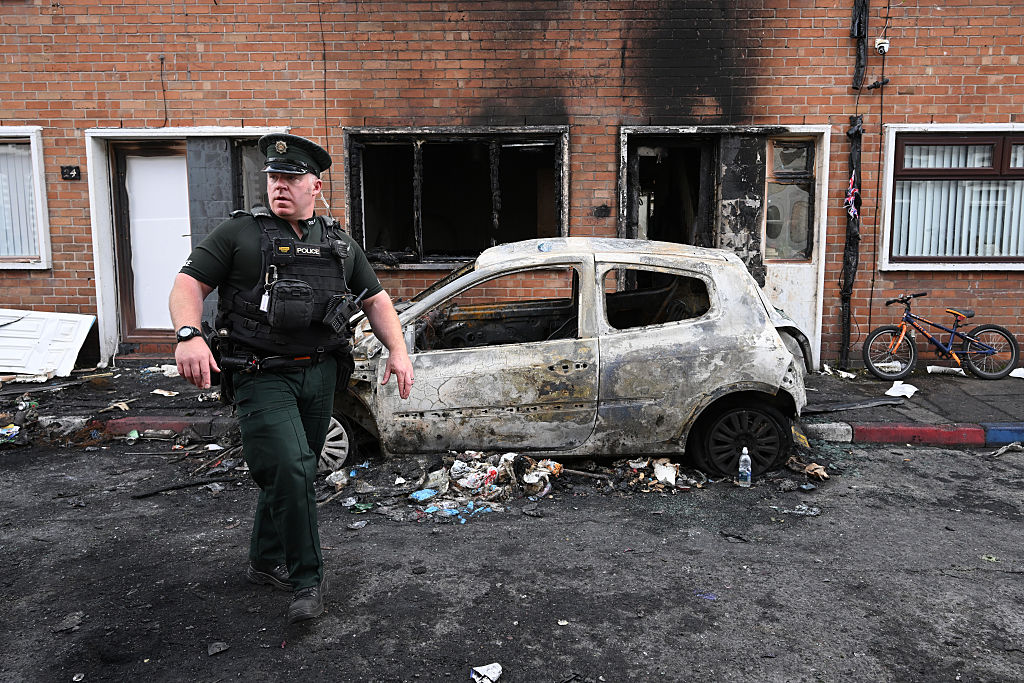
Tuesday night’s anti-migrant riots in Belfast have prompted an appalled reaction across the mainstream press. Tory commentator Mark Wallace called arson attacks on migrant HMOs a “pogrom”. Former prison governor Ian Acheson declared that anyone employing such methods had lost all legitimacy. The usual chorus blamed Nigel Farage and Elon Musk for whipping up extremism.
If you ask me, the public has a right to be angry when someone claims asylum in a foreign country, receives free housing and pocket money, then expresses his gratitude by pinning down a local and trying to saw off his head. Does this merit targeted reprisals against ethnic minorities across an entire city?
Among those for whom the answer is no, many pointed out the asymmetric nature of public reactions to less or differently racialized violent crimes. What about domestic violence in Northern Ireland, asked some. What about the Nazi obsessive who tried to kill a Kurdish man in Bristol? What about that Saudi guy who got stabbed?
Left-wing commentator Ash Sarkar is right to point out that the outrage machine increasingly operates along tribal lines, amplifying race in some reports of violence and ignoring it in others. The unhappy picture is of a polity rapidly degrading from an aspiration to equality before law and public policy, into an overlapping mess of racialized special pleading and, online, mutually hostile ethnocentric filter bubbles.
Some blame progressivism and mass immigration for this unhappy state. Others blame “the far-Right” or Elon Musk. But a bit like the old story about the blind men describing an elephant, each of these accounts has a piece of the puzzle while failing to look at the whole thing. What’s at work is a recurring and disintegrative cycle, amplified by digital communications. It’s now well on its way to demolishing public faith in neutral politics, and replacing it with something far darker and uglier.
The most dramatic recent spasm in this cycle came at the culmination of the social-media-enabled Great Awokening, and was very much a creature of its mimetic power. The protests which followed the viral, video-recorded death of George Floyd triggered rioting that then spread via social media to countries thousands of miles from Minneapolis. This disorder was treated almost universally with deep solemnity, as an upswelling of legitimate anger at racialized injustice, and became a vector for reversing the previous injunction to neutral, universal public policy in favor of explicitly racializing everything in the name of “antiracism”.
The “racial reckoning” that took hold after the Summer of Floyd set out explicitly to invert the dream famously articulated by Martin Luther King, that his children would “not be judged by the color of their skin but by the content of their character”. In its place, an “antiracist” model held that color-blindness is always racist in practice, and should be replaced with an “equity” model that explicitly treats people differently according to race.
Classical liberals warned at the time that, however imperfectly the principle of universalism was ever realized in practice, abandoning it in principle would produce not less racism but instead far more of it. Most centrally, no one advocating making public policy asymmetrically racist seems to have considered the risk that white majorities might, in time, begin to ask: what about us?
Now this appears to be happening. Britain has experienced three bouts of white-majority protest in the last two months alone: in Epsom, in Southampton, and now in Belfast. Increasingly, these employ the same mimetic, digitally-networked tools as Black Lives Matter did, spreading the same mood of viral grievance and tribal identity. In the case of the Henry Nowak riot in Southampton, they’re also responding to policing guidelines adopted after the BLM protests, making this even more directly downstream of — or, perhaps more accurately, still a part of — the great “racial reckoning”.
The classical liberals were right. Nothing good has come of pressuring institutions to discriminate based on race, even if they thought it was for social justice. It just took a few years for the new policy of explicit institutional racism to be noticed and internalized, in combination with a concurrent dizzying increase in immigration, and for the other shoe to drop.
So congratulations, race activists: you got everyone to see race. Now we have white race activists too, who say that because politicians “took the knee” for race rioters when it was BLM, no one can complain when they do it too.
I don’t know how, or even if, this Pandora’s box can be closed. But my fear is that the genie is out of the bottle, with no small thanks to BLM and social media, and that things will get considerably worse before they get better.

Join the discussion
Join like minded readers that support our journalism by becoming a paid subscriber
To join the discussion in the comments, become a paid subscriber.
Join like minded readers that support our journalism, read unlimited articles and enjoy other subscriber-only benefits.
Subscribe