




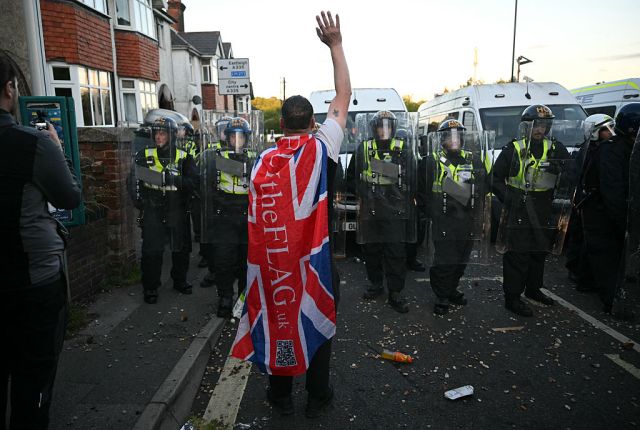
A protest in Southampton. (Justin Tallis/AFP/Getty)





On 1 June 2026, shortly after the sentencing of Henry Nowak’s murderer, the man who is touted to be our next prime minister put out a statement: “Today’s revelations will further damage people’s confidence in our political system.” It will, I predict, come to be regarded as shocking that Andy Burnham could speak of “today’s revelations” and mean, and assume that everyone else would understand, not the horror of Nowak’s murder, but another round of Mandelson rigmarole. Nothing could better demonstrate what Tony Blair, in his recent essay, called a “politics bubble” — a blinkered, superficial clique of which Burnham, for all his anti-Westminster posturing, is very much a part.
But soon enough it became obvious, even within the bubble, that Nowak was not just a murdered teenager but a moment, a moment demanding a response. After days of trying to quell the situation, Sir Keir Starmer has hosted the Nowak family at Downing Street. Yet the response so far has generally been half-baked. There are vague references to avoiding “division”, indistinguishable from what came in the wake of Manchester and Southport. There seems to be no effort whatsoever to grapple with the — admittedly difficult — facts of the case. Nigel Farage has been met with incoherent screeching. It is seriously suggested that his call for “pure, cold rage” somehow “incited” yobs to hurl bins at discombobulated bobbies. “Eleven police officers were injured during unrest in Southampton last night”, said James O’Brien: “is that cold enough for you?” One wonders what he thinks “cold” means. Starmer called Farage’s “appeal for rage… unforgivable”, but he feels angry all the time. The Mandelson rigmarole made him “absolutely furious”. Does the murder of Nowak make him furious? Does it not fill him with pure, cold rage?
The bubble’s response is awash with deflection and denial. Their Hail Mary is that we all have goldfish memories, or that we will have the good graces to forget the events of the past six years. “Beware those cunningly politicising people’s pain,” said Tanmanjeet Singh Dhesi MP. In 2020 he wrote that “we cannot allow #GeorgeFloyd to become merely another statistic, but need structural change to ensure a better society for all”. Not only do calls for “structural change” now fall on deaf ears: you are guilty of “sowing division” or “politicising pain” if you dare to make them.
The government’s effort to cast “two-tier policing” as a crankish conspiracy theory also rests on some forlorn hope of collective amnesia. In 2020, it was unilaterally decreed that the police should junk color-blindness as an ideal. They were foolhardy enough to put this in writing: “Our commitment to racial equity… does not mean treating everyone ‘the same’ or being ‘color blind’.” Shabana Mahmood recently had to intervene to ensure that the sentencing guidelines would not grant special leniency to ethnic minorities. Now they have the temerity to say that the very notion of two-tier justice is a far-Right fantasy, that the only reason anybody in Britain believes it is Elon Musk. I have always disliked that voguish and overused term, “gaslighting”: gaslighting is simply lying, and usually bad lying at that. The “politics bubble” response to Nowak’s murder, their flat-out denial of two-tier policing, isn’t making us question our own sanity. We are only questioning theirs.
It has become the standard position of the “politics bubble” that now is not a good time to speak about the Nowak murder. This is the gist of Starmer’s response to Farage, and of the calls from various quarters against “politicizing” something that is, apparently, otherwise non-political. It is deemed improper or uncivil to try to draw any lessons from it at all. Instead we are told that the tragedy should not be “politicized” because this would be disrespecting the wishes of a grieving family. What kind of sick person would do that? Only “scum”, wrote Dan Hodges — a rather divisive word. Drawing a leaf from this book, Robert Peston asked Farage: “Why does the family of Henry Nowak mean nothing to you?” The strategy has ascended now to the highest level, to be limply deployed by the prime minister at PMQs. Rage, Starmer declared: that is Farage’s “response to a father who’s lost his son and asked for that not to happen”.
The strategy is selective. We have heard much in recent days about “exploiting” and “weaponizing”: the bubble is exploiting and weaponizing people’s compassion. They are demanding that total deference be paid to the wishes — or, rather, what they purport to be the wishes — of a family that has been through unspeakable anguish. But no such deference has ever been paid to the family of Rhiannon Whyte, stabbed to death with a screwdriver by an asylum seeker in 2024. Her grieving mother has said that Starmer has “blood on his hands”; her message, that we should stop the boats, remains unheeded. Sir David Amess MP was murdered by an Islamist extremist in 2021. His daughter has been repeatedly appealing to Downing Street for a public inquiry. Starmer still has not commissioned one: Katie Amess says he has “just ignored us”.
If the wishes of grieving families risk posing any challenge to the status quo, then they are ignored; if they fit the agenda, then they can be indulged. Recent years have seen a spate of “[victim’s name] Laws”, kneejerk responses to heart-wrenching tragedies, usually ill-conceived. Martyn’s Law, named after a victim of the Manchester arena bombing, is costing businesses billions, and does nothing to address the actual cause of the attack. It is not hard to see why these laws sail through parliament; who would dare set themselves against a dead child? These quick fixes duck thorny questions about immigration, integration, and crime, and bring governments back into their comfort zone: burdening businesses with statutory obligations and red tape. These laws, like the mawkish appeals now to the wishes of Nowak’s family, are examples of what Madeleine Grant calls “tweeslop”, a “mobilization of the British people’s worst instincts for sentimentality and self-congratulation”. It is, we might say, the British vice.
The bubble repeats ad nauseam a single sentence from the statement given outside the court by Nowak’s father. It is the only part of his remarks which has garnered attention: “We do not want his death to be used to create further division, hatred or tension.” The statement as a whole, however, makes perfectly clear that the Nowak family does think the murder has a political dimension. In fact it strays quite close, in places, to talk of two-tier policing, dwelling on the difference between the police’s treatment of Digwa and of Nowak. In calling for “stronger action” on the “ownership and carrying of all knives”, it seems to suggest removing the legal exemptions given to religious Sikhs. The family urges a “common sense approach to law and order”: “common sense” always was, in ordinary parlance, the antithesis to “woke”.
But let us suppose for a moment that the Nowak family really did want the murder to be kept out of “politics” altogether. Of course we must feel sympathy for a grieving family; but sympathy cannot be our only feeling. Victims’ families do not have a monopoly on our response to a crime. It is wrong to suggest that a grieving family ought to dictate the parameters of public conversation. To grant them such a thing would be to dissolve a foundational premise of our criminal law. Crimes are not just crimes against a person or a person’s family: they are crimes against the crown, breaches of the king’s peace, attacks on the very fabric of society, attacks against us all. There is a good reason that the case which convicted Nowak’s murderer is R. v. Digwa, rather than The Nowak Family v. Digwa.
These appeals to the supposed wishes of the Nowak family rest on the old logic of the clan. Someone from Family X kills someone from Family Y; then Family Y determines how to respond. The patriarch of Family Y, in the Nowak case, has issued (what is held to be) his definitive response; now the rest of us ought to quiet down and move on. This seems to be the government’s position. But, to put it bluntly, that is not how we do things. It is not how we have done things since the very early Middle Ages. Our systems of criminal justice moved past the feud a long time ago. We moved past it when the family or the clan forfeited its traditional monopoly; when it came to accept, in other words, that any crime is inherently political, that everyone else in society has an interest in punishing and preventing it.
We know, of course, that not all cultures work this way. The logic of the clan and the feud predominate in many parts of the world. It is especially important to reject the clan logic in this instance, because that very logic was at play in the murder of Nowak. The family of Vickrum Digwa embodies the alternative theory of justice which England overcame long ago. Crime, for the Digwa family, really was non-political. Finding their son committing a murder — catching him red-handed — they felt no higher obligation to the state, to the crown, to the king’s peace, to British society. The mother hid the weapon. The brother spun a cover story. Even after Digwa’s conviction, they shouted at Nowak’s family in court. They resented that the case had ever got to court. Perhaps they thought the murder ought to have remained a private, family matter.
These appeals to the wishes of families are appeals to clan logic; and if clan logic is now infiltrating wider British society, it makes sense that it should do so via emotional manipulation, to which Britain is so susceptible. The appeals are designed to banish avoidable events from the realm of the political: that is the plain meaning of “politicize” as a verb of disapproval. They turn human tragedies into acts of God, about which nothing can be done save a sigh and a sob. The British mainstream has always liked to tut at those Right-wing Americans who traffic in “thoughts and prayers” after every school shooting. But the “politics bubble” could hardly be clearer: there is to be no talk of radically overhauling the police, of abolishing “two-tier” justice, of restoring an older, liberal ideal of treating people as individuals rather than members of groups, of defining anti-racism in terms of color-blindness. There is, in the “politics bubble”, supposed to be no political talk at all. “Thoughts and prayers” are reassuringly inert and inoffensive. “Thoughts and prayers” are what they’re after. But “thoughts and prayers” do not meet the moment. And they will not spare other families from the devastation that has torn through Henry Nowak’s.
