




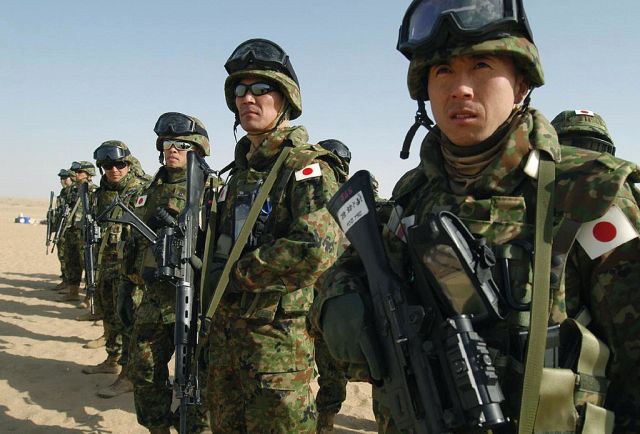
'If Japan’s role as a beacon of pacifism is indeed coming to an end, its new purpose could be almost as valuable'. (Yasser Al-Zayyat/AFP/Getty)





President Donald Trump’s aides will no doubt be delighted that his recent visit to China went off without drama or controversy. In Taiwan, however, there have been concerns. “We talked the whole night about [Taiwan],” said Trump, recalling one of his conversations with Xi Jinping. “I think I know more about Taiwan right now than I know about almost any country.”
To Taiwan’s leaders, that sounds ominous. Did Trump just receive a thorough schooling in Xi’s view of his near neighbor, making it less likely that Trump might — in his own words — “travel 9,500 miles to fight a war”?
At stake is not just whether this US administration, or a future one fashioned in its image, would defend Taiwan if attacked; Trump is also currently mulling the approval of $14 billion worth of weapons sales to East Asia’s most embattled island.
The uncertain politics of weapons supplies renders all the more important a controversial decision made in Japan last month. It is moving to abolish long-standing restrictions that limit military equipment transfers to five nonlethal categories: rescue, transport, warning, surveillance and mine-sweeping.
In future, countries with which Japan has a defense equipment and technology transfer agreement — a roster of 17 nations that includes the US, UK and Australia (but not Taiwan) — will be able to avail themselves of Japanese-made missiles, rockets, drones, jets, frigates and eventually electromagnetic railguns and laser weapons, both currently in development. Lasers, of the type tested in recent weeks aboard the experimental vessel Asuka, are seen as the holy grail of cost-efficient defense against swarms of cheap drones.
Japan’s move has been widely described as historic. The country has been a beacon to pacifists for more than 80 years. Atomic devastation at Hiroshima and Nagasaki in 1945 forced the world to face the possibility that any future war might be humanity’s last. Leaders and citizens in those two cities have, as a consequence, long embraced a role as the moral conscience of anti-nuclear activism. Japan is celebrated as an example of a society that flourished after renouncing war — which it did at the behest of the United States, author of Japan’s postwar constitution during a transformative seven-year Allied occupation.
Yet advocates of Prime Minister Sanae Takaichi’s more assertive security stance argue that Japan’s postwar comeback had less to do with pacifism and more to do with the country’s strategic value to the United States during the Cold War. Japan allowed US bases and forces on its soil, turning the archipelago into a giant aircraft carrier. In return, the US allowed Japan to shelter under its nuclear umbrella while devoting its industrial expertise to cars and consumer electronics rather than costly defense.
Increasing numbers of Japanese now accept that those days are over. The new world of the 2020s is all about countries fending for themselves, as America becomes a less stable global guarantor, and international institutions like Nato, the EU and especially the UN struggle to maintain relevance. With China pressing its regional interests, and North Korea refining its nuclear weapons technology, Japan must do more than simply cross its fingers that if push came to shove a future American president would invest potentially scarce political capital in protecting its old Asian ally — especially if they had recently been treated to a late-night history lesson by a charming Chinese president.
Takaichi has made clear the importance of self-sufficiency in areas like energy, semi-conductors and rare earths. She clearly takes the same view when it comes to self-defense. She is subjecting Japan’s key national security documents to a fast-tracked review and is now seeking to grow her country’s defense sector by expanding its client list beyond Japan’s own Self-Defense Forces (SDF). Ever-greater proportions of Japan’s GDP are being ear-marked for the country’s own defenses. And within weeks, the Prime Minister will receive recommendations on reviewing those key national security documents — including potential revisions to her country’s three non-nuclear principles: never to produce or possess nuclear weapons, or allow them to transit Japanese territory.
Developing Japan’s defense sector is a long-term project. Toshiba and Mitsubishi Electric have already announced that they will be hiring new people. But such is the gradual pace at which capacity is built, products developed and sales agreed, that Takaichi herself may well not be in office by the time her latest policy change begins to bear fruit.
Still, the potential market for Japanese weapons is vast. America’s own stocks are perilously low after wars in Ukraine and the Middle East, and Asian neighbors including the Philippines appear keen to acquire Japanese hardware. The Philippines’ defense secretary has welcomed Takaichi’s move, and a sale is in the offing of three pre-loved Abukuma-class destroyer escorts, which are soon to leave active service in Japan.
Further afield, Japan may be able to steal business from the US arms industry, amid growing complaints about high costs and late deliveries. Added to this is Japan’s perceived ability to make big ideas work where America has given up. The railgun is a prime example. The US spent half a billion dollars over several decades before setting the project aside in 2021. Japan has a working prototype.
Problems loom. China has once again raised the specter of Japanese “remilitarisation”. For now, Takaichi may be able to shrug this off as hypocrisy: China is building up its own military at a far quicker rate, while rising to become the world’s fifth-largest arms exporter — to countries including Pakistan, Bangladesh and Myanmar.
And yet consider how Japan’s latest move looks if you’re sitting in Beijing. Japan has long been building links with countries such as the Philippines, Indonesia, Thailand, Vietnam and Australia, in an attempt to counter Chinese economic and military power. If you then start to see hi-tech Japanese weapons arriving at military bases in these countries, you might conclude that a line is being crossed from friendly ties into coalition-building.
Then there is the question of the past. Memories remain vivid in East and Southeast Asia of the swaggering entitlement and resulting cruelties — murder, rape, starvation — that characterized a militarily-dominant Imperial Japan in the first half of the 20th century. Part of the problem is Japan’s perceived lack of contrition, thanks to the absence of political and public stock-taking comparable to that seen in postwar Germany. The question asked by those in Asia who genuinely worry about remilitarisation is whether, in 1945, Japan entered a period of deep change or was simply deprived by the Allies of the ability to behave as it previously had. For some, this is about a putative Japanese psyche, which blends civility with a propensity towards unrestrained violence. It is an old notion, dating back in the Western imagination to Catholic missionaries’ shock at the ease with which lives were taken by warriors during Japan’s 16th-century civil war.
We ought to resist such arguments, which in their modern form are rooted in wartime Allied propaganda. The Imperial Japanese Army did not start out as an evil organization, a mere vehicle for Japanese bloodlust. It degenerated, under specific historical conditions in the Thirties and Forties, into an institution defined by brutality, poor discipline and a racist disregard for the value of non-Japanese life.
Those concerned about Takaichi’s latest move ought to worry less about unreconstructed samurai toting laser weapons and take an interest instead in how it was that Japanese civil society eroded. One of the most important forces launching Japan down the road to true militarism back then was a perceived threat from abroad — the US, China, the Soviet Union — combined with the dominance of the country’s politics by industrialists, military men, an unaccountable police force and a partially corrupt judiciary. Critical newspaper coverage was met with bullying, fines, imprisonment and eventually the shutting down of publications. Radio remained under strict government control. Parliamentarians, already given precious little real power under Japan’s constitution, were progressively silenced. Bit by bit, and under the rhetorical cover of doing what had to be done to save their country, a ruling clique squeezed the life out of Japan’s fledgling democracy.
Now look at how Prime Minister Takaichi has instituted her new policy on lethal weapons. It was not in her manifesto; nor was it put before parliament. Instead it was decided at cabinet level — albeit flagged back in 2025 as something Takaichi wanted to do. The question for the next few years is probably not going to be whether Japan ought to build up its military-industrial base and give its armed forces greater legal leeway. It will likely do both — the strategic climate, sadly, seems to require it. The question is whether Japan’s democracy, and the civil society on which it rests, remain healthy enough to manage these changes in a way that people, both in Japan and around Asia, can trust.
In 2013, when Takaichi’s mentor Shinzō Abe was seeking to develop his policy of “proactive pacifism”, he got a State Secrecy Law through parliament. Now a government can, with no external or judicial checks, deem anything it likes to be a secret — thereby preventing its disclosure. Meanwhile, the people who collect and weigh the nation’s secrets are subject to little oversight.
This matters because Takaichi’s far-reaching reassessment of Japan’s national security includes the creation of a new national intelligence bureau, to replace Japan’s existing and fragmented system. She also plans to launch what some are calling a “Japanese CIA”: a foreign intelligence service and training school. Critics charge that these organizations, together with new cybersecurity initiatives, are developing faster than the sorts of checks and balances needed to uphold constitutional rights including the right to privacy. Add to this mix the building of a lucrative defense industry heavily reliant on export contracts, and you risk a return to foreign policy being shaped by cliques working in murky semi-darkness.
Back in the Sixties, some of the staunchest defenders of constitutional freedoms were communists, socialists and university students. Mass protests in 1959-60 against renewal of Japan’s security treaty with the US became serious enough that Japan’s democracy was briefly threatened: there was violence inside and outside parliament, and a decision was nearly taken to cross the Rubicon and call in the Self-Defense Forces to put down the protests.
A protest tradition has remained alive and well in Japan ever since: seen in student protests during the late Sixties; a struggle over government attempts to seize farmland to build Narita Airport; opposition to the presence of American forces in Okinawa; and anger, in the aftermath of the triple disasters of 2011, at the mismanagement of Japan’s nuclear power infrastructure.
Takaichi has faced protests of her own in recent weeks, including over the prospect of Japan sending military equipment to the Gulf. Developing more robust forms of self-defense and even deterrence is one thing: people in Japan are not naïve about the threat posed by China and North Korea, and their warm relations with Taiwan continue to be a thorny issue in Sino-Japanese diplomacy. But setting out to make money from the prosecution of wars around the world is a very different proposition. Becoming a “merchant of death” far more obviously offends against the history and morality of postwar Japanese pacifism.
It may also be bad for businesses, in particular those whose profits depend on Japan’s global reputation as a peaceful and civilized place — from tech and games companies to the country’s burgeoning tourist industry. They may become part of a new post-pacifist coalition, which accepts that those sunny postwar decades are not coming back but seeks to carry their best peace-loving qualities into the future — not as rhetorical cover for something darker, but as meaningful “Japanese” values.
Japan is already home to a large number of well-networked NGOs, which campaign on a range of civil society issues. These include holding the police and judicial system to account over the importance of their independence from politics together with the questionable methods used to secure Japan’s famously high conviction rate of over 99%. Nihon Hidankyō, an organization which campaigns for nuclear abolition, won the Nobel Peace Prize in 2024.
The activities of these civil society groups, in shaping the thinking of the electorate while holding power meaningfully to account, will be essential over the years to come. If Japan’s role as a beacon of pacifism is indeed coming to an end, its new purpose could be almost as valuable: showing the world’s democracies how a country can rearm without losing its conscience.
 drchrisharding