




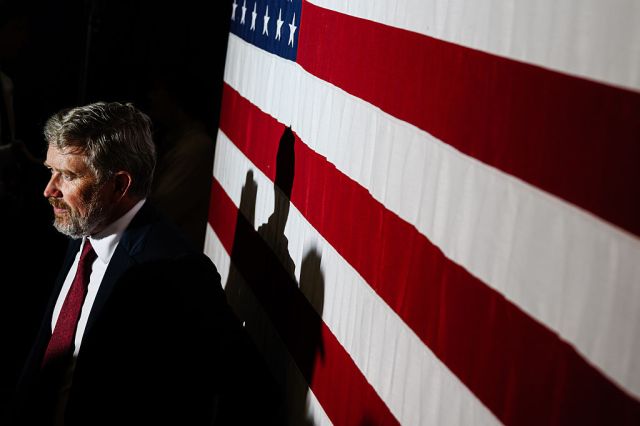
Pro-Israel donors poured millions into attack ads against the Kentucky libertarian. Credit: Getty





Rep. Thomas Massie’s decisive loss in a Kentucky Republican primary is proof that President Trump still dominates the Republican Party. It will be his party until he is no longer president — or even, perhaps, until he is dead.
Trump’s personalist rule over the MAGA GOP, meanwhile, is increasingly bound up with the pro-Israel cause. And indeed, it was just these two forces — MAGA and pro-Israel hard-liners — that came for Massie, a principled libertarian in the Ron and Rand Paul mold, who opposes the war with Iran and has called for cutting all foreign aid, including to the Jewish state.
The GOP under Trump has ideological underpinnings, but fealty to Trump comes first. That is the only tangible reality. As Rep. Randy Fine (R-Fla.) put it on X, “This is Donald Trump’s Republican Party. The rest of us get the privilege of living in it.” Fine — who combines such utter servility to Trump with grossly anti-Muslim rhetoric (“the choice between dogs and Muslims is not a difficult one”) — fits in much better with the second Trump term than the independent-minded Massie ever could.
And Massie realized what he was up against. It wasn’t only that Ed Gallrein, a former Navy SEAL, was personally recruited by Trump to run against him. It was the money: more than $34 million poured into the primary, much of it funding anti-Massie attack ads by pro-Israel groups, making this the most expensive House primary in US history. Combined with Trump’s frothing opposition, and anti-Massie messaging from the likes of Pete Hegseth, it was enough to easily sink him.
Rarely has a House primary been about one person (rather than an opposition between two of them). Several months ago, Trump said publicly that he just wanted a “warm body to beat Massie.” Gallrein made it clear he would happily serve in that role, promising to back Trump 100% of the time. That was all there was to it. He granted almost no interviews, and declined numerous debate invitations from Massie. Here was a foot soldier for Trump, going against a Republican who was willing, time after time, to go his own way.
Trump reviled the Kentucky libertarian for holding up a Covid relief bill in 2020; for voting against the “Big, Beautiful Bill” tax-and-spending package; and for leading the bipartisan fight to force the Justice Department to release the Epstein Files. For Trump, that last was the point of no return. Massie would have to suffer for linking up with Democrats like Rep. Ro Khanna of California in a bid to seek the truth about the late convicted sex offender.
If, for the president, Epstein was the breaking point, Massie’s greatest political challenge was defying the traditional American foreign-policy consensus. Unlike most Republican politicians, Massie was willing to be a principled isolationist. His conservatism on domestic matters translated to a deep skepticism of foreign entanglements, and he was the rare Republican to criticize Benjamin Netanyahu. He voted against a House resolution condemning the Boycott, Divestment, and Sanctions movement against Israel and also opposed Iron Dome funding. Hence why AIPAC and Republican Jewish groups made it their priority to wipe out Massie. AIPAC gloated over his defeat: “Being pro-Israel is good policy and good politics!”
Why, exactly, were they so motivated? For Israel hawks, the Republican Party is their true last stand. The Democratic Party isn’t totally lost to them, but they can read enough polling data: in five or 10 years, there may not be any politicians like Senate Minority Leader Chuck Schumer left: powerful Democrats who offer unstinting support for the Jewish state. Not very long ago, almost every top Democrat attended the AIPAC conference and delighted in landing a speaking slot. In 2016, when Bernie Sanders refused, his decision was considered mildly scandalous. Hillary Clinton, meanwhile, had been a proud attendee.
Those days are over. Several potential presidential candidates have said already that they’d refuse AIPAC donations. Democrats have turned on the organization for its backing of Republicans and its willingness to bludgeon Democrats who deviate from the Netanyahu orthodoxy in any fashion and even to the mildest degree. Even more centrist-minded Democrats, like former Chicago Mayor Rahm Emanuel, have called for limiting military aid; California Gov. Gavin Newsom described Israel as an apartheid state before walking it back (sort of).
Many Democrats, too, see the triumph of Zohran Mamdani, a pro-Palestine mayor who supports BDS, as a watershed moment, and evidence that it’s possible to win elections while defying the Israel lobby. Mamdani won in New York, the most Jewish city in America.
With Republicans under age 50 turning against the Jewish state, the possible proliferation of Massie-esque Republicans is an existential threat to the Israel hawks, and they will continue to pummel politicians to ensure the GOP will keep sounding like Lindsey Graham, Tom Cotton, and Ted Cruz. The defeat of Massie promises, at the minimum, that Republicans will think twice before breaking with Israel in any fashion. It’s not that regular voters care all that much — it’s the money, so much of it, ready to deployed at a moment’s notice to annihilate any Republican who steps out of line.
How long that lasts is the real question. For now, Israel hawks unquestionably dominate the Republican Party. What about 2036? 2046?
The hawks have proved, in Kentucky, that they can overwhelm a House primary with unprecedented amounts of cash. But they haven’t yet shifted the attitudes of young conservatives, many of whom are either isolationist — they take the slogan “America First” seriously — or veer into anti-Semitism, like the Groypers who follow Nick Fuentes. Anti-Israel or Israel-skeptical conservative commentators including Candace Owens, Megyn Kelly, and Tucker Carlson are undoubtedly on the ascent, while traditional hawks like Ben Shapiro are seeing their enterprises shrink. The conservative grassroots, whether animated by old-fashioned hatred of Jews or straightforward opposition to foreign-policy entanglements, is not supporting the Shapiro-style Republican. If they still, largely, back Trump, they’re weary of the Iran war and don’t understand how America benefits.
It’s not obvious, yet, what the post-Trump Republican Party looks like. Neoconservatives and hawks have had a resurgence in Trump’s second term. Led by Secretary of State Marco Rubio, they’ve emerged as true power brokers, while JD Vance, who used to represent the party’s isolationist wing, has been forced to accept a war in Iran he might not have backed were he president. Massie has, for the most part, been the outlier, playing the gadfly role occupied by the likes of Ron Paul in past decades.
But it’s Massie’s vision, as marginal as it is, that may point to the future of the Republican Party — or a future, at least. Not all GOP voters are as strongly libertarian as he is, but as the current cohort of Gen-Z ages, more will probably be receptive to his message in the coming years. A recent New York Times/Siena poll found that while a vast majority of Republicans still back Trump, 37% want to see the party’s next nominee “move in a different direction.” Notably, 45% of Republicans believe “it is best for the United States to be active in world affairs to maintain security and prosperity,” while half say that “they want the country to pay less attention to problems overseas.”
When Trump exits the scene, those viewpoints will remain. Trump won his first election, after all, excoriating the Republicans who’d championed the Iraq War. If he broke his campaign promises, he still retained control of the base thanks to his magnetism. But future Republicans won’t have the same power. One day, a vacuum will open up. Unfortunately for Massie, that day isn’t here yet. It’s Trump’s Republican Party. MAGA apostates don’t have a place in it. For now.
