




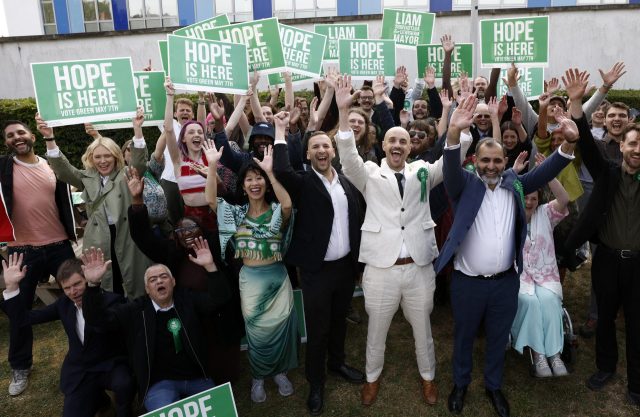
(Brook Mitchell / AFP/ Getty)





Two years ago, voters approached the polls with careful consideration: tactical voting and electoral compromise all played a part. This week, the mood was the polar opposite. The local elections were characterized by a deepening dissatisfaction, aggravated by a chaotic information environment in which it is impossible to know for sure who is in contention. As a result, voters are increasingly following their hearts rather than their heads. And the politicians benefiting are those who campaign with a compelling, emotional narrative. In other words, we are firmly in an era of conviction politics.
Much of the subsequent “post-match analysis” has not understood the magnitude of this shift, so we’ve decided to debunk some of the local elections myths you are going to hear on repeat over the coming week.
Myth #1: Labour should be relieved it wasn’t worse
The loss of 1,200+ seats is, amazingly, being recast as a surprisingly good result for Labour. Our internal estimates of how England would have voted if the whole country were up for election puts Reform on 28% of the vote, followed by the Conservatives on 20%, with Labour on 18%, the Greens on 17%, and the Liberal Democrats on 15%. Compared with the 2024 general election, there is no local authority in England where Labour did not lose ground.
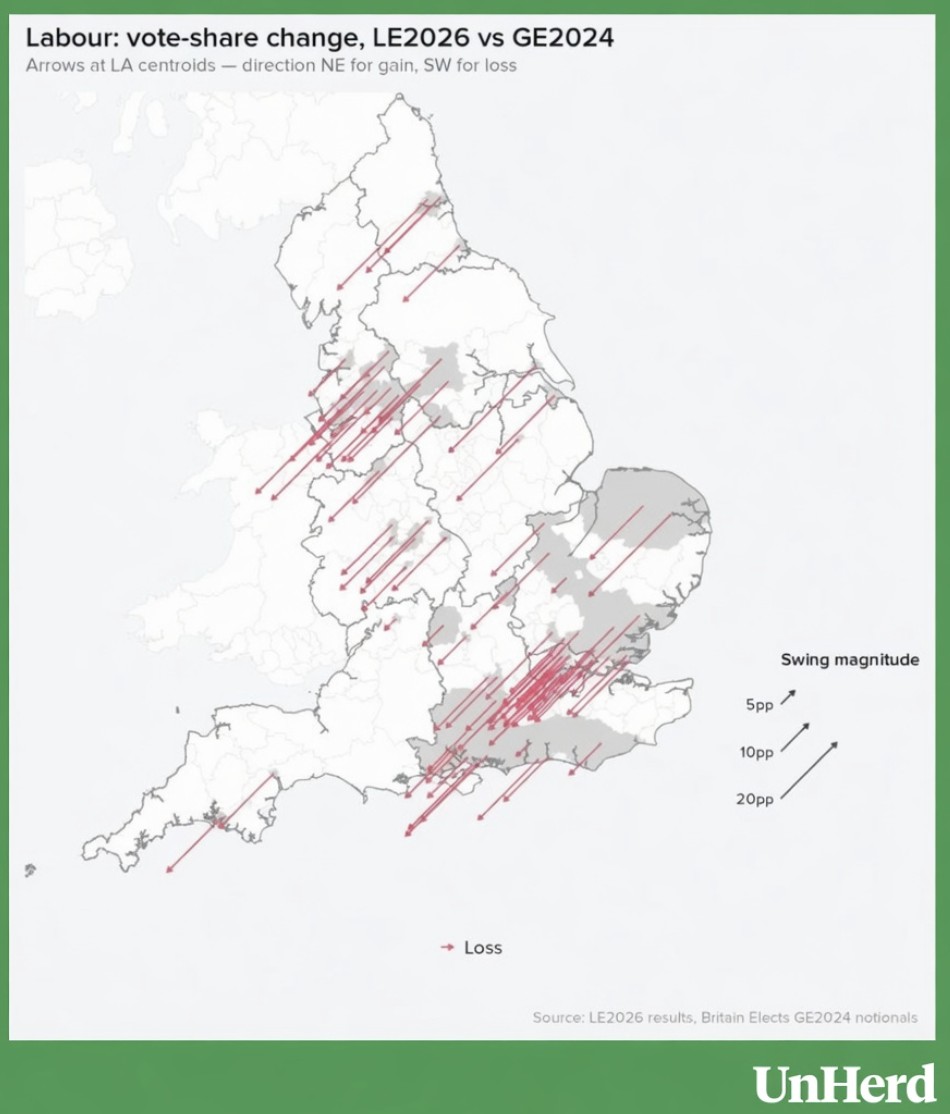
There is, then, a very real possibility that in an England-wide election, Labour would finish behind both Reform and the Conservatives (and possibly the Greens), while being wiped out in Wales and pushed into third place in Scotland. In no reasonable world could a governing party failing to finish in the top two of any of Britain’s constituent countries be seen as anything other than catastrophic.
Myth #2: The Liberal Democrats should be thrilled
While the Liberal Democrats gained some seats in this election, our modeling shows its vote share has barely changed since the 2024 general election. Once the country’s natural third party, it has failed to capitalize on electoral fragmentation to anything like the extent of Reform or the Greens. It may have seemed like the party best-placed to capture Labour voters deserting the government — no longer.
Liberal Democrat leader Ed Davey is one of the clear victims of this new era of conviction politics. Polling consistently shows that the public’s feelings towards Davey are more muted compared with feelings towards either Nigel Farage or Zack Polanski — so while Davey is less polarizing, he is also less galvanizing. This week, a poll from Deltapoll put the Lib Dems on just 9% of the vote, down 3 points on the 2024 general election.
At a time when voters are fed up with the two main parties, this is a bad result.
Myth #3: Reform has peaked
The idea that Reform support has dropped since the 2025 locals, popular in some circles on social media, is not supported by the data. Our projected national vote share sees Reform more or less equal with its 2025 level. It may be true to say it has plateaued, but if so it is still several points above its rivals. Under first-past-the-post, that is enough to deliver a landslide of seats.
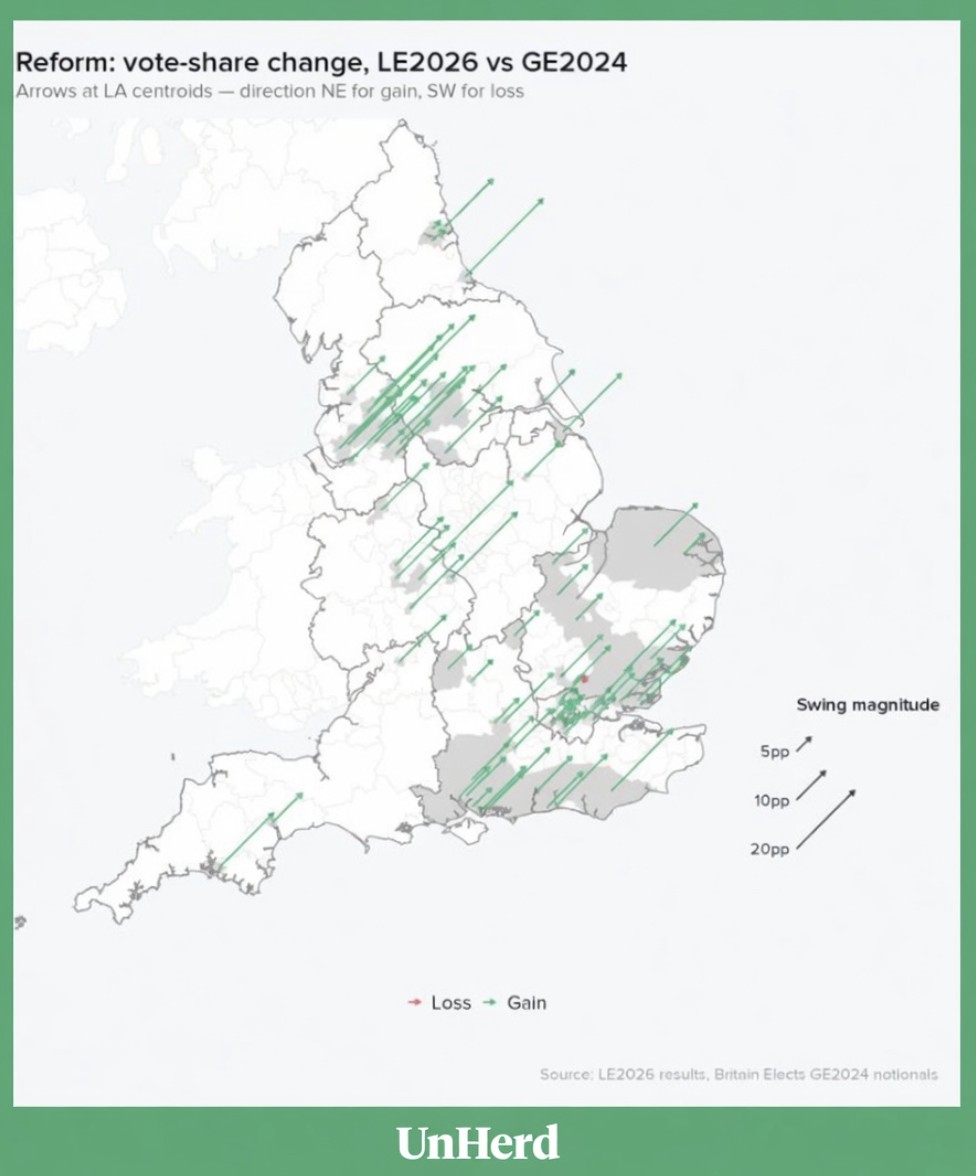
It is notable that the one area where Reform did lose ground is in Norfolk, where it faced 11 candidates from Rupert Lowe’s Great Yarmouth First, though Lowe’s local popularity means this challenge is unlikely to materialize nationwide.
Myth #4: Reform and Green gains were driven by turnout and tactical voting
In England’s first experiment with five-party politics on Thursday, tactical voting was barely a factor. Since the polls closed on Thursday, we’ve spoken to 2,000 voters in parts of England where elections were held. When we asked voters to describe in their own words why they voted the way they did, fewer than 1-in-10 raised tactical voting as a consideration.
Reform’s resilience cannot be attributed to differential turnout. One of the most telling findings from our poll is the general election vote intention among people who did not vote on Thursday, in which Reform is ahead on 24% of the vote.
Myth #5: The rise of populist parties is down to a protest vote
There is no consolation to be found for the Labour government in the notion that this is a midterm “protest vote”. Our analysis finds that both Reform and the Greens have the highest levels of voter retention between the local election vote and voters’ stated general election vote intention. Of those who voted Reform on Thursday, 85% said they would do so again at a general election, closely followed by the Greens on 83%. There is simply no evidence to suggest that the electorate voting in Reform councilors would be uncomfortable with the prospect of Nigel Farage in No. 10.
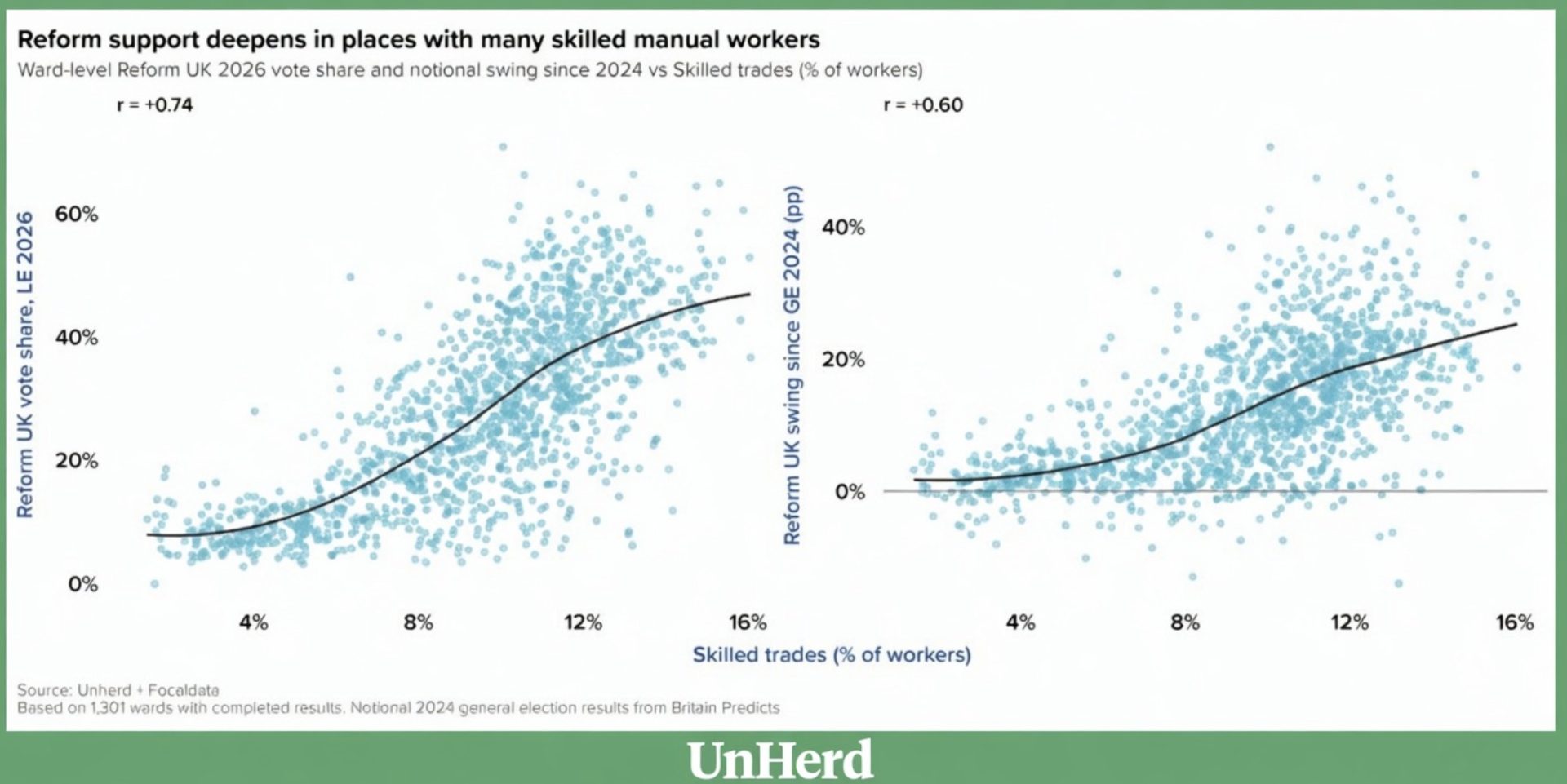
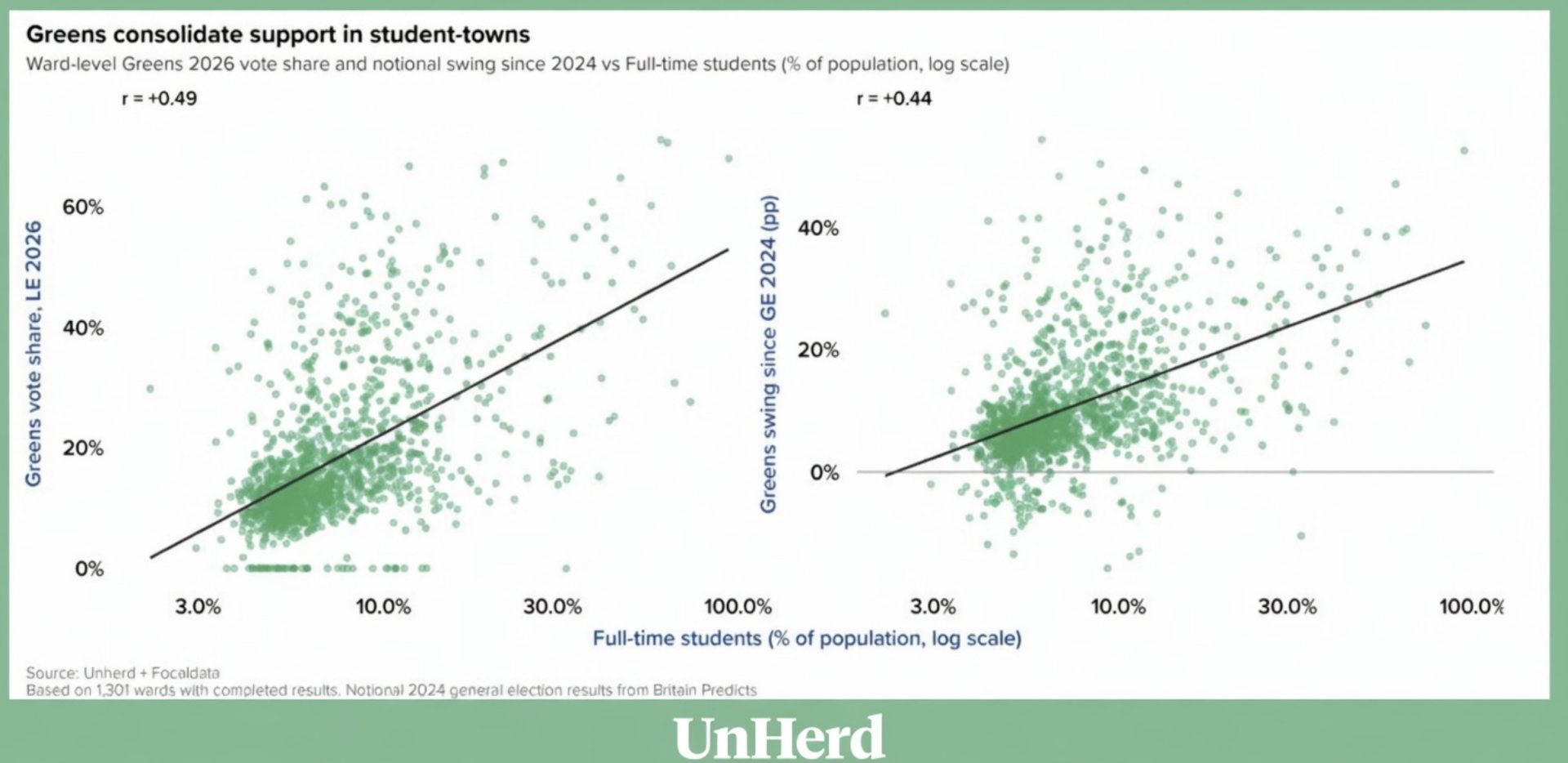
The data are clear: the continued success of Reform and the Greens cannot be attributed to tactical voting, differential turnout, or mid-term crankiness on behalf of the electorate. Instead, we are witnessing a systematic consolidation of support for these insurgent parties among their respective bases. We ran regression analysis on the wards which have already reported results while writing this piece, and found that the largest demographic drivers of constituency swing for the Greens and Reform were the exact same demographics which predicted their previous strength. In other words, Reform and the Greens are locking in ever-increasing shares of their potential support bases, rather than making inroads into unfamiliar territory.
Myth #6: The scale of Labour’s losses is down to small margins
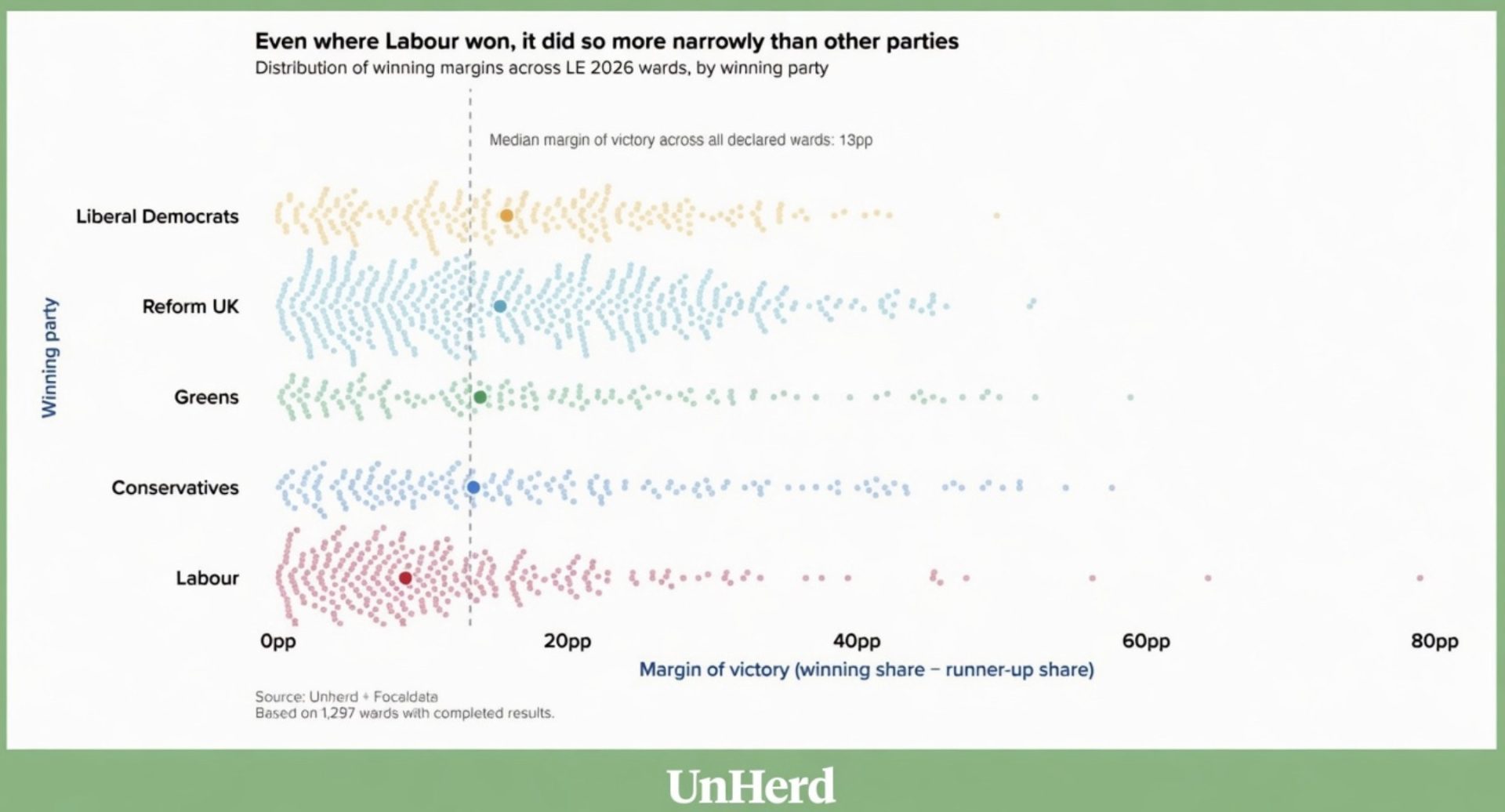
Now that five-party politics has truly arrived, one consequence is that margins of victory in elections are narrowing. Most contests are now won by candidates with less than half of the votes. Unfortunately for Labour, there is no solace to be taken in this trend either: it is their victories which were the narrowest of all in Thursday’s elections. In contrast, where Reform won, they won comfortably.
These are not protest votes. They are not tactical votes. They are not merely a reflection of turnout differentials, or the vagaries of local elections taking place in unrepresentative areas of the country. What we are seeing across the country is a genuine increase and consolidation in support for the two insurgent populist wings in British politics. Around 45% of voters would have backed Reform or the Greens if these elections were replicated England-wide, rivaling the total of the three establishment parties.
This, then, was the first proper test of how Britain’s quixotic, first-past-the-post electoral system would hold up under the weight of five parties. It is clearly already beginning to feel the strain. Our modeling suggests that if these results were replicated at a general election, Reform would comfortably win the most seats, but still fall just short of a majority.
Given the increasingly chaotic and distorted nature of our elections, this five-party system may not last for long. But those hoping for a return to two-party politics should be careful what they wish for. If Britain enters a new era of dominance by two parties, there is no guarantee that those parties will be Labour or the Conservatives.