




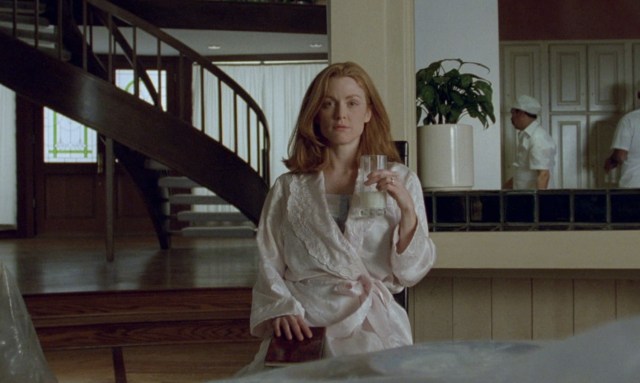
Young women are taking their health into their own hands. Credit: Sony Pictures Classics





In 2023, I met with a colorectal surgeon at the University of Wisconsin’s research hospital while on a holiday break from my master’s program. I had been diagnosed with Crohn’s, an immune-related inflammatory bowel disease, and my academic performance was declining along with my appetite and weight. Humira, an anti-inflammatory drug commonly prescribed for Crohn’s, wasn’t working. I needed a solution. After reviewing my colonoscopy results, the doctor told me that if my condition didn’t improve, she would install a colostomy bag. Her recommendation shocked me. I was 26 years old, and my peers were getting married, entering serious jobs, or starting PhD programs. When I asked her if it was reversible, she replied that my Crohn’s diagnosis indicated I’d have to keep it for the rest of my life. The idea made me want to kill myself, so I rejected it altogether. I left the hospital campus determined to find another way.
Later that day, I searched “Crohn’s disease” on the X app and found someone talking about Dr. Ray Peat. I connected with several sick people who were following a Peat diet, and they helped me one-on-one to build a recovery plan. Their instructions — avoid pork and seed oils (polyunsaturated fats), eat raw carrots, take desiccated cow thyroid — saved me. After I ovulate each month, I take progesterone dissolved in Vitamin E oil. The product, Progest-E by Kenogen, is crafted by Dr. Peat’s widow. The first time I took it, my body was so affected by its immediate tempering of estrogen — a key Peat idea is that estrogen is a driver of disease — that I had to lie down.
My muscles, taxed by estrogen dominance, became so relaxed from the progesterone that I could no longer stand. I still take it. The regimen runs for 14 days post-ovulation until I begin bleeding. I pop aspirin, another Peat hallmark, like candy every day. A few times a week, I take a custom blend of Vitamin D and Vitamin K called Estroban from a Washington, DC, cosmetics lab to offset aspirin’s blood-thinning properties. I eat as much red meat as I want, and my gut inflammation is at an all-time low. Three years later, my Crohn’s disease is no more. I will never try a new medication, I will never get surgery, and I will never stop Peating.
My devotion to Dr. Peat is what’s now being called healthmaxxing. It’s an online trend that, along with the intertwined practice of looksmaxxing, is drawing ire from the online Left, Millennials and Gen X specifically. “Why should so many perfectly healthy young women spend their youth tending to their imagined poor health?” The Cut asks. It’s “warped and wrongheaded” to looksmaxx, according to The New Yorker. In these precincts, taking pride in cultivating your health and personal appearance is coded as selfish and indifferent to Palestine, and women interested in healthmaxxing are targets for ridicule.
Women are subjected to shame online and offline. A popular Peat poster, Veronica Hoffman, known online as the mononymous Veronica, is the founder of anti-aging and hormone-safe skincare line Aurabiōm. Veronica is dragged across X as a crackpot anti-vaxx lolcow for her insistence that a cortisol-free lifestyle is required to stay beautiful. Others celebrate her and credit her with changing their lives.
Many “Trust the Science” Millennial and Gen X women have accepted chronic illness as just part of living in an America under siege by people they disagree with. They brand themselves the permanent victims of obesity and mental-health disorders. Lena Dunham, the self-appointed voice of Millennial women, has recently completed press for her new memoir, Famesick. Like Veronica, she publicly diarizes — but instead of discussing health, she discusses her relationship with her fatness and mental illness. Dunham presents obesity as a feminist victory, a rejection of patriarchal ideals of beauty. Non-famous Millennial women watch Girls and read Famesick and see a stunning and brave heroine theatrically parading the medical interventions necessary to correct health issues that shouldn’t have arisen in the first place. Motivated by these negative examples, my generation, Gen Z, has taken health into our own hands.
Americans are sicker than they have ever been. A 2023 article in the journal Current Opinion in Immunology puts the global figure for autoimmune-disease prevalence at 19.1%, up from the approximately 8% estimated by the Centers for Disease Control and Prevention’s Emerging Infectious Diseases journal in 2004. At that time, 78% of those affected were women. Nobody with a medical degree treats this as an emergency, and the Millennial American treats psychiatric conditions as just another personality quirk.
In an inversion of the days of pro-anorexia Tumblr, the internet has become a solution for sick women. If I had not connected with the Peat community on X, I would be dead — because I refuse lifelong, humiliating interventions for my health condition. Substack and X have become places where hyper-online sick women discuss experiences in and out of the medical-pharmaceutical complex. Many of these women conclude that contemporary illness is tied to hormonal disruptions, such as estrogen dominance, thyroid dysregulation, and progesterone deficiency. They believe that nutrition and environmental conditions contribute to these disruptions, and that seed oils, synthetic additives, urban living, artificial light, lack of sunlight, and the psychic stress of New York City or Los Angeles have negative impacts on our bodies. Contemporary life is incompatible with health, and has created a public-health crisis to which women seem to be the most vulnerable.
Lily Sperry, a brand consultant who runs the popular alternative-health Substack Health Gossip, articulates the environmental side of the issue. Sperry has posted on X about living in Chicago and feeling drawn to more rural environments. “Your approach [must] consider the context that you’re operating in — like, are you living in a city, alone in a studio apartment, not getting sunlight? I think those factors should be addressed,” she wrote me in an email. Sperry’s paid-subscriber chat room functions as a nouveau, female-oriented forum for this philosophy: acupuncturists, energy healers, and the alternative-health-curious post threads asking for infrared sauna recommendations, healthy restaurant lists, and product reviews. Women share what has actually moved the needle for them, not what their doctors suggested.
Balancing hormones is the pillar of this movement, which distances itself from looksmaxxing, though both exist in overlapping internet circles. Veronica and others explicitly identify hormonal balancing as the holy grail, first for female health and second for beauty. Hoffman diarizes her wellness routines publicly on Instagram: European travels under red-light chicken lamps, nibbles of the Mexican thyroid medication Cytomel, and aspirin in between. My own Crohn’s is a case study in what hormonal intervention can accomplish. When I began progesterone supplementation post-ovulation, it deleted my symptoms. My inflammation markers sank quickly. I still see regular doctors, and haven’t given up conventional medicine entirely, but I credit my deep remission to my desire to balance my hormones, and not to my yearly $8,560.32 box of Humira.
Health is a nobler goal than beauty, especially for women, who are labeled vain if they prioritize the latter. But healthmaxxing and looksmaxxing are intertwined, though they’re also polarized thanks to unhealthy (and fertility-destroying) pharmaceutical looksmaxxing approaches practiced by influencers like Clavicular, who takes meth to stay skinny and uses a hammer to reshape his cheeks. Hoffman coined a phrase now printed on hats: “You’re spiking my cortisol and making me less beautiful.” Chronic stress elevates cortisol, which destroys skin, hair, and body composition. Modern female life is a cortisol machine. Taking action against it is both a health intervention and an aesthetic one.
The Millennial author Tao Lin, one of the earlier adopters of the health-first philosophy, reached similar conclusions via a different route. Like the healthmaxxing women of today’s timeline, Lin took to the internet to determine what was wrong with him, and self-diagnosed with autism and other disorders. His approach is centered on detoxification — first of the body through garlic and bentonite clay (a detoxifying skin mask), and then of the mind by opting for psilocybin over benzodiazepines for anxiety. In Lin’s 2021 autofictional book, Leave Society, he portrays the protagonist’s healing as a meaningful, spiritual event.
Still, he says, looks can’t be separated from the overall holistic health approach. “I healed myself to reduce the amount of pain and itchiness and anxiety and depression and autism and other undesirable symptoms,” he told me. However, “most forms of healing make people look better, which can help people motivate themselves to heal themselves, which seems good.”
New Mexico podcaster, author, and wellness influencer Chloé Happe frames the movement with characteristic clarity: “The entire basis of alternative health is us calling out into the void, ‘Hey, we’ve really lost ourselves here. How do we find our way back?’” she told me. Happe was raised as a Seventh Day Adventist, a tradition in which health is a religious obligation. The first time she understood that this wasn’t a universal principle, she told me, she was at the state fair with an aunt who hadn’t been raised in the church. Happe, waiting in line for her first hot dog, pointed at an obese man and asked, loudly, why he was so fat. Her aunt was horrified and made her apologize. She felt guilty, initially about the comment, and then about eating the hot dog. “I knew that being fat and eating hot dogs were things to feel guilty about,” Happe says. It’s not allowed in Leftist circles to say so, but she was right.
Ultimately, this has become a political problem. In a scene from Desolation E-Girl, Happe’s debut novel, her protagonist deletes photos of herself wearing a MAGA hat from her X profile because she assumes that it may cost her suitors. For the Left, MAHA-type alternative health-consciousness and Right-wing politics have become almost the same thing, and people are afraid that embracing one means embracing the other. When RFK Jr. joined the Trump campaign, he effectively poisoned the concept of health for most Left-leaning people. Rational engagement with the health question now requires social courage. This, even though many of these impulses — a view of industrial modernity itself as the cause of illness — used to be Left-coded.
What actually drives the healthmaxxing wave is something older than MAHA and even older than the crunchy California Left that RFK channels: a concept as old as the Greeks that beauty is synonymous with health, and that both are good. What’s truly sick is that we can no longer state this without controversy.
Emily K. Sipiora is a Mexican-American poet and the Creative Director of internet literature podcast VICTIM RADIO.
 emily_sipiora