




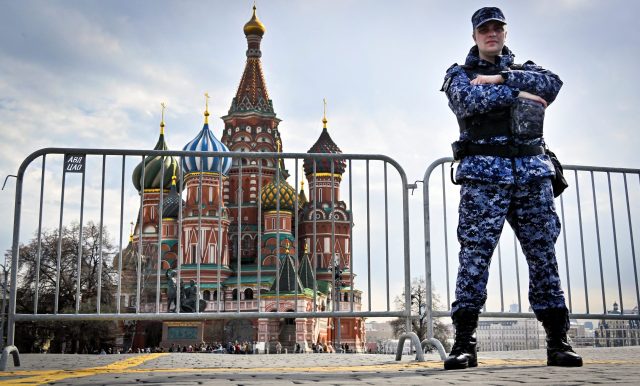
A Russian National Guard serviceman stands guard on Red Square on April 1, 2026. (Alexander Nemenov/AFP/Getty)





Since the invasion of Ukraine, Europe has had only two options regarding its stance toward Russia: forever war or offering Russia a sensible peace and security pact.
Europe’s leaders chose forever war. They labeled Vladimir Putin the new Hitler. Once they had done so, it was impossible to envision any agreement with him. Like Donald Trump, who had hoped that shock-and-awe over Tehran would trigger an internal coup or rebellion that might topple the Islamic Republic, European leaders placed their bets on the prospect that the combination of tough sanctions on Russia and arms for Ukraine would topple Putin. It didn’t.
Four years of sanctions and war have achieved the opposite result. They rebalanced Russia’s current account, energized factories that lay dormant since the end of the Soviet Union, transferred foreign-owned companies to Russian oligarchs and kept oligarchic profits within Russia. Thus, the sanctions combined with military Keynesianism to stabilize Putin’s reign. Meanwhile, despite its impressive resistance on the battlefields, Ukraine’s economy is being steadily weakened while Europe is trapped in a geostrategic conundrum of its own making and the new oil crisis engineered by Israel and the United States.
Lacking both a strategy for winning the war and an interest in suing for peace, European leaders have ended up struggling to find increasingly scarce means of prolonging the war a little more in the vain hope that some miracle may deliver them from their strategic void or that their tenure will have ended by the time their folly has been exposed for all to see. Meanwhile, the bodies pile up in Ukraine’s killing fields and Europe’s social economies are hemorrhaging.
With Europe’s strategic defeat a near certainty, there are only two ways it will play out. One is that President Trump puts on the table a take-it-or-leave-it peace plan that President Zelensky and the European Union must accept, or else the United States ceases to share intelligence and to sell weapons to the Europeans to pass on to Ukraine. Exhausted by their energy crisis, fiscally stressed, and unable even to maintain the current level of support to Ukraine, German, Italian and French politicians will acquiesce to Trump’s plan. A Europe that has left them high and dry will leave Ukrainians feeling abandoned, unsafe and disillusioned. The ignominy will be complete when Russian natural gas begins to flow again into Germany, Italy and the rest of the European Union through pipelines that are, now, partly US-owned, with Washington retaining a share of the proceeds, while the European Union foots Ukraine’s reconstruction costs in their entirety.
The other possibility, one that will obtain if Donald Trump remains distracted for the rest of his tenure by his Iran war folly, is even less appetizing. Russia’s juggernaut, boosted by the windfall from high oil and gas prices, ekes out the rest of the Donbas slowly, painfully, devouring lives with a ruthless, mechanical precision until, at a moment of his choosing, Vladimir Putin declares victory and announces a unilateral ceasefire. Then, any leverage the European Union might have had to shape a peace and security agenda for its neighborhood withers to nothing.
What if Europe were to ditch forever war in favor of its second option, the path never taken? What if it were to offer Russia a sensible peace and security pact that extends beyond settling the Ukraine war? Just posing the question will, undoubtedly, trigger howls of betrayal, charges of appeasing the new Hitler, accusations of reciting Moscow’s speaking points. These are the natural responses of having made, initially, the forever war choice which, as already argued, leads to a bitter betrayal of Ukraine and a miserable outcome for Europe.
To envisage this second option, a European offer of a peace and security pact, there are three prerequisites. First, the abandonment of the delusion that the offered pact should contain nothing that Putin can present as a victory. All pacts, agreements, peace deals, etc., must offer each signatory things they can present as great gains to their own constituency. Is there something that Putin can present to the Russians as worthy of their sacrifices during this awful war which Europe, including Ukraine, can live with? I think so. How about that, in the same way the United States can say an emphatic “No!” to the right of Mexico to deploy Chinese weaponry in Tijuana, Russia also has the right to seek security by demanding, as it has done for three decades, that Nato stay out of Georgia and Ukraine? A provision in the proposed European Peace and Security Pact that recognizes this Russian concern is not just a particularly small price to pay but also one that Europe should desire, in view of the dangerous tensions that a face-off between Russian and Nato troops within a postwar Ukraine, or indeed in Georgia, would generate.
The second prerequisite for a genuine peace and security pact is the rejection of the notion that it will have to involve an Anglo-European “coalition of the willing”; that is an army of British, German, French soldiers facing off their Russian counterparts along whatever line of control is agreed to. To insist on such an army is to state that Europe is not even attempting a genuine détente, assuming it to be impossible. The United States did exactly that on the Korean peninsula, leaving behind an ironclad, nuclear armed, huge army to police an impenetrable line of control. Europe cannot and should not want to do likewise in Ukraine. The best Keir Starmer’s “coalition of the willing” can deliver is a sad outfit facing the fate of UN peacekeepers in South Lebanon. It takes no more than a few moments of clarity to recognize that a functional peace and security pact must involve full de-militarization of the contested territory and its surrounding areas. In turn, this requires a spirit of détente based on the recognition that Europe must provide both sides, Ukraine and Russia, with security guarantees.
Finally, the third prerequisite is a readiness to be creative with issues of sovereignty and governance over disputed territories with a view to preventing the type of airtight partition left behind by the British Empire in India, Palestine, Cyprus, and Ireland, guaranteeing permanent conflict. Speaking of Ireland, the Good Friday agreement, a worthy effort to part ways both with the logic of strict partition and Westphalian sovereignty, is a splendid example of how the Donbas and other contested areas can be governed after the cessation of hostilities as part of a comprehensive peace and security pact.
Having stated the three prerequisites for a European pivot from forever war to offering Russia a peace and security pact, and before delving into what such a proposal might contain, the importance of rebuilding channels of communication with Russian society cannot be overestimated. The European Union’s policy of frowning upon, even sanctioning, anyone who dares maintain communication channels with Russian civil society is a form of self harm. This is why I accepted an invitation to address an investment conference in Moscow last week, one that involved no government representatives but did engage a large audience of financiers, technologists, students and journalists. If channels of communication are to be rebuilt, this is the type of audience that needs to get involved.
My visit to Moscow did not come out of the blue. In April 2022, two months after the war’s commencement, the movement that I helped co-found, DiEM25 (the Democracy in Europe Movement 2025), canvassed a five-point solution which I subsequently campaigned for, leading to the Athens Declaration on behalf of the Progressive International which called for a solution to the Ukrainian tragedy within the broader framework of a new Non-Aligned Movement. That was the background to my recent Moscow visit. Naturally, a Moscow visit by a former finance minister who failed spectacularly to alter Europe’s course a decade ago is not any kind of breakthrough, at least not in itself. However, what it can do is to demonstrate how Europeans can begin to mend fences with Russian civil society.
Turning to the actual proposal for a comprehensive European peace and security agenda, which I went to Moscow to canvas for, it consists of six parts.
First, Ukraine becomes in the 21st century what Austria used to be during the Cold War: a neutral but armed European country with its territorial integrity and political sovereignty jointly guaranteed by all European countries, plus Russia, under the auspices and in accordance with the Charter of the United Nations.
Second, the signatories of this Peace and Security Agenda shall agree on the gradual elimination across Europe of certain categories of weapons (including nuclear, chemical, and AI-powered drones). Within this context of deescalation, Russian and Ukrainian troops shall withdraw fully 300 kilometers on either side of the agreed border or line of control.
Third, all war refugees will have the right to return to their pre-2014 homes, with all sides committing to aid their return in practice.
Fourth, the Donbas and other disputed territories that come under Russian control shall be demilitarized and governed in the same manner as Northern Ireland under the Good Friday Agreement. Just as London retained sovereignty on paper but, in practice, shares it with Dublin, while the two communities share power equally on every governing body (from local government to Stormont), the idea here is that sovereignty of the areas that Russia is granted will remain formally within Russia, but free movement within and outside these regions will be guaranteed, and each municipality as well as every Oblast will be governed on the basis of equal representation of Russian- and Ukrainian-speakers. Anyone who says that this is impossible must be reminded that, not long ago, it seemed similarly impossible to envision Sinn Féin and Ulster Unionists power-sharing.
Fifth, the European Union unfreezes Russia’s assets and removes all sanctions. Meanwhile Russian energy begins to flow again to Europe, with a portion of all proceeds dedicated to a Ukraine reconstruction fund.
Sixth, modeled on South Africa’s Truth and Reconciliation Commission, established after the fall of apartheid to offer an opportunity to air grievances and to be heard by the opposite side, a similar council shall be convened by the UN, led by judges with experience in restorative justice from South Africa and other countries.
As wars and the fear of war expand their domain, an international push for peace is more pertinent than ever. An inability to imagine what a comprehensive European peace and security agenda would look like is perhaps the worst impediment to its emergence. The above six-point proposal is meant as an example of how to overcome this obstacle, outlining concrete steps Europe could take to break the deadlock and give itself a chance to become relevant again.
Many will ask: how would the Russian government, Vladimir Putin in particular, respond to such a proposal? While no one knows until it is on the table, my recent experience in Moscow tells me that Russian civil society is not only ready to welcome it enthusiastically but also to pressurize its government to take it seriously. Eager to reconnect with the West, but repulsed by the clear signs EU leaders want to see Russia torn apart by centrifugal forces, Russian public opinion is keen to enter into a fruitful dialog on the basis of such a plan — including opponents as well as supporters of Putin’s government.
Last but not least, many of the Russian technocrats, students and journalists I met in Moscow last Saturday told me there was a reason they were more amenable to this particular proposal for a European peace and security agenda: it was put to them by someone whose stance on the Ukraine war four years ago (“Stand with Ukraine but not with Nato’s expansion”) was attacked with equal venom by the Russian government’s supporters and Nato stalwarts. This may help explain the impromptu party atmosphere, following the proposal’s presentation, to which I surrendered happily. Mending fences in the cause of peace takes a variety of small, human steps.
Yanis Varoufakis is an economist and former Greek Minister of Finance. He is the author of several best-selling books, most recently Raise Your Soul! A personal history of resistance.
 yanisvaroufakis