




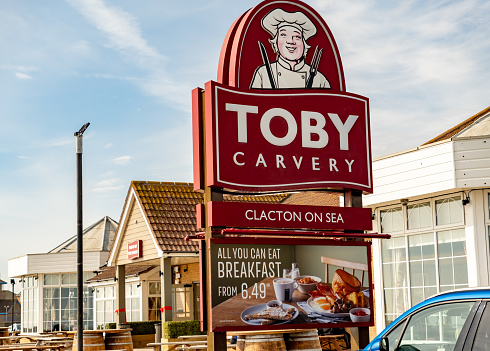
'Toby Carvey is a cultural barricade as much as a cost-of-living-friendly place to eat' (Getty)




The most memorable restaurants tend to involve a bit of temporal stasis. The River Café is bathed in the eternal, early afternoon sunshine of a long Thursday lunch in the first flush of Tony Blair’s Labour. Carbone, recently deposited in the base of the Chancery Rosewood hotel in Grosvenor Square, is a perpetual Manhattan midnight. TGI Fridays literally built its quitting-time vibe into its name.
And then there is Toby Carvery, the 41-year-old pub chain and rumpled mainstay of Britain’s social furniture. The roast dinners are available every day, the trimmings are limitless, and the implicit invitation is to live out a month, even a lifetime, of Sundays. It’s a bit like Morrissey’s plaintive croon — “Every day is like Sunday / Every day is silent and grey” — only here there are stuffing balls and everyone is extremely into it.
This was the comforting reality I was reminded of as I made my way towards bellowing signage (“The Home of the Sunday Roast”) and into the Toby Carvery in Eden Park, south east London, on a nothing Wednesday. Set against a busy main road and opposite a car garage, it has the feel of a frontier post — the last redoubt of the suburbs. Beyond, London thins out into Kentish golf clubs and country parks.
This is one of Toby’s 158 surviving sites and, considering it had been roughly 20 years since I last visited one, to cross the threshold was to feel the lurching rush of decades collapsing. Here was the vast, vaguely familiar barn of a bar area with its display cabinet of leering Toby jugs and inactive fireplaces ornamented with fairylit, decorative log-piles. Here was a huddled bank of fruit machines and electronic quiz cabinets flashing and winking so brightly they could almost distract passing air traffic. Here was the thick, bovine miasma of gravy, produced at the sort of industrial scale that brings to mind hospital corridors and school cafeterias. And here, perhaps most unexpectedly, was a sizeable lunchtime crowd: pint-sinking tradesmen, chirpy female friends, solo lunchers and a gaggle of spry pensioners, all shuffling towards the dining area and artificially illuminated hearth of the self-service counter.
Still, those who have been paying attention would not necessarily be surprised by the gathered hordes. Having long been dismissed as a naff, vaguely Partridgean culinary relic, the pub carvery in general — and Toby Carvery in particular — has emerged as an unlikely cult phenomenon. Trade has boomed: last year, Millers & Butlers (which operates Toby, Harvester and All Bar One) reported £2.7 billion venue, with like-for-like sales growth of 4.3% at a time when most of the hospitality sector is struggling. Meanwhile the #Britcore trend that swept TikTok in recent years — encompassing everything from jacket potatoes and the Oasis reunion to arcane Northern slang — has sparked a cottage industry of Gen Z reviewers rating their local carvery. A video of an American YouTuber called Alan Barr trying a Toby Carvery for the first time has been viewed 602,000 times (“They say this is like Thanksgiving buffet seven days a week”); a similar Nando’s visit yielded only 241,000 views. The cultural high point arrived when Danny Dyer revealed, on Kathy Burke’s podcast, that he’d been given a Toby Carvery “gold card”, entitling him to a complimentary, unlimited roast for life. This made the national news and underscored Dyer’s geezer-savant/national-treasure credentials.
On the one hand, there is nothing much to see here. The fact that Toby Carvery and other value-forward chains like Greggs and Wetherspoons are suddenly in the ascendency is not surprising, given the state of the economy. It’s driven by nostalgia, comfort and the lulling wash of cut-price booze, fat and sugar. As George Orwell wrote in The Road to Wigan Pier: “When you are unemployed, which is to say when you are underfed, harassed, bored, and miserable, you don’t want to eat dull wholesome food. You want something a little bit ‘tasty’.” But, from another angle, the reenergized cult of the carvery is a reflection of a time when pre-pandemic pretension has faded from view. Mildly chaotic authenticity is everything. The line between sincere devotion and ironic enjoyment has never been more blurred.
Then there is the political context. The emergence of Faragism as a discourse-shaping national idea has run alongside wider social debates related to the pub and the version of nationhood it projects. A beleaguered Keir Starmer is accused of “waging war on pubs”, despite the fact that he extended a 15 percent business rate discount to pubs and music venues back in January. For his part, Nigel Farage has announced that Reform will reinstate the two-child benefit cap to fund a £2 billion tax cut for pubs. “[Farage has] got the massive advantage in that he’s a genuine piss artist,” said Wetherspoons founder Tim Martin, welcoming the news with typical élan.
Then there is its soft patriotism. Right from its inception in the 1980s, Toby Carvery gestured towards a distinctly British tradition of feasting-hall excess. The Toby jug that adorns every menu has its origins in the tale of Toby Fillpot: a tricorn-wearing, Yorkshire drunkard and philanderer whose remains were magically turned into clay. He is always depicted with a brimming tankard of ale, a partially unbuttoned waistcoat and tobacco pipe — not so much cautionary tale as Dionysian advert. Though the Reform party leader is not quite so physically stout, his signature pose – wide grin, full pint, smoldering cigarette – trades on the same semiotics. To march beneath the banner of a gregarious, beer-swilling mascot is to implicitly pick a side in at least one aspect of culture war.
Once you throw in “funflation” — an economic term, imported from the US, describing the increasingly prohibitive cost premium associated with once-accessible leisure activities like gigs and eating out — the Toby Carvaissance makes more sense. It’s cultural barricade as much as a cost of living-friendly place to eat, its gravy-doused buffet and circa-£5 pints pushed as an inalienable British right by a cross-generational pincer movement. It may have taken a while to get there. But, suddenly, Toby Carvery looks like a herald of Britain’s future.
Though the carvery is perhaps most closely associated with the 1970s and 1980s, its origins date to much earlier. Roasting meats, carved from a single, warmed joint, have been a presence in the UK’s restaurants since at least the middle of the 19th century. Famously, at Simpson’s-in-the-Strand, carving trolleys were the solution to diners who needed their daily repast to be compatible with marathon games of chess. (The new owner, Jeremy King, has gone big on carved beef in the restaurant’s new incarnation.) Still, it wasn’t until the 1950s, when catering behemoth Lyons added a carvery at London’s Regent Palace Hotel, that the genre emerged in its recognizably self-service, all-you-can-eat form. (A Lyons executive actually got the idea after witnessing Scottish anglers helping themselves to candle-warmed joints of meat after a day’s work.)
The carvery’s Boomer-era formula of reasonably priced, Bunter-ish excess soon proliferated across the country, drawing both excitement and a kind of awed horror from generations who could still remember the privations of rationing. A 1959 story in the Coventry Evening Telegraph described a carvery customer “who calmly slipped all but a complementary fragment of a joint into his newspaper and transferred it to his briefcase”.
The first Toby Carvery only opened in 1985, with an earthenware depiction of a folkloric English glutton as its logo and spirit guide — and soon gained the kind of market dominance and name-brand recognition enjoyed by McDonald’s and Hoover. Still, it’s fair to say that for much of its life, the carvery has been distinctly out of fashion. In a 1998 column in The Spectator, Alice Thomson described a £35 Blackpool hotel carvery of “overcooked beef… yellowing cod mornay [and] watery cauliflower cheese” that had “all shrunk under the harsh lights”. In 2001, Sue Townsend had a 34-year-old Adrian Mole visit “Ye Olde Carvery… [with] trays of ye olde foode congealing behind the bar”.
What had once been associated with, if not exactly luxury, then attainable, Victorian-era abundance had, by the first years of the new millennium, begun to feel like an overpriced, ill-kept human trough. This was the version of Toby Carvery I first encountered as a snakebite-bloated undergraduate: a cavernous mock-Tudor inn near Windsor where my strongest memories are of silty bowls of mint sauce, gray slices of meat and, of course, the haunting fug of gravy.
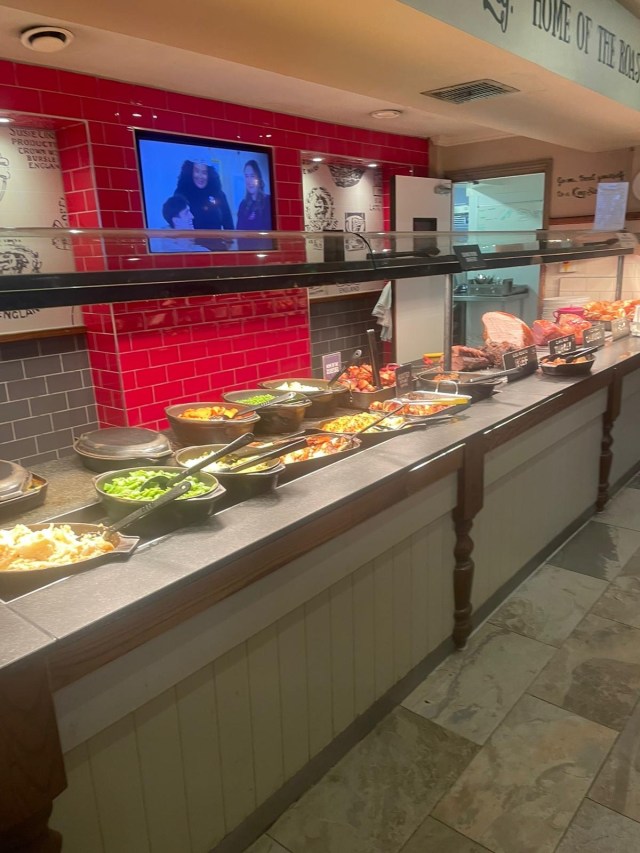
I wasn’t optimistic that the 2026 version would be any improvement — we are living in an age of skimpflation, razor-thin hospitality margins and precipitous food costs. But Eden Park surprised me, three times over. The first surprise was the price. Midweek, the signature deal of roast meats and as many trimmings as you like is £10.99; an all-you-can-eat breakfast is £7.99. The second was the visual impact of the hot counter: a rolling massif of roast potatoes, burnished fists of Yorkshire pudding, lacquered joints of beef, gammon, ham and turkey, all carved by a chirpy server in chef’s whites: “Wanna know why you’ve come at the best time? Because I’m here!”
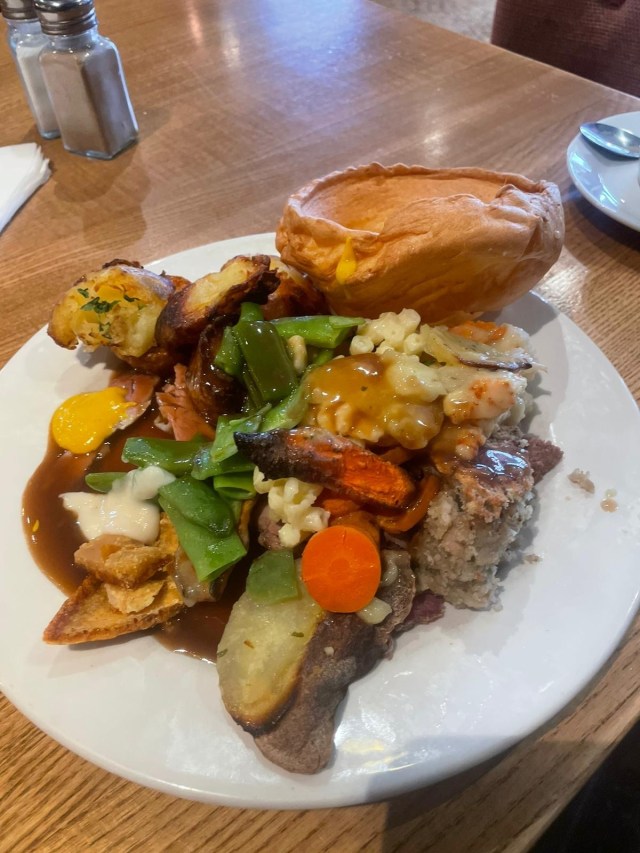
Thus meated, I moved on to the self-service sides — macaroni and cheese, stuffing, sliced mangetout, peas, municipal coins of boiled carrot — and then the cauldron of thickly emulsified, brown goop labeled as “Toby’s Famous Gravy”. As is often the case at a self-service buffet, greed, panic and poor planning produced a plate of utter chaos: a vast slop-pile of vegetables, proteins and stray peas, a Bash Street Kids nightmare.
Nevertheless, after I had ferried it back to my table in the corner of the bar, the final surprise arrived. It was far, far better than it had any right to be. Moreish, deeply savory gravy. Terrific pork crackling with a bubbled, echoing crunch. Fluffy, sharply crisped, beef dripping roasties. Yes, the meat wanted for succulence and the cauliflower cheese was a little gluey. But I can say with absolute certainty that I have paid at least twice as much for aspirant gastropub roasts that were not half as good. The fact that you can return for more potatoes, more Yorkshire pudding, also somehow feels much, much closer to the domestic ideal of what a Sunday roast should be. This is, after all, “The home of the Sunday Roast.”
This, fundamentally, is core to Toby Carvery’s renewed appeal during a strained economic moment — more so than any of Britcore/Farageist associations. All-you-can-eat speaks to the times. There are iterations everywhere: see Senza Fonda, a bottomless lasagne spot in Shoreditch; or Faith In Strangers in Margate, which offers steak and “infinite fries”. An endless cascade of decent roasties is so much more generous than two miserly gastro spuds — or dolloped servings of truffled cauliflower cheese. In an era of culinary de-skilling and labor shortages, a dining category born from a desire to cut staff costs looks like a shrewd business model. The Sunday roast may have thrust forward. Toby Carvery has stumbled towards relevance by standing still.
“We get a lot of regulars and it’s a friendly pub,” said Fiona, one of only two harried bar staff as she came over to grab my (mostly) finished plate. “I think people like it because it’s a good price and they know what they’re getting.”
The carvery continued to fill as the late afternoon tipped into the early evening. Yet more pint-hefting gangs of tradesmen. Guffawing duos of female friends placing coasters over their glasses of rosé before they went up to the hot counter for their carveries. (“No one’s going to nick my Temu jacket, are they?” giggled one). Harangued parents bringing their uniformed children in from the rain for some respite and a Fruit Shoot after the school run.
In the same way that branches of Costa have become proxy living rooms for all sorts of different Britons, Toby Carveries like this become sanctuaries for the kind of connection more commonly associated with village pubs than national chains. “What are you having, Paul?” chirps Fiona, as a smartly-dressed old boy approaches; “The usual?” asks one half of a married couple, peering over her half of Peroni at an opened menu.
Maybe that is the other part of the mock-historic promise of a Toby. It projects an unrestrained and unapologetic version of Britishness that recalls a bygone age. Meanwhile, it has the kind of knock-down prices that are only possible when you have the purchasing power of a hospitality giant with 50,000 staff and an operating profit of £322 million.
Whether it can weather the future, we shall see. Rising wage bills and food prices (which Toby owner Millers & Butlers says could cost it as much as £130 million in the next year) suggest a need to spread the gluttonous gospel to an even wider congregation. In the meantime, Toby Carveries endure — like Ryanair flights before them — as sites of the kind of digital-age misbehavior that the writer Clive Martin terms “British chaos”. On The Sun’s website, you will find a video of punter hurling a glass at a member of staff in a Hampshire location. It’s one of 430 pieces to feature the words ‘Toby Carvery’.
This tendency became more apparent as I lingered in Eden Park and watched those hard-drinking tradesmen begin to throw ice cubes at each other. By the time a man holding an unlabelled bottle of orange liquid shambled over and asked me for change, I decided it was probably time to leave. This, of course, is the flip-side of Toby Carvery’s lasting role as a non-judgmental third space. True, the menus may now feature vegan onion and shallot tarts and Yorkshire pudding wraps. But the offer is still indulgence in a time-warp bunker, resistant to liberal gentility and a changing world.
Join the discussion
Join like minded readers that support our journalism by becoming a paid subscriber
To join the discussion in the comments, become a paid subscriber.
Join like minded readers that support our journalism, read unlimited articles and enjoy other subscriber-only benefits.
Subscribe