




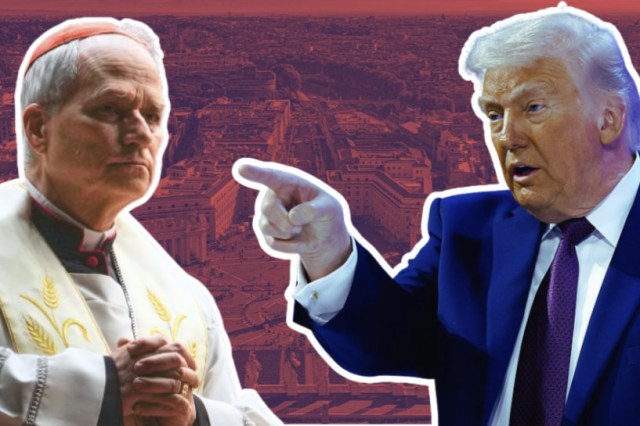
Pope Leo described Trump's war as "not acceptable". (Credit: Getty)





The recent war of words between President Trump and Pope Leo XIV is probably as close as we moderns will get to a bygone age when emperors clashed with pontiffs. The rift first emerged soon after Leo’s election to the Petrine Office, when old Twitter posts resurfaced in which a pre-papal Robert Prevost had criticized Trump (and Vice President JD Vance). It deepened when the Pope instructed the US bishops to speak up for migrants caught in the dragnet of Immigration and Customs Enforcement. And things came to a head this month, when Leo described Trump’s threat to erase Iranian civilization as “truly … not acceptable”.
Trump responded with a long Truth Social rant, in which he slammed the Roman pontiff as “WEAK on crime”, as if he were addressing the Democratic mayor of a coastal city, and fulminated about Leo’s opposition to the Iran War. He followed that up with an AI-generated image of himself as a Christ-like figure, miracle-healing an ailing man; the image was later deleted, even as Trump maintained that it was supposed to portray him as a “doctor” (the internet didn’t buy it).
Superficially, this is a disagreement between an unprecedentedly tactless president, on one hand, and the sovereign of a tiny city-state who also happens to be the spiritual leader of some 1.4 billion people, on the other. With his ill-defined Iran War petering out, Trump is lashing out wildly — including at the pope, whom he views as just another politician and, therefore, fair game for the sorts of insults he might fling at (say) the “Palestinian” Sen. Chuck Schumer or the “failing” New York Times.
But one needn’t accept the maxim that all conflicts are theological to notice the deeper theological dimensions of this one: the apparently considered decision of Leo XIV to cast off the hawkish brand of conservative Catholicism that once bridged Washington to Rome. In doing so, the Pope has forced an uncomfortable choice on conservative Catholics: do they stand with the successors of Peter, who’ve imposed increasingly stringent moral limits on warmaking? Or do they stick with a Republican Party that can’t do without wars in the Middle East, even under its supposedly populist guise? The more fundamental problem behind these questions: how should Catholics relate to a country that is presumptively skeptical (at best) of apostolic or historic Christianity?
Back in the Seventies, and especially in the Reagan-Bush years, the Catholic conservatives supplied one answer to this persistent set of problems: they furnished highbrow Catholic justifications for Republican foreign and domestic policy; presented Catholicism as, in essence, “safe” for the Right’s conception of American order; and even sought to remake Roman thought in the American image.
The impulse was understandable. A century earlier, America’s protestant majority scoffed at the Catholic Church for its pompous, “foreign”-language liturgies; spurned the extra-biblical reasoning of Catholics, with its admixtures of pagan and heathen philosophy; and treated with suspicion a group whose highest loyalty lay with a man in a funny hat in Rome. Those were the days when The Atlantic would publish editorials stating forthrightly that a “loyal and conscientious Roman Catholic could never be the US president, for the simple reason that Catholics are beholden first to the man in Rome” (this was in 1927, and the presidential contender in question was New York’s Al Smith).
Things began to change mid-century. That was when the Catholic Church found common cause with American power in the face of a common foe, Soviet Communism. Alongside Mainline Protestantism and Reform Judaism, Catholicism came to form one of the pillars of a stolid cultural consensus. It was left to the Catholics, for example, to draw up Hollywood’s censorship codes: no mentions of abortion; bad behavior must always be shown to lose by the end of the plot, and so on.
A pivotal figure in this transformation was John Courtney Murray, a Jesuit priest and Vatican II peritus, or expert, who attempted a reconciliation between the faith and the American civic religion of liberal nationalism. Murray argued that when the popes in the 19th century condemned “liberalism”, they had in mind the high-handed, militantly anticlerical liberalism of Continental Europe, and not the American model, which emphasized pluralism and comported with Catholic notions of natural law.
Murray’s maneuver wasn’t without precedent. In the early 19th century, a gathering of the American Catholic bishops in Baltimore had declared that the Founding Fathers had “built better than they knew”: meaning, that although the framers of the Constitution may have been inspired by erroneous liberal doctrines, they had in practice brought forth a regime in which the Church could survive and even thrive. And so it did, throughout the 19th century, notwithstanding the assaults of Know-Nothings and the Klan, but especially in Murray’s day — a high watermark for the American Church in terms of vocations, educational and philanthropic expansion, and sheer cultural influence. Murray said, in effect: They knew and built well.
The conservative Catholics I speak of here are best seen as Murray’s intellectual heirs. These, to be clear, weren’t traditionalists. The “trads” stuck to the old-line anti-liberalism, and some of them fell into schism in reaction against the reforms of Vatican II. The Murray-ites, by contrast, sought to synthesize the faith with American (neo)liberal order, and to help strengthen that order with Catholic scaffolding.
Thus, in his 1982 book, The Spirit of Democratic Capitalism, the writer Michael Novak brushed aside longstanding Catholic anxieties about market systems to herald a brand of Catholic neoliberalism. Much as Murray had distinguished (good) Anglo-American liberalism from (bad) Continental liberalism, so Novak argued that the popes’ concerns about market society had been limited to the “industrial tyrannies” of the 19th century. These were far from the “equal opportunity and open social mobility” that supposedly characterized “later” capitalism, ensuring that it was free of coercion.
Novak, however, merely recapitulated the shop-worn arguments that the previous Leo pope — Leo XIII — had confronted in Rerum novarum, his landmark 1891 encyclical that inaugurated modern Catholic Social Teaching. In Leo XIII’s time, too, defenders of the unrestrained market insisted that the elements of choice and consent meant that no one was coerced under capitalism. Leo disagreed. Given the lopsided distribution of power and wealth generated by markets, “the richer class have many ways of shielding themselves… whereas the mass of the poor have no resources of their own to fall back upon.”
The “freedom” touted market fundamentalists in his time — and by Novak nearly a century later — was thus illusory. Real freedom and justice, Leo XIII taught, would be found in “united action” of the kind promoted by “workingmen’s associations”, and by the government promoting “balance in the social body” between labor and capital.
Novak barely mentioned organized labor in The Spirit of Democratic Capitalism; when he did, it was to lament the corruption of union leaders. Of course, there have been corrupt union leaders. It was shocking, all the same, for a book on Catholic political economy to offer such a pinched account of labor and its rights.
In translating the Catholic tradition for Reagan-era America, Novak rendered it perfectly inoffensive. There was nothing wrong with an individualistic system that couldn’t be fixed with more individualism, bootstrapping enterprise, and a robust “public moral culture” — a pet phrase of the Murrayites. Yet in their telling, the culture or morality was completely innocent of political-economic and other structural dynamics. They were loud about restricting abortion, as Catholic doctrine insists, but refused to notice how a ruthless, efficiency-maximizing order might come to treat the unborn (and the disabled and the elderly) as disposable. More than any other sector of elite opinion, they contributed to the development of a conservatism that would police the bedroom, but never the boardroom.
Novak and his confrère played an equally important role in applying a Catholic veneer to GOP belligerence in the twilight years of the Cold War and, especially, in the wake of 9/11. Toiling in Right-wing think tanks, and later clustered around the religious journal First Things, they attacked a “presumption against war” that had taken hold among the Catholic bishops, as the writer George Weigel put it. Read that again. Weigel was unhappy that the successors of the Apostles — followers of the author of the Sermon on the Mount — had developed an undue presumption against war.
Weigel’s deeper critique, in fairness, was that the Church’s just-war tradition must be viewed as a public normative framework for the upkeep of peace, understood as the “tranquility of order”, rather than the mere absence of conflict. Under such a framework, he argued, the determination of a just war can’t be reduced to a check list or a matter of private conscience alone (since the public magistrate is under obligation to his public to secure them against threats).
Perhaps this had some salience in the Eighties, when Weigel first floated his hawkish theories. He did so in response to a statement of the American bishops that called for nuclear disarmament and the reconsideration of Washington’s first-use posture, while declaring nuclear attacks on cities to be immoral. Such statements, Weigel warned, ignored the reality that nuclear deterrence can make war less likely. More than that, they risked collapsing the Catholic position on war and peace into an outright pacifist one, and that couldn’t have been right: if the Church has cultivated a just-war tradition over centuries, it must follow that some wars are … just.
But by the early post-9/11 years — when Weigel had reached the apogee of his influence, thanks mainly to a blockbuster biography of John Paul II — his position had hardened into an undue presumption for war. In a 2004 essay for First Things, the author contended that the same “presumption against war” had also animated the “many warnings of catastrophe from religious leaders that preceded the … the most recent Iraq war.”
The “most recent Iraq war” was in reference to George W. Bush’s misadventure, which indeed proved catastrophic, and for which Weigel, Novak, and First Things founding editor Father Richard John Neuhaus campaigned vigorously. Their efforts even reached the Apostolic Palace, where they repeatedly sought a papal blessing for the war. John Paul II refused. More than that, the pope in the leadup to the Iraq invasion urged world leaders to “extinguish the ominous smoldering of a conflict which, with the joint efforts of all, can be avoideds”. Afterwards, his successor, then-doctrinal chief Josef Ratzinger (the future Pope Benedict XVI), insisted: “It was right to resist the war and its threats of destruction.” And on another occasion: “There were not sufficient reasons to unleash a war against Iraq.”
Weigel would go on to gripe about the American bishops over their supposedly insufficient enthusiasm for the Iraq War. Just-war theory, he asserted in the early days of the Iraq War, “lives more vigorously … at the higher levels of the Pentagon than … in certain offices at the United States Conference of Catholic Bishops.” This made it seem as if the bishops were in rebellion against the magisterium — subtly eliding the fact it was Weigel himself who dissented from John Paul II’s and Ratzinger’s stance against the war.
In years to come, Weigel would explicitly criticize a magisterial document — Saint John XXIII’s 1963 encyclical, Pacem in Terris — for insufficient hawkishness and an overly expansive account of human rights. The cohort represented by Novak, Weigel, and Neuhaus — only Weigel is still alive — thus nurtured a conservatism with clear purposes: to safely position Catholicism within the matrix of GOP hawkism and neoliberal political economy; to clear the air of any lingering doubts that the faith might pose a moral challenge.
The populist uprisings that erupted on both sides of the Atlantic beginning in the mid-2010s offered the chance for a rethink. The scale of voters’ discontent with the pre-populist consensus was an index of the intellectual opportunity. Why not reach deep inside the Church’s repository of ideas for sources of renewal? And indeed, there were some gestures in this direction. I should know. It was right at this moment of flux that I entered the Catholic Church. Having launched my career within conventional, Weigel-style conservatism, I was at first unsettled and then enrapt by the possibilities: new journals; a new-old language for discussing culture and society; group manifestos outlining new politics; the thrill of iconoclasm.
This was still, technically speaking, the world of conservative Catholicism: the same tweed jackets, the same boozy galas, the same literary coordinates, the same closet cases. But in those years, they — we — were permitted to question free trade and call ourselves “pro-life New Dealers” or “anti-abortion Catholic socialists” or even “integralists”. We could even admit that George W. Bush’s wars had turned out disastrously and that “domestic reconsolidation” should be the order of the day, as current First Things editor R. R. Reno repeatedly did.
Yet, with about a decade in the rear-view mirror, it’s doubtful that a true renewal will arise in these quarters. Although today’s Catholic conservatives have differences with the Weigels and Novaks, the mold those men cast has finally proved too rigid to reshape. Too many of the figures in this sphere spent the past decade opposing Pope Francis, thoroughly alienating the late Argentine pontiff from the Right. This, when Francis’s critiques of Enlightenment rationality and soulless capitalism might have fortified their mental armories. That attitude habituated yet another generation of conservative Catholics to bend their faith to GOP imperatives, rather than the other way around. Hence, the convert JD Vance’s recent admonishment that Pope Leo “stick to morals” — as if his boss’s talk of erasing a whole civilization didn’t implicate the gravest moral concerns.
Further proof: as of this writing, more than 48 hours after the fact, First Things has yet to raise a critical peep about Trump’s anti-Leo harangue. More significantly, Reno was quick to defend the Iran War in just-war terms, even if with much less enthusiasm than Weigel mustered for Iraq. “When Trump announced ‘major combat operations’ against Iran,” Reno wrote, “he was not so much declaring war as recognizing the failure of the most recent tacit ceasefire.” Which is only a slightly more highbrow version of the Fox News talking point that “Trump didn’t start a war; he ended one.”
Likewise, many of the Catholic Republicans in my social networks appear more anxious about their relationship with the party, the White House, and the conservative world in the wake of the Leo spat than they are about the honor of the Roman pontiff. Indeed, MAGA Republicans are alienated from Roman authority to a degree that would have been unthinkable to the Murray-ites in their heyday.
Those men were solidly in the ecclesiastical mainstream, especially during the reign of John Paul II, even if they couldn’t bring him onside over the Iraq War. And they took pains to align themselves with papal and conciliar teaching, while carefully distinguishing away the inconvenient bits (just as liberal and progressive Catholics sometimes do). The characteristic MAGA posture, by contrast, is open rebellion, importing the populist and paranoid style into their relations with the Church: “not my pope!” “Leo is a communist!”
Again, all this is at least partly understandable as a sort of compromise formation for Catholics caught between Rome’s claims and American order. But is the compromise as necessary today as it was in the 20th century? Mid-century Catholics like Murray, after all, were responding to a highly coherent American order whose counterpoint was Communist totalitarianism. Today’s American order, by contrast, is far more messy and internally incoherent.
Is it necessary to compromise with a pro-Israel hawkism that that faces a negative-47-point favorability deficit among men under 50? Doesn’t it make sense, rather, to offer a Catholic conceptual framework and practical cooperation to rising progressive forces whose economic and geopolitical vision is more congenial to Rome’s? Why should disagreements on some issues prevent such collaboration, when differences with the Right didn’t prevent the formation of an alliance that lasted some 70 years?
Leo can’t force a rethink of the Iran War in Washington. But he has already sounded the death knell for Catholic conservatism of the kind which flourished in the late 20th century and, especially, the post-9/11 years; and which still guides a narrow but influential corridor of Right-wing Catholic punditry and the donors who maintain it. It’s up to American Catholics to figure out how to replace the old compromise.
Sohrab Ahmari is the US editor of UnHerd. His next book, on The Triumph of Normal, is forthcoming from HarperCollins.
 SohrabAhmari