




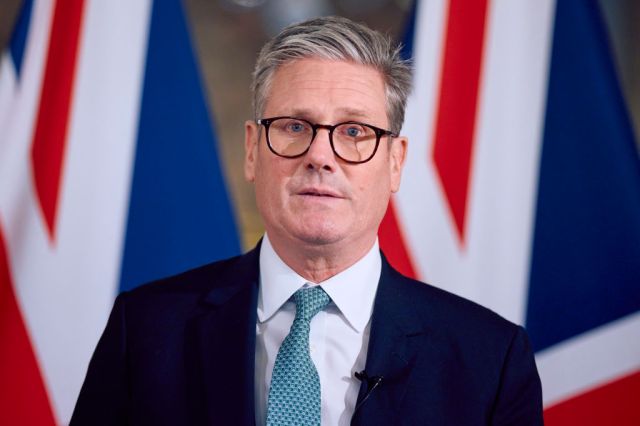
What does he know? (Benjamin Cremel/Pool/Getty)





“Keir’s not driving the train”, a giddy No. 10 staffer told journalists back in 2024. “He thinks he’s driving the train, but we’ve sat him at the front of the DLR.”
Downing Street this week has essentially confirmed this assessment. The recurring nightmare of the Mandelson-Epstein scandal cannot be banished with a backroom reshuffle alone. In an effort to rescue Starmer’s zombie premiership, the current line is, in essence: the Prime Minister did nothing. He knew nothing. He was not told, he did not ask, and he could not have reasonably been expected to do so. Nobody told him and so the man deemed responsible, Sir Olly Robbins, has been fired.
So we’re back to an unedifying ministerial dance of defending the least bad of two options. The first is that a party grandee and New Labour factional ally was appointed “our man in Washington”, despite his known close links with a convicted pedophile financier, and with the Prime Minister ignoring his inability to pass the vetting process. The second option — and this is the official position of the Government — is that a party grandee and New Labour factional ally was appointed US ambassador despite his known close links with a convicted pedophile financier, but with the Prime Minister unaware that he had failed his deep security vetting. While the first implies that Starmer has misled Parliament and the public repeatedly, the second merely signals utter incompetence.
For a Prime Minister who lacks the ability to define his own politics and communicate a moral purpose for his government, either account is terminal. In contrast with the ideological crusading of Brexit, Corbynism, and Liz Truss’s doomed Reaganite experiment, the Prime Minister promised to tone down the big ideas, dial down the politics and lock in. He based his appeal on personal probity and his supposed abilities as an administrator. To that end, he said, “there’s no such thing as Starmerism, and there never will be”.
But this “post-ideological” offer is ironically rooted in a premise that is, in fact, deeply ideological: if we strip back the partisanship, steering the ship of state is a technical problem to be solved by getting to grips with the details. Certainly, it explains Starmer’s embrace of our system of rule-by-committee. The relevant stakeholders shall be consulted.
But politics is not the equivalent of watchmaking, tinkering with the nuts and bolts of a complex machine until it ticks soundly. Rather, it is a never-ending process of managing and choosing between conflicting interests. There are (or were) people around Starmer who clearly understand this. Morgan McSweeney, for one, was fully plugged into the weird Matrix of Labour factionalism, with all its competing visions of Britain and the world. Here’s another irony, as Starmer’s aides pushed hard for Mandelson as an appointee. Whatever the Prime Minister’s own commitments to post-ideological technocracy, the people around him knew Mandelson represented a kind of politics that they themselves were invested in — the world of Cool Britannia, liberal globalization, and the transatlantic alliance.
Those two currents — the stakeholder state and the hard-nosed politicking — have long been in tension. On the one hand, after all, New Labour created for itself a kind of diffuse parallel state of arms-length bodies, expert appointees and independent regulators, neutral in theory but which nonetheless reshaped the constitution. The “old Labour” view of meddling, top-down governance would give way to a new understanding of power. “New public management theory” introduced marketization and competition into the public sector. New committees and modern bureaucracies proliferated to oversee the shift. But while ministerial authority was dispersed across this new quangocracy, Blair himself attempted to circumvent the unwieldy machine with his adoption of “sofa government”. He ceded power with one hand, and tried to grab it back with the other.
Starmer has fallen into the same trap. His instinctive legalism holds international law and an activist judiciary as superior to every state on Earth; the law must protect the individual from the unseemly power of the demos. It’s notable, here, that the Prime Minister’s whole professional life — he entered No. 10 at 61 — was spent defending the victims of government overreach. The professional-managerial classes that he represents so vividly are the very administrators of the contemporary, post-Blairite public sector, the very civil servants that may have waved Mandelson through and ruined Starmer for good.
One of Starmer’s supposed selling points was his experience running public prosecutions at the head of a major public body. This was the serious Roundhead to Boris Johnson’s clownish Cavalier. And yet his grip on power is as elusive as everyone since Blair. The Prime Minister is unable to live up to his promise of delivering easy efficiency through the Whitehall networks. “Mission Units” have been set up, then scrapped. Every new season seems to come with a relaunch focused on a “delivery phase” that never quite arrives.
Here, again, is another irony. For it was the PM himself who last year told the Liaison Committee of his frustration that “every time I go to pull a lever”, the machinery of government is so clogged and sclerotic that “the action from pulling the lever to delivery is longer than I think it ought to be”. This is an interpretation of the British state’s cumbersome, bloated nature that’s equivalent to the common spectacle of Conservatives bemoaning the dire state of public services — as if they themselves weren’t responsible.
Even so, even after almost three decades of the quangocracy, these latest revelations have the power to amaze. Defenders of Robbins have emerged to say that it is routine for ministers not to be told of the outcome of deep vetting. Permanent secretaries — the most senior civil servants — can, apparently, overrule vetting advice without the knowledge of secretaries of state or MPs. This suggests a level of dysfunction in the relationship between elected politicians and the deep state that’ll shock most Britons, giving life to Dominic Cummings’s oft-repeated claim: the Government does not run the country.
Next week, meanwhile, Robbins may address the Foreign Affairs Committee investigating the scandal. In other words, this chapter is by no means closed. Bad news, of course, for Starmer — but also his successor. For prime ministers will continue to be hoisted by their own administrative petards until they tackle a central issue of our time: the diffusion of state capacity across the bureaucracy. The spectacle of political leaders claiming impotence in the face of the state apparatus is deadly to democracy, and reversing the trend requires a reassertion of real executive and ministerial authority, to say nothing of a fundamental change in the mindset of a political class that would likely interpret such a development as an authoritarian power grab. On the contrary, it would constitute a return of the political to domains that have for too long remained in a technocratic abyss.
That’s for the future. For now, Labour MPs watch on in grim resignation. Yet there is no alternative: a Blairite health secretary with an ultra-thin majority representing clean-shaven Davos Labour, tainted both by Mandelson and by the fact that he’s disliked by the membership; a more plausible King of the North, but stuck sulking outside of Parliament; a less plausible Angela Rayner, who struggles to convince colleagues that she wouldn’t represent a serious liability in the highest of offices.
And so the Starmer era totters on. Perhaps until May, when a local election disaster awaits his hollowed-out party, or until the clamor from senior ministers reaches a crescendo, as MPs recall their fragile majorities. Until then, Starmer lurches from scandal to scandal, less the hapless child at the front of the DLR and more the passenger on a ghost train, careering wildly across the broken railroads of the British state.
Jonny Ball is a Contributing Editor at UnHerd. He formerly wrote under the name Despotic Inroad.
 DespoticInroad