




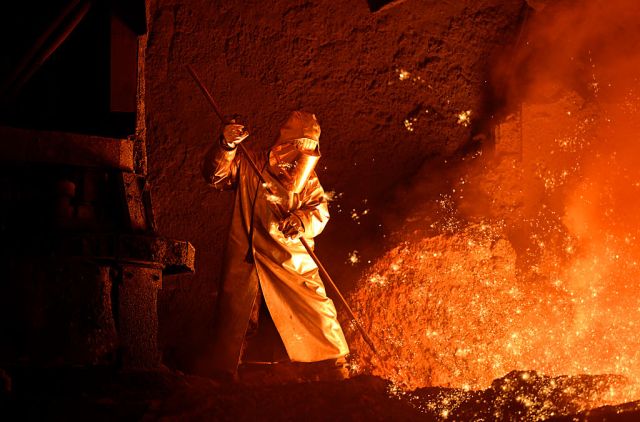
Steelworkers have become a rarity in the British economy. (Ina Fassbender/AFP via Getty Images)





At a sprawling Texan-owned oil refinery overlooking Milford Haven, an estuary town in Pembrokeshire, crude oil from America and Norway is distilled inside 200-foot steel towers. The oil is heated to 400℃. Hydrocarbons with low boiling points, like gasoline and kerosene, rise to the top of the column, while heavier chemicals like asphalt remain at the bottom. Out of the towers come the fuels that power cars, trucks, shipping, aircraft, and much of the chemical industry, not to mention almost all military vehicles. Britain was formerly home to over a dozen refineries. Yet the Milford Haven site is now one of just four refineries left in Britain, with two closing in 2025 alone, one in Scotland and another in Lincolnshire. Similar scars are borne by many towns and cities across the country. Just recently, we’ve lost production of salt in Runcorn, synthetic textiles in Brockworth, steel in Rotherham, bearings in Newark-on-Trent and ceramics in Denby. British Steel in Scunthorpe limps on, if only with government support.
It has been a steep decline. At the turn of the millennium, Britain possessed the fourth-largest industrial economy in the world. More than 800,000 people worked in foundational sectors: oil and gas extraction, refining, metals, chemicals, and inorganics. Contrary to popular belief, Britain’s energy-intensive production did not peak in the Seventies — but in 2002, supported by relatively cheap energy and booming global demand.
Then, between 2006 and 2008, Britain’s output and productivity began to fall. Globally, heavy industry shifted decisively toward China, hollowing out Western industrial employment. Britain, like its peers, lost jobs — but suffered more acutely. Heavy industry employment has halved from over 800,000 workers in the early 2000s to just over 400,000 today. Since 2008, Britain’s steel sector has nearly collapsed multiple times; the ammonia industry has died out; salt production has ended and aluminum production has rapidly declined. Production of cement and glass is down, while imports of the same materials are up. Those jobs were lost during a time of perceived economic and political stability, where countries would specialise and become ever more integrated. But due to tariffs, wars, pandemics and a general sense of insecurity, talk of reindustrialisation, once dismissed as pangs of nostalgia, is becoming de rigueur in Westminster. Robert Jenrick, who stands a good chance of being the next chancellor, has argued for “creating the conditions for Britain to reindustrialise, restore our proud industrial heritage and create good jobs for British workers once again.”
For different parties, “reindustrialisation” means different things. Ed Miliband envisages a “green industrial revolution” where Britain’s reindustrialisation is directly tied to his ambitious carbon reduction targets. For Nigel Farage, the term means cutting red tape and reopening the mines.
If reindustrialisation has cross-party appeal, it is because it intuitively makes sense that being able to manufacture complex equipment makes a nation stronger, more productive and more prosperous. This intuition has been tempered by economists who argue for economic specialisation and enjoying the reduced cost of goods by offshoring manufacturing to cheaper locations. But recent global events — Covid’s effect on supply chains; the Ukraine war’s effect on energy prices; the Iran war’s effect on shipping — have made this view increasingly hard to defend. Deindustrialised Britain grows its economy anaemically, if at all. The same is true of its productivity. As a result, the country’s hard power has rapidly diminished.
Hence the cheerleading for reindustrialisation. This high-spirited rhetoric rarely acknowledges tradeoffs, but it ought to. This is because deindustrialisation was a price willingly paid for cheaper consumer goods from imports, increased welfare spending, periodic tax cuts, and progress towards meeting Britain’s environmental and emissions targets — or, at least, those targets that pertained to onshore activity rather than activity handed off to the developing world. Reindustrialisation, then, might require some of those dividends to be relinquished. Partly for that reason, none of the cheerleaders have yet made firm commitments for how much of our economy should be manufacturing, or what level of growth they would aim for. Currently, the concept of “reindustrialisation” is comparable in rigour to “soft power” and “clean energy superpower”.
Granted, the country has industrialised before. But the Britain of Pitt and Lord Liverpool, with its high wages, captive markets and cheap energy, was primed for such a transformation. Modern Britain, with its expensive energy, low levels of investment, and asymmetric openness to foreign goods, is certainly not. Reversing decades of insufficient investment and making Britain a major manufacturing power is going to be a mammoth task.
Some argue that it is a task not worth pursuing. The staple criticism has come from free-marketers like Daniel Hannan, who argues there is “nothing special about manufacturing”, and that globalisation is good for the consumer and the economy. Prior to becoming an MP, Labour thinktanker Torsten Bell argued that Britain should stay focused on being a world-leader in services. But the productivity statistics are on the side of the reindustrialists. Beyond the most rudimentary wood and textile craftsmanship, manufacturing is more productive per worker than average. Britain’s energy-intensive and resource-extractive industries employed 1% of the workforce, but accounted for nearly 3% of gross value added (GVA), an important metric of economic value. The average heavy industry employee contributes 77% more in GVA than the average worker.As for the advanced manufacturing sector — defined in the Government’s 2025 industrial policy as chemicals, transport, aerospace, machinery, and electrical equipment — it accounts for just 2% of jobs (721,000) but 6% of GVA (£80 billion). For context, London’s creative sector, the most culturally prestigious sector in the country, encompassing computer programming, video game development, film and TV production, generates just £64 billion with 730,000 workers.
If we accept that some level of reindustrialisation is desirable for economic and extra-economic reasons, how do we achieve it? First, we must understand why British manufacturing is in the doldrums. For many, the blame lies with Thatcher’s reforms. For others, it is the mismanaged mergers of the Sixties and Seventies.
I would argue that the real evidence of industrial decline, the kind that is most relevant today, occurred much later. Britain’s industrial malaise is not simply the delayed aftermath of the Eighties, nor an inevitable by-product of a modern service economy. It stems from three big problems arising over the last 30 years: high energy prices, underinvestment in capital equipment, and the uneven nature of global trade, where some countries are far more open to imports than others.
While the Thatcherite consensus had allowed for industrial growth, it was growth that was incredibly uneven. Pharmaceuticals, automobiles and aerospace prospered, but increasingly under the ownership of foreign investors. Heavy industry, like chemicals, metals and the machining of components, was offshored as a result of generating lower marginal returns. This partial atrophication made manufacturing in general much more dependent on imports. It also made it harder to scale up new industries. As a result, there have been almost no new British industrial giants formed in the 21st century. Successful new corporations like Ineos and Astrazeneca were formed from the scraps of previous giants like Imperial Chemical Industries.
The strength of the pound, and lenders’ demands for ever-higher margins in shorter timeframes, certainly did not help. Studies have shown that the UK during this period saw a uniquely significant contraction in jobs and a uniquely low investment in automation. We were coasting on the momentum of the 20th century.
That momentum is rapidly dissipating. Glass factories, refineries, and ethylene plants are closing. North Sea oil and gas production began declining in 2004, and the need for substantial investments in the electricity grid, which had been deferred for decades, drove up energy costs rapidly from 2005 onwards. These increases were compounded by the expansion of levies to support intermittent renewables.
Arguably as important as energy prices is the decline of the capital stock in manufacturing. This is a term that refers, essentially, to the total value of all the machinery, equipment and infrastructure accumulated to power Britain’s industrial base. The country is well below its peers in the purchase of industrial machinery. Some commentators have blamed the relative lack of industrial investment on the financial sector and private equity, both of which, it is argued, are overly focused on short-term returns. The decline of capital stock can also be seen as a supply-side problem: in other words, it is too hard to build and do business in Britain. For that reason, companies are unwilling to make large, capital-intensive bets on future manufacturing orders.
On that front — the supply side — policymakers could at least have worked toward making energy cheaper and capital expenditure more appealing. But a third great force has been hurting British manufacturing: the overcapacity of global manufacturing, exacerbated by uneven trade practices which benefit producers in some countries over others. Overall, global growth in manufacturing has slowed in the 21st century. But, some countries, most notably China but also Thailand, Vietnam and Taiwan, have, in mercantilist fashion, prioritised market share over profit margins. This has led to massive overcapacity, which has deflated global prices for consumers but also pushed out Western producers.
British firms have weathered this harsh environment stoically, increasing worker productivity and keeping overall value roughly stable in the aftermath of the 2008 financial crisis. But the consequence of this efficiency has been a degradation of overall capacity and the ability to compete in new markets. Being a major manufacturer of electric vehicles is a non-sequitur: Britain has little capacity to refine the chemicals that make lithium-ion batteries. Given that our government has decided to ban petrol vehicles in the near future, this means we could conceivably lose most of our car industry within a decade.
With other Western countries increasingly adopting a dirigiste stance toward protecting their own industries, British companies are being lured elsewhere. The German government, in a new spirit of fiscal profligacy, has actively courted major manufacturers, attempting to lure British Rolls-Royce with the implicit promise of subsidies. The company has urged the UK to subsidise its engine production, arguing it will otherwise be forced to move abroad.
Whether the Government will give in to Rolls remains to be seen. No. 10 is already grappling with steel production, which has become the most visible industrial challenge. In 2024, Britain produced four million tonnes of steel, down 33% from 2023. This was less than Austria, Belgium, the Netherlands, Australia, and Saudi Arabia — and only twice the output of Luxembourg. This might be seen as the fag-end of a long decline, but up until relatively recently, steel production was viable. It is worth noting that in Wales, which has been particularly hit in recent years, steel production peaked as late as 1997.
The Government’s recently published steel strategy will protect the industry through subsidies and tariffs. It sets a target to use domestic steel for 50% of consumption, up from 30% today. It also tightens the quota for excess imports and increases tariffs on those imports. Through the National Wealth Fund, the Government will provide £2.5 billion in funding to upgrade steel plants. The Government has also confirmed it will be a major buyer of steel for public procurement needs. This is a fairly meaty support package, and necessary to keep a steel industry here, but it leaves out the penalty of expensive energy. For as long as Britain’s industrial energy is among the most expensive in the world, the steel sector — which is highly energy-intensive — will suffer.
British industrial decline, then, is most visible in energy-intensive industry, but the decay is just as pronounced in the secondary stage of production: fabrication. Once manufacturing material has been produced in its primary form, it must be fabricated into products. This includes casting, forging and machining of components through the use of machine tools. Here, the importance of energy costs begins to give way to a lack of capital.
As an example of the fabrication stage, some components have to be forged using enormous hydraulic presses. A handful of facilities worldwide can produce 500-tonne steel ingots, required for nuclear reactor pressure vessels. Britain — through the Ministry of Defence’s ownership of Sheffield Forgemasters — remains one of only five such locations on Earth where such ingots can be forged.
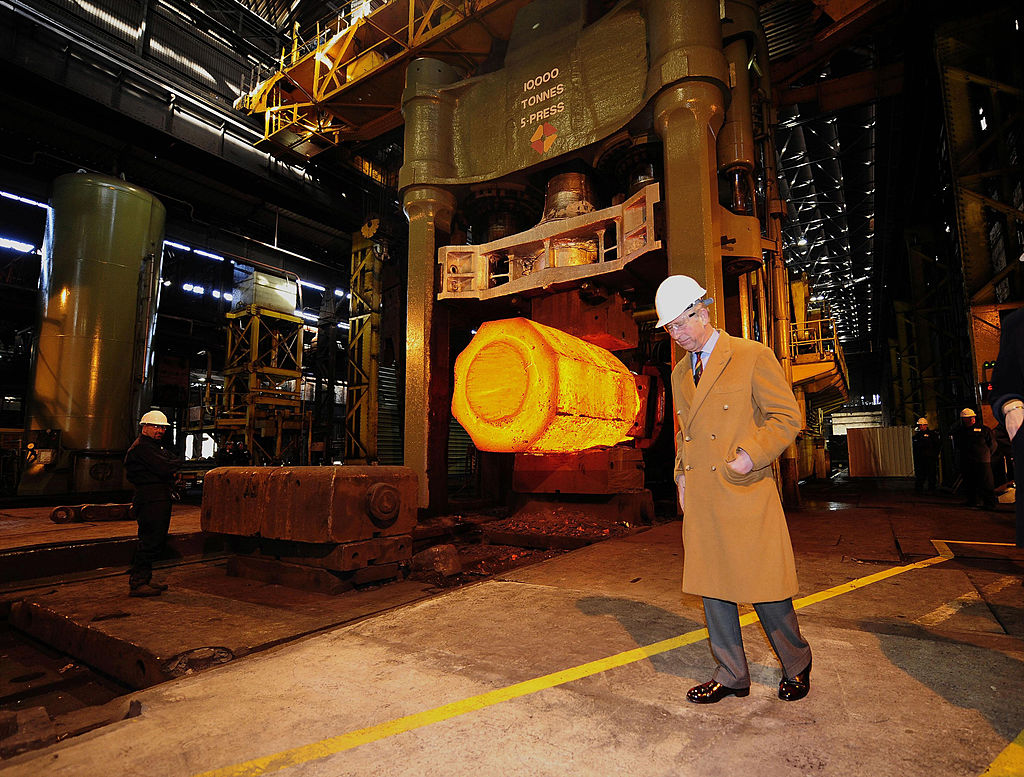
While Forgemasters is a large operation, the majority of machining in Britain is done by thousands of small machine shops, which rely on repeat orders from longstanding clients. When Jaguar Land Rover (JLR) suffered a cyberattack, the existential threat was felt not only by JLR but also by suppliers such as Genex UK, which derives up to 70% of its business from JLR contracts.
This hidden economy is built around thousands of machine tools: a catch-all term for machines that cut and form components that are then assembled into products. Britain was once a major producer of such equipment. Today, most tools are imported from Germany, Japan, Korea, and increasingly, China. Despite having a similar industrial base, Britain consumes less than half as many machine tools as France.
The problem is stagnant demand and poor access to capital. Consolidation sounds appealing, but it is structurally complex. Most machine shops fabricate a low volume of highly variable components on thin margins. Yet their economic impact is disproportionate to their size. While a component may represent a tiny fraction of a nuclear plant’s cost, the ability to procure it quickly and locally could dramatically reduce project timelines and capital costs. There is circumstantial evidence from Korea and China that nuclear plant costs dramatically fall in line with higher domestic content.
These machine shops are the ligaments of Britain’s industrial body: small, numerous, and under severe strain. Start-ups like Ealing-based Isembard, which franchises software across machine shops, offer a glimpse of renewal.
To what extent could that renewal be made national? There are no obvious examples of major countries that industrialised rapidly, deindustrialised and subsequently reindustrialised. Rather than envisioning a second British Empire, an incoming government could credibly commit to make manufacturing 10% of GVA by the end of its first term, and 12-14% thereafter. This would represent a 25-50% expansion from today’s 8% figure, restoring Britain to its early-2000s position — not some imagined golden age. This would mean a larger industrial base, higher productivity, and greater capacity to complete significant infrastructure projects and defence orders quickly.
The price of this improved capacity: more costs for consumers for intermediate and finished manufactured goods, since industry is currently costlier here than abroad. Additionally, Britain will shed some jobs in the “creative” and “business services”, as an increase in domestic production will increase demand for labour, even with automation. While painful and politically difficult, these developments will be manageable and even desirable. While some increased consumer prices will make us poorer in the short term, this would be meaningfully offset by higher productivity jobs, higher wages, more exports and greater R&D spending.
How can the Government get us there? Supply-side reform remains essential. Lower energy prices, reduced carbon levies, and R&D tax credits can help, but would require the end of the Net Zero project as it is currently constituted. The discretionary carbon taxes that inflate the cost of gas, and therefore electricity, should be scaled back. Allowing for more exploration and drilling in the North Sea would have a limited impact on prices, but would improve our balance of trade and keep high-paying jobs in Scotland. More ambitious plans to frack in Northern England could have a much more significant impact on prices. In the short term, nuclear power development would be costly, but in the long term would provide firm power at acceptable prices.
But cheap energy alone is not sufficient. Despite lower electricity prices, France has only marginally outperformed Britain since 2008. The primary benefit will be that key heavy-industry sites will not require government bailouts. Nearly three times more R&D tax relief is claimed by “office administrative and business support activities” than by machinery and equipment manufacturing. Much of this is thinly disguised tax arbitrage. Britain’s industrial R&D intensity is about half the global average, while its financial sector is nineteen times more research-intensive than said average.
An eminently achievable policy would be to provide grants for industrial machinery. This should be a key focus: the country’s manufacturing sector has a lower capital stock of equipment now than in 1995. Rather than spend billions chasing speculative technologies or subsidy wars with the EU, US, and China, Britain would gain more by directly financing capital equipment purchases — modernising workshops across the country. A £1 billion annual grant (under 2% of the £60 billion spent annually on industrial policy) for machine tools would double British purchasing capacity overnight. Those free-marketeers suspicious of a return to Sixties-style grants could be buttered up through cuts to energy levies, dubious R&D tax credits, and unmeritorious university funding.
But even with a government committed to reindustrialisation, trade imbalances make the task uphill. The rise of Chinese industrial power, now accounting for more than 30% of global manufacturing value, has depressed production in the West. While Trump’s US has been the most avowedly protectionist, the truth is Europe and India have joined the East Asians in using tariffs and subsidies to hold on to industry.
As the most open, least competitive industrial base in the developed world, British producers are the least well-placed to thrive in an environment where trade is fractured yet globalised. There are no solutions; only trade-offs. In my view, plenty should be sacrificed to make industry competitive again. The current government has accepted protectionism for steel. Though far from ideal, it is the least worst decision and bides us time to make Britain more competitive through reduced energy costs.
While a manufacturing boom would not be a panacea to all Britain’s maladies, it would improve our ability to meet those challenges. It would mean greater prosperity outside of London, a wider tax base and greater security. With greater wealth in the regions, it could allow for the reduction of welfare spending. The establishment of large, modern British manufacturers would give the nation a chance to compete across high-value sectors like drones and rocketry. This, in turn, would allow us to field a stronger armed forces without periodically raising our defence spending.
It is unlikely that the credit for such dividends would be monopolised by one statesman or government. In fact, those determined to make reindustrialisation happen will face significant opposition. A strong industrial base is rarely attributed to a singular individual, but to general good governance.
Reindustrialisation is anything but an easy win. Yet if politicians and civil servants continue to act like there are no hard choices, expect the stagnation of the 21st century to turn into absolute decline.