




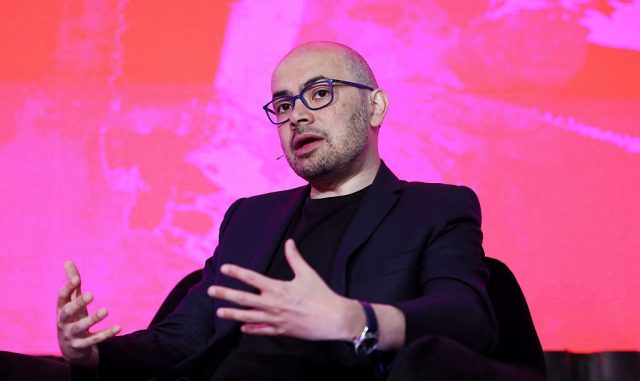
The new Cromwell. (Jack Taylor/Getty/SXSW London)





DeepMind wasn’t taken particularly seriously when it was founded, back in 2010. Its grand ambition, to build artificial general intelligence (AGI), was considered outlandish at the time. But over the years, with a succession of breakthroughs and acquisition by Google, the company has chipped away at skepticism to build a formidable reputation — though many still may not have heard of it.
Its founder, Demis Hassabis, occupies a similarly odd place in the firmament of tech luminaries. He has a Nobel Prize and a knighthood, and commands enormous respect within his community, but he’s not really famous. He hasn’t crossed into the realm of celebrity in the manner of Jeff Bezos or Bill Gates. His rival in the AI race, the OpenAI chief executive Sam Altman, has a far bigger public profile. Even Anthropic founder, Dario Amodei, is becoming more widely known, if only because of February’s dust-up between his company and the Trump administration’s Department of War.
Interviews with Hassabis often lead one to believe that this low profile is deliberate. His dedication, he claims, is to the work of expanding human knowledge, and deeper dives into his biography balance signs of his genius with markers of his normality; he may have been a childhood chess prodigy, but he loves a game of table football with the guys.
Though a new biography of Hassabis, The Infinity Machine: Demis Hassabis, DeepMind and the Quest for Superintelligence, succeeds in poking some holes in this narrative, its author, Sebastian Mallaby, essentially comes to the conclusion that the humility is genuine. For one thing, when quizzed about extravagances, Hassabis yields only that he has a Liverpool season ticket. While this sets him apart from his Silicon Valley peers, with their private planes and multiple homes, really, Hassabis is doing the same thing as all of them: fashioning a persona.
Hassabis seems aware that history has its eyes on him. Mallaby, for his part, observes that his subject revels in “maximalist ambition”, talking casually of a post-scarcity society and of mining asteroids. Because of the nature of their world-changing technology, the people involved in AI’s creation seem to experience events on two planes: how they are happening in the moment, and how consequential they might be in the history of the world. Both Hassabis and Mallaby remain hyper-conscious of this throughout the book. There are countless references to the Manhattan Project, Los Alamos, and J. Robert Oppenheimer. Hassabis is drawn to the ambition of the physicist’s endeavor, alluding to it as he starts to bring top researchers together to form DeepMind. Mallaby sees it as a parable about the innovator’s impulse to solve a technical problem no matter the consequences.
Hassabis does come across as someone who has become accustomed to telling a certain set of stories about himself. One formative episode is given particular significance. At 11 years old, exhausted and stressed from the competitive chess circuit, Hassabis concedes a game to an adult opponent at a tournament. His rival then relishes pointing out how he could have won. This moment of defeat, in Hassabis’ telling, triggers a realization that his fellow chess champs are using their cognitive power to win a game rather than solve hard scientific problems. This supposedly sows the seeds for the career that Hassabis would one day embark on.
It’s a significant recurring anecdote because he uses it to accentuate his humility — or even his humanity. He was just a little boy. And yet he traveled the world going up against adults. An exceptional little boy, then. It is also a reminder that his ultimate inspiration is the human brain, its sanctity paramount to both Hassabis’s research and his self-image. Elsewhere, after all, he posits that the development of superhuman AI will reveal the secrets of nature and so bring man closer to God. “For me,” he tells Mallaby, “science is a spiritual endeavor”.
There are striking echoes of history here. Until the dawn of modernity and secularism, political figures had to insist on their ultimate servitude to God even as they sought hard power in the temporal world. Thomas Cromwell, in his famous portrait by Holbein, appears in the sober garb of a serious power-player — one who has just orchestrated the submission of England’s clergy to King Henry VIII, fundamentally changing the shape of religion in England forever. Yet a Book of Hours sits on the table in front of him, signaling his continued devotion.
If we are to believe predictions, AI will have a far greater effect on our society than did the Dissolution of the Monasteries. Such a change cannot be forced through without backlash. To mediate it, today’s AI bosses must project respect for the human, even as they build something that could surpass us. As Cromwell doffed his cap to faith, even while ushering in shattering changes to religion, his Silicon Valley successors must position their work as serving humanity while upending daily life. Hassabis has repeatedly demonstrated this respect, idolizing the human brain through his neuroscience research and talking of a quasi-religious calling to unlock the secrets of life.
To figure out what’s really driving his protagonist, Mallaby is particularly concerned with what Hassabis and his ilk are reading. His ignorance of the books of the AI prophet Ray Kurzweil sets Hassabis apart from other attendees at the Peter Thiel-backed Singularity Summit, a hive of the early AI scene. Of far greater literary interest to Hassabis is the eponymous protagonist in Ender’s Game. The story of a gifted child tasked with saving humanity resonated so deeply with Hassabis that he asked Mallaby to read it in advance of their first interview. Elsewhere, great scientists are his chosen models. “Isaac Newton, Alan Turing, all my heroes,” Hassabis says of walking down a street in Cambridge. “I could feel them in the bones of the stone, their intellect and vision. They were almost calling out to me.” He is often getting goosebumps like this, taking pictures of the Nobel Foundation’s guestbook signed by Einstein and Feynman. It is charming, suggestive of the eager, nerdy young boy under the surface. But it is also another way of self-fashioning, absorbing those figures into his own story. Here they stood and now I am here too.
Hassabis also defines himself against others, especially OpenAI’s Sam Altman: “I’m doing it for knowledge and science. He seems like he’s doing it for power.” He seems a little baffled by Altman, who comes from a new mold. Instead of Hassabis’s deference to the God-like power of nature, Altman starts to build a cult-like following for himself.
This all makes me wonder how much of the access granted for the book, and the production of the DeepMind documentary, The Thinking Game, and the appearances at world conferences and in interviews, is actually about Hassabis craving recognition. Altman, remember, not only kicked off an AI race by releasing ChatGPT, but in doing so made himself the defining figure of AI.
Admittedly, some of Hassabis’s efforts to build his public profile predate the release of ChatGPT. But the invisible hero narrative feeds back into those twin competing pillars of exceptionalism and humility on which Hassabis perches his identity. Mallaby allows his subject to speak at length in the final pages, where Hassabis sets out his own vision of his place in the world. “I’m a weird British outlier, on this little island here, and I’ve made my own path. I’ve followed my passions and tried to stay true to what I believe in.” His refusal to leave London, for which he gets a lot of credit in British policy circles, becomes part of a narrative of being not like the other tech bros.
It should hardly be surprising that someone who spends much of his time thinking about consciousness, both human and artificial, might be particularly preoccupied with his own identity — and how that should be projected. “In my world, humanism and spiritualism and science all go together,” he says. And, like Cromwell, it is to a Renaissance figure that he looks for a model. “Da Vinci is my favorite because everything’s just flowing into one river. And that’s how I try to live.” The meaning is obscure, but Hassabis seems less enthusiastic to incorporate that element of his personality which thrives on competition and the exercising of power —though he is willing to accept them when Mallaby points them out. “I have to do what’s necessary.”
Hassabis, in short, appears to be banking on a longer-term legacy, one that emerges long after the machinations of the court are concluded. But if he or any of his rivals actually succeeds in creating AGI, this careful self-fashioning may become less relevant. If you change the world, it won’t be the books or paintings that dictate your reputation, but the consequences.