




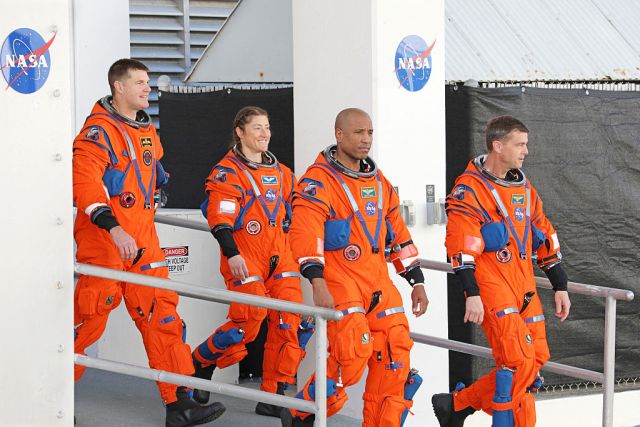
The astronauts are there to satisfy Nasa's belief that the public wants heroes. (Gregg Newton / AFP via Getty Images)





Americans, it seems, are returning to the Moon. The Artemis II mission, barring any delays, is due to be launched today. It will take four astronauts on a flyby, in preparation for eventually establishing a permanent station. That lunar base might then be used as a starting point for a trip to Mars. For someone like me, who has followed the space program closely for over 60 years, it all seems like déjà vu, vu. The same honeyed words are being used to justify the Artemis mission; the same cynical ambitions lurk beneath the surface.
On 25 May, 1961, President John F. Kennedy told Congress that “this nation should commit itself to achieving the goal, before this decade is out, of landing a man on the Moon and returning him safely to the Earth.” The speech was prompted by Yuri Gagarin’s momentous feat, the previous month, in becoming the first human in space, thus casting doubt on American technological supremacy. Five days later came the Bay of Pigs fiasco, when a CIA-backed invasion of Cuba catastrophically failed. In response to this double blow, Kennedy promised the Moon.
His speech was stirring but in retrospect rather hollow. Kennedy struggled to explain why a lunar mission was so important. In private, he confessed that “I’m not that interested in space.” On another occasion, he said: “Don’t you think I would rather spend these billions on programs here at home, such as health and education and welfare?” But, he lamented, the country has no choice: American prestige “is too heavily involved.”
That same vagueness is evident today. As NASA now puts it: “We’re going back to the Moon for scientific discovery, economic benefits, and inspiration for a new generation of explorers.” Similar promises were made back in the Sixties; giant leaps would be made for mankind. The rhetoric disguised the fact that the lunar mission was simply a Cold War pissing contest.
After Gene Cernan left the lunar surface on 14 December, 1972, America abandoned the Moon. NASA wanted to launch a Mars program, but Richard Nixon vetoed the idea. The race with the Soviets had been won, American prestige restored, and so further missions seemed pointless. There was nothing left to gain, no riches to harvest.
Though Nasa loves to compare itself to the 16th-century explorers, in truth the comparison is facile. Space travel isn’t remotely like what Magellan once achieved. Those explorers brought back treasure: gold, silver, tobacco, potatoes. The barren nature of the Moon is the best explanation for why humans have not returned. There are no potatoes there.
Artemis, just like Apollo, is being justified in terms of man’s innate need to explore. The eventual plan is to land near the lunar South Pole, where there might be frozen water. Nearby is the Aitken Basin, the largest impact crater in the solar system, which penetrates deep into the Moon’s crust, thus providing a graphic representation of its formation. Meanwhile, back on Earth, Americans are exploring how to live without affordable healthcare.
During one of the many debates on Nasa budget in the Seventies, Congressman Edward Koch, the future mayor of New York, confessed: “I just can’t for the life of me justify voting for monies to find out whether or not there is some microbe on Mars, when in fact I know that there are rats in Harlem apartments.” Senator Walter Mondale made a similar point, arguing that “it would be unconscionable to embark on a project of such staggering cost when many of our citizens are malnourished.”
Every president since Nixon agreed, arguing that there were too many pressing problems on Earth to justify massive expenditure in space. But then along came Donald Trump. He’s hopelessly attracted to shiny objects, and there are few things shinier than manned space travel. He probably expects that the great patriotic pride once generated by the 1969 Moon landing can be replicated. That seems unlikely, given the current fractious state of America. At the very least, he perhaps thinks that Artemis might provide a distraction from his myriad problems.
Throughout most of its life, Nasa has been seen as a highly respected public agency, an image carefully cultivated but never fully deserved. A huge proportion of its budget has gone toward public relations. The agency’s reputation has depended heavily upon artifice. Projects like the Moon landing itself were shaped not by scientific curiosity but rather by a cynical aim to impress those who controlled the purse strings. NASA, really, is a giant machine for spending money. Huge risks were taken, as the Apollo 1 fire and the Shuttle disasters demonstrated, in order to please a public addicted to adventure. Impatience and ambition led directly to the three horrific disasters which killed 17 astronauts.
There’s great similarity between Apollo and Artemis, but also important differences. Kennedy intentionally created a mood of consensus behind the lunar project. Lucrative contracts were distributed among the 50 states, encouraging the feeling that everyone was involved in this great lunar venture. That’s not the case today, since Trump has a habit of rewarding his cronies and cares nothing for consensus. Kennedy also enjoyed a healthy economy, with money to spend on big public works projects. The national debt in 1961 was just $289 billion; it’s over $37 trillion today. One also suspects that, with Congress emasculated, Artemis won’t be subjected to the rigid oversight that once applied to Apollo. That’s frightening, given Nasa’s habit of cutting corners on safety.
This entire enterprise reeks of Musk. The latest Artemis mission will involve a Nasa rocket, but, as the program proceeds, the involvement of Elon Musk’s SpaceX Starship will steadily increase. The details of Musk’s deal with Trump are shrouded in mystery, but it’s safe to suspect that some quid pro quo is involved. Trump’s enthusiasm might have something to do with the $250 million that Musk donated to his 2024 presidential campaign. While we’re encouraged to believe that today’s adventures in space are privately funded, in truth SpaceX has so far received $17 billion in government funding, with future payouts expected to exceed $56 billion.
Musk wants to settle a million people on Mars by 2050, with the first colonists arriving by 2030. He has outlined plans to “terraform” the planet, turning it into an Earth-like environment by exploding nuclear bombs in the polar regions to release the carbon dioxide held there. A weather system, breathable air, oceans, lakes, flora and fauna are all promised.
The big question, though, is: “What’s the point?” Why build a colony on Mars if Earth’s environmental problems could be fixed for a fraction of the cost? Musk counters that humans need to become interplanetary in order to survive as a species. “There’s always some chance that something could go wrong on Earth,” he said. “Dinosaurs are not around anymore!’ When Musk talks about space he sounds like a 13-year-old addicted to video games.
The space industry has two faces. The great achievements that have transformed our lives have occurred in near space thanks to boring, unmanned satellites. Advances in communications, weather forecasting, intelligence gathering, have all brought enormous benefit. But there’s still this obsession with astronauts, this insistence that space must have a face. Nasa still believes that attracting funding depends heavily on producing heroes.
“A rat done bit my sister Nell”, the African-American poet Gil Scott-Heron wrote in 1970. “But Whitey’s on the moon.” Apollo was never as popular as Nasa pretended. Opinion polls showed great support for the individual missions, but, when the public was asked about increasing the NASA budget, support was consistently below 50%. White males loved Apollo, but women, people of color and the poor questioned its obscene cost. I doubt that a president who taxes the poor to pay the rich and cuts basic services will be able to inspire enthusiastic support for Artemis. Americans have grown tired of these absurd expressions of vanity, these futile pursuits of prestige.