




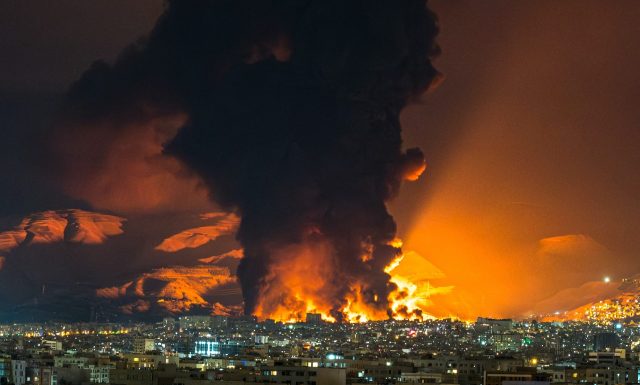
Explosions following airstrikes on an oil depot in Tehran (SASAN/ Getty)





So, Donald Trump just TACO’d again, did he? Mere days after insisting he would accept nothing less than “unconditional surrender” from Iran, on Monday he decided “we’ve already won” and that his war would end “very soon”. Oil prices, which had shot up to $120 a barrel earlier in the day, plunged below $90, stocks rallied, bond yields fell. Happy days were here again.
Yet when Asian markets opened later in the night, the search for oil and gas resumed and prices came back off their lows. With traffic through the Strait of Hormuz still at a virtual standstill — and the Islamic Republic warning “the end of the war is in Iran’s hands” — the President is learning that it’s easier to start wars than finish them. Trump may now have to confront an unpleasant dilemma: either stand down US forces and allow a murderous regime its victory parade, or save face and risk derailing the world economy.
Yet despite chatter to the contrary, such a downturn wouldn’t reprise the Seventies. Then, an oil-price spike triggered by a Middle East war caused inflation to skyrocket. Now, the impacts will be considerably more muted, for several reasons.
First off, the world economy is much less carbon-intensive than it was back then. On average, it takes half the energy to produce a dollar of output than it did when the Yom Kippur War began, with the productivity gains most pronounced in Western economies where the shift from manufacturing to services and more efficient technologies have greatly reduced dependence on imported energy. Second, the US has gone from being dependent on the Middle East for its energy to being a net exporter of oil and gas: making it less vulnerable to external shocks. Third, many countries are well into an energy transition towards renewable energy, and so are more able to withstand a surge in oil and gas prices.
All the same, while the world is more resilient to an energy shock than it was 50 years ago, in other ways it is actually more vulnerable to the impact of an oil shock right now. To begin with, the interruption of oil flow is bigger than it was then, with one prominent industry analyst arguing that the supply removed from the market has been twice the size of any previous shock. That’s unsurprising: this time, the entire Gulf supply has been cut, representing 30% of the world’s output.
This price shock hits the world economy at a delicate time. All three of the world’s biggest economies are already showing signs of weakness. China just downgraded its growth target, recognizing that its economy is slowing, and that boosting domestic consumption will be harder and more time-consuming than hoped. Europe, for its part, is still in a funk and is being hit hard by the price rises — especially when it’s so dependent on oil and gas imports.
As for America, there are already signs that its economy has also been softening. As last week’s employment report revealed, the job market is in bad shape – 90,000 jobs lost last month and revisions to previous reports that reveal the economy hasn’t created any new jobs since last spring. Meanwhile, the GDP report for the final quarter of 2025 came in much weaker than expected, and while most economists have anticipated a bounceback once new tax cuts kick in, higher oil prices would neutralize their effects.
While the oil shock will be less severe in the US than in Europe, meanwhile, it will nonetheless encourage inflation if oil prices stay on their current path. Even though futures markets indicate traders expect oil prices to start falling soon, they also expect them to finish the year some 25% higher than was expected just a few months ago. In other words, even in the optimistic scenario, higher prices may be here for a while.
Nor is oil the only inflationary challenge here. Because such a large share of the world’s fertilizer supply comes from the Gulf, prices here have shot up too. This will feed straight through to food prices — and because the northern hemisphere has already begun its spring planting season, these increases are already informing production costs. Farmers could adjust by using less fertilizer, particularly in developing countries, but given the tight correlation between fertilizer input and crop yield, this pretty much guarantees production shortfalls and so higher food prices later in the year.
For their part, aluminum prices have shot up too, with shipping costs rising by about a fifth. If the war lasts for more than a few weeks, supply chains may take months to re-establish, and backlogs will persist for a while, just as they did after the Covid lockdowns. Aluminum, for example, is widely used in construction and in the production of cars, consumer electronics and packaging. Its increased cost will ripple quickly through the economy.
All this is happening as inflationary pressures rise across the US economy. Last month’s Producer Price Index came in much hotter than expected, suggesting inflation was looming. That’s as a recent report from the Institute for Supply Management found that manufacturers are expecting substantial price increases this year. At worst, then, this oil shock will raise inflation; at best, inflation won’t come down, possibly for the rest of the year.
Either way, it will now be harder for the Federal Reserve to cut interest rates, which will provide a headwind to the stock market. Wall Street has traded sideways for four months, and is now down slightly since the start of the war. So far there’s been little sign of panic, and stocks are far from bearish. Even so, that may not offer much solace to investors. With the job market now so weak, and American consumers having run down their savings, the so-called “k-shaped” economy has been kept afloat by rich Americans spending their stock market gains.
Any interruption could therefore slow consumption in the top half of the economy, contributing to a wider slowdown. But it could also store up some even bigger problems. In particular, private equity firms were looking to a positive 2026 to finally unclog the pipeline of IPOs they need to generate the cash for shareholders. A weak stock market may affect their cash flow negatively, which could in turn force their owners, including big institutional investors like pension funds, to sell other shares to generate income. Already, we’re seeing strains in the credit part of the private equity industry, where Goldman Sachs is now pitching funds that will short corporate loans, pointing to what could be a difficult year.
All told, the US economy, like most of the world, can ill afford a protracted shock. And while global markets won’t follow the plotlines drawn in the Seventies, they’re still at risk of decelerating if Trump’s war doesn’t end soon.
For the moment, we must see where oil prices go. If they keep falling through the week, it may suggest that traders genuinely see an end to the war. But if they keep rising, or even stay where they are, the global economy faces a grim 2026.
To be sure, a global downturn wouldn’t necessarily mean a global recession; many economies would continue growing, albeit more slowly than before. But for developed economies, the risk of outright recessions would be high. And, given the debt burdens already accumulated by Western governments, their space for fiscal stimulus could be constrained, meaning any recession could prove quite stubborn.
In short, we must hope for peace — and soon. Unfortunately, those prosecuting this war don’t appear to have a clear idea of how to end it. Part of Trump’s challenge now is that even if he cuts and runs, the Gulf will remain volatile, which could prevent normal traffic. Israel, for its part, may continue its strikes even if the Americans step back. Without a definitive defeat for Iran, the Islamic Republic may opt to keep the Strait closed in order to secure better peace terms.
Worse for Trump personally, meanwhile, is that he’d lined up several investment commitments from regional governments, which were to benefit both the US economy and his own family. With Gulf governments understandably distracted, these plans may be put on hold. Already, governments which had pledged hundreds of billions of dollars of US investment and offered to fund Trump’s Gaza Board of Peace are reconsidering their plans. So even if Trump wants to believe he’s exempt from the old Pottery Barn Rule — if you break it, you own it — he may now be stuck with a hell of a bill: whatever he does next.
John Rapley is an author and academic who divides his time between London, Johannesburg and Ottawa. His books include Why Empires Fall: Rome, America and the Future of the West (with Peter Heather, Penguin, 2023) and Twilight of the Money Gods: Economics as a Religion (Simon & Schuster, 2017).
 jarapley