




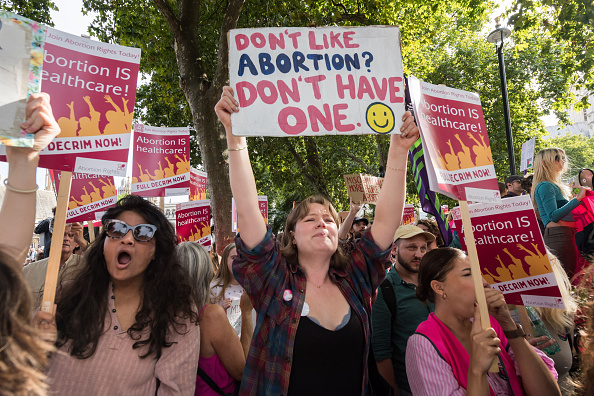
Pro-choice protesters in London, September 2025 (Wiktor Szymanowicz/ Getty)





Infanticide should be fully decriminalized for mothers. Cases like those of Constance Marten — whose dead baby was found in a shed, placed in a plastic bag — should never come to court. Only a tiny number of mothers kill their infants each year. Those that do are inevitably vulnerable and gravely traumatized. Putting these women through police investigation and prosecution simply damages them further. Much like the old defense of domestic violence, the police should just stay out of it.
Replace the general term “babies” with “babies still in the womb”, and this was the underwhelming shape of an argument offered by the abortion provider, the British Pregnancy Advisory Service (BPAS) this week, defending the parliamentary reform that recently decriminalized late term abortion for women, right up until birth. As is now clear, there has been a significant rise in women attempting late-term abortions of babies at home, using the pills-by-post scheme first introduced during lockdown. In future, providers not acting within existing abortion rules can still be prosecuted, as can other participants. But after a vote in the Lords last week, it seems that the woman herself will be officially off the hook.
BPAS thinks this is as it should be, and favors what we might call the Victim Strategy as its rationale. That is, it urges us to picture all such women as in desperate circumstances, with limited responsibility almost by definition. Any cases involving the deaths of babies after 24 weeks — whether intentional, natural, or accidental — are to be pitied alike, and offered nothing but sympathy and support. Prosecution is inappropriate a priori.
On this approach, the death of a baby is only ever something that happens to a woman and never something she does. The BPAS website reminds us that women who attempt late-term abortions include “victims of domestic abuse, human trafficking, and children”. Sharp-eyed readers will notice that the interests of even smaller children, also in desperate circumstances, somehow don’t figure at all.
At the same time as this justification was being offered, a rather different one was being given by the former chief executive of BPAS, Ann Furedi, who has also written a book on the subject. Let’s call this one the Omniscient Gambit. It starts with the same premise: only tiny numbers of women seek late-term abortions. It also assumes, with equally strange confidence, that this fact is unlikely to change even despite decriminalization. But rather than conjure up the frantic mental states of the woman concerned, Furedi urges us to see her as uniquely mentally competent.
We should trust the pregnant woman’s decision-making, Furedi says; for “[t]he best person to answer the question of whether to have an abortion should be the woman who has to live with the consequences”. And in an earlier article on the recent increase in abortions generally — 300,000 in 2023, as opposed to 630,000 live births — Furedi writes: “Women who use abortion to back up their contraception are not immoral or reckless. They are making the decision that’s best for them.”
The Victim Strategy and the Omniscient Gambit can’t both be true. Women seeking late-term abortions for healthy babies cannot be disempowered, traumatized wrecks, but also clear-sighted rational actors whose decisions society should respect. If the number of late-term abortions grows after the removal of the criminal deterrent, then presumably the defenders will stick to their respective sweeping stories even so. Women who induce late abortions are too emotionally delicate to withstand judicial scrutiny, but somehow also powerfully agentic. Either way, their personal involvement in the deaths of their babies is no matter for the law.
Away from the lobbyists, the most obvious thing to predict about such cases is that they are bound to differ. Feminists originally fought to get people to see women as having a fully human nature. In practice, this means that women vary from one another — but it seems the old myth of a feminine hive mind can still occasionally be useful. In reality, for some of the women deliberately ingesting abortifacients at a late stage of pregnancy, there will be mitigating factors in light of their circumstances and personal histories. For others there will not — as is the case when assessing potentially criminal activity, generally. The police and the CPS used to be able to investigate, and could make allowances where appropriate; but soon no longer.
Another problem with both Victim and Omniscient defenses is that they treat women’s behavioral patterns with respect to late abortion as static, no matter what changes in the law, social norms, or new technologies are introduced. Both assume that the circumstances of rare cases in the past will be a reliable guide to what people do in future, even as the numbers of abortions generally have been leaping upward since the pandemic. Clearly, moral attitudes towards abortion are not fixed. If they were, it would be hard to understand why lobbying groups like BPAS spend so much time and money trying to change them.
It seems we have here another example of the “Let’s Be Free” people and the “Let’s Be Kind” people teaming up to wreak havoc upon settled moral intuitions. I first noticed the dynamic during the gender wars, and wrote about it then: of gimlet-eyed sexual libertarians taking advantage of the cover provided by mumsy rainbow types with lanyards. While the former pushed the boundaries, the latter preached compassion to unfortunate minorities and accused anyone who objected of cruelty. To their credit, some present defenders of late-term abortion were staunchly against the primacy of gender identity all along, including Furedi. Others — like MP Stella Creasy, for instance — seemed completely taken in. Promoting the chemical alteration of young people’s bodies by doctors was said to be both the exercising of a fabulous right to self-expression and a life-saving kindness for the unfortunate. Letting men have access to women’s services and spaces was both taboo-busting liberation and a favor bestowed on the basically pitiable. Whenever the freedom narrative became too alarming in its consequences, the kindness narrative was there to do some strategic shushing and patting, soothing any nascent doubts.
Although it doesn’t work in exactly the same way, a related dynamic operates in the assisted death discourse. (I go into the matter in some detail in my new book, published next week.) Avowed freedom-lovers tend to frame assisted suicide and voluntary euthanasia as simple exercises of autonomy. They are nobody else’s business but the person concerned. Like the pregnant woman seeking an abortion, we should trust someone seeking his own death to know what is best for him. As with the pregnant woman, any officials expediting the deed need not inquire as to the individual’s particular reasons. A person’s grounds for self-extinction should not be the law’s concern.
Presented baldly like this, the argument is scarcely compelling as a justification for medical involvement in suicide. In the case of abortion, the risk to maternal health is sufficient to justify clinical oversight. It is partly this fact that allows the pro-abortion lobby to keep repeating the line that abortion is always “vital healthcare” — even, ludicrously, when they are talking about self-administered late interventions which may pose significantly greater risk to the woman’s health than giving birth.
But in the case of a desired suicide, the grave risk to health is priced into the project — indeed, it is its whole point. So it is still unclear why doctors are morally obliged to assist. At this point, though, the “kindness” people helpfully enter the scene, insisting it is urgent that doctors facilitate things — not as a matter of respecting autonomous wishes, generally, but rather as a matter of merciful intervention for ill people in particular.
They say we ought to be putting poor suffering souls out of their misery when their lives are no longer worth living. Unlike the subjective freedom narrative, then, this one puts a definite value on a so-called undignified life. Thanks to the dust thrown up between these two different stories — and the tendency of each group to use the language of the other when it suits — any proposed safeguards aimed at establishing whether death really is the most merciful option for a suffering person are stifled at birth. Cautious measures — insisting on an adequate reflection period; requesting that an applicant receive a palliative care consultation; excluding people with learning difficulties as too suggestible; and many others — are judged to be obstacles to the realization of personal freedom, and then dismissed.
Why our legislators should be so befuddled by the twin siren calls of freedom and kindness is an interesting question. Clearly our legal and political institutions are weak and easily distracted, helplessly prey to pressure groups with catchy but ultimately shallow slogans. The focus on getting access to a particular “freedom” — by “right”, even — is often just a disguised demand for some concession, regardless of the secondary effects on others. To disguise the implicit foot-stamping, it is useful to find a particular group of people for whom the concession superficially looks like a compassionate response. At this point, further leveraging can begin. In Canada, euthanasia was first granted only for the terminally ill; but soon enough, disabled people were able to receive it with no terminal diagnosis. As things stand, the mentally ill will get access in 2027. Today, 5% of deaths are now at the hands of doctors, a number that is going up each year.
And as for full-term abortion here, it seems likely that — having removed the women at the center of the story from the possibility of prosecution — there will be later attempts to legalize the process fully, removing providers and partners from criminal sanctions too. Indeed, Creasy has been trying to do this for some time.
Though decriminalization is currently being presented by BPAS as a kindness towards damaged and exploited women-children, I predict that institutional memories will be short. After some time has passed, the act at the heart of the debate will be framed once again as a vital freedom for all kickass girlbosses, at which point surrounding prohibitions can fall away. How can it be rational, it will be asked, to punish providers, doctors, or romantic partners for helping with a process that is not actually a crime for the main participant? Not wishing to go against women’s “reproductive freedoms” or indeed their “vital healthcare”, many politicians once again will not know what to say.
Do Not Go Gentle: The Case Against Assisted Death by Kathleen Stock (Little Brown £22) is published on April 2nd.
