




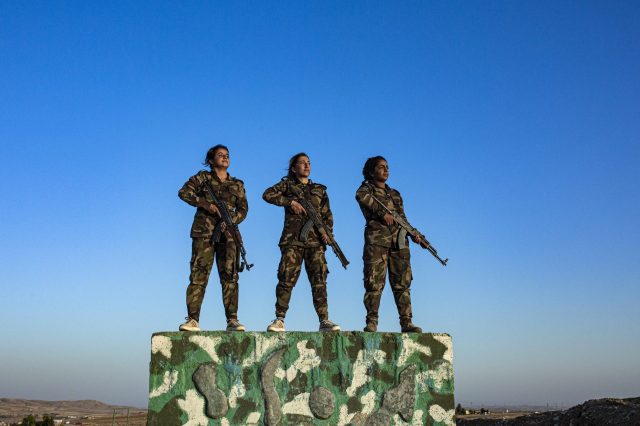
Three Peshmerga recruits of the PDKI pose for the camera while holding their AK-47s in Erbil, Iraq. (Credit: Keiwan Fatehi / Middle East Images via AFP via Getty Images)





All Iranians have good reason to fear death from above — but the country’s Kurdish opposition faces a more complex calculus. For if Israeli strikes are pummeling the Islamic Republic at large, leaders of the country’s Kurdish opposition parties must also contend with their own government, as their bunkers are targeted by regime missiles and drones. These Kurdish-Iranian forces could soon help build a new Iran — or face worsening violence as the Middle East is engulfed in a bloody regional war. “We have been preparing for this for almost five decades,” says a spokesperson for the Kurdistan Freedom Party (PAK), speaking from a tunnel complex just across the Iraqi-Iranian border. “Our role is clear: to support and protect our people in the new Iran.”
To this end, a new big-tent grouping, known as the “Coalition of Political Forces of Iranian Kurdistan”, has united the PAK with other parties in the broader Kurdish-Iranian opposition. As Tehran smolders, that’s led to overtures from both Tel Aviv and Washington. Donald Trump has signaled his willingness to back armed factions on the ground in Iran, in comments with implications for the Kurdish umbrella organization which is now Iran’s most numerous and combat-ready opposition force. But there’s still some way to go before these forces can challenge Tehran on the ground — while the Kurds know from bitter experience that their autonomy can easily be sacrificed at the altar of Western strategy.
Iran’s estimated seven to 15 million Kurds share deep links with the country’s Persian majority, including closely related languages, a shared cultural and mythic background, and dynastic ties stretching back millennia. Yet the Kurds have also suffered long-term repression under successive Iranian regimes — as suggested by the lack of clear census data.
Iran’s Kurds first declared autonomy back in 1946, but that Soviet-sponsored project was crushed by the regime of the young Mohammed Reza Pahlavi, the Western-backed Shah of Iran. Three decades later, Kurdish forces and protesters contributed to the nation-wide uprising which ousted the Shah in the 1979 revolution. But they were rapidly excluded as power centralized around the new Islamic order. A Kurdish bid for greater autonomy was bloodily crushed as over 1,000 Kurdish political activists were executed by the new regime, setting the scene for five more decades of repression.
Kurds have been systematically tortured, imprisoned and executed by the Iranian authorities, with Tehran hanging hundreds of Kurds in recent years. That’s amid a broader climate of cultural repression and economic exclusion. To eke out a living on the margins of Iranian society, thousands of Kurds have lost their lives working as illegal cross-border porters in the country’s rugged border regions.
Repression has also seen the development of a complex Kurdish opposition landscape. Iran’s short-lived 1946 Kurdish Republic was spearheaded by a traditional nationalist force called the Kurdistan Democratic Party-Iran (KDP-I). Though it retains political cachet on the ground, its armed strength has dwindled in recent decades. Founded in 1991, by the scion of a well-known Iranian Kurdish militant dynasty, the smaller PAK was trained by the US and gained combat experience in the war against ISIS, but is largely reliant on its sponsors in Iraqi Kurdistan rather than an organic domestic base of support.
Meanwhile, other Kurdish regions in Turkey, Syria and Iraq have seen the rise of an alternative political project spearheaded by the Kurdistan Workers’ Party (PKK), which claims to reject Kurdish nationalism in pursuit of the novel goal of a region-wide democratic federation, marked by a prominent role for women. The PKK’s Iranian affiliate, PJAK, has been responsible for the bulk of attacks on Iranian forces in recent years, claiming to have killed hundreds during hit-and-run cross-border attacks, such as a 2018 raid that killed 10 Revolutionary Guards. Iran’s most effective opposition force, the PJAK can field an estimated 3,000 fighters, while drawing on the PKK’s broader network of well-trained, well-resourced militants.
All these forces have generally been pushed back into camps and tunnel complexes in neighboring Iraqi Kurdistan, limiting their ability to act on the ground. In 2022, Kurdish women were at the forefront of nation-wide protests after Jina Mahsa Amini, an Iranian Kurdish woman, was beaten to death by the morality police for an alleged hijab infringement. Yet though the demonstrations brought the PKK’s “Woman, Life, Freedom” slogan to the world’s attention, Iranian-Kurdish parties themselves kept a cautious distance, apparently assessing it was unlikely the popular rage could be translated into an organized opposition movement.
But following two years of Israeli attacks on Iranian assets across the Middle East, the balance of power has permanently shifted. This February, five of Iran’s leading opposition groupings put aside ideological and historic differences to form the new Coalition of Political Forces — just one week before the bombs began to fall on Tehran. In its first statement after the assassination of Ayatollah Khamenei, the Kurdish Coalition laid the blame for the conflict at Tehran’s door, describing a “domino effect” leading Iran towards its “most decisive days”.
Perhaps. For now, the Kurdish Coalition is yet to announce any intended or actual military operation on the ground. Rather, the Kurdish Coalition struck a cautious note, calling for defections from the armed forces, the protection of public and administrative institutions, and restraint as a potential new order takes shape. Significantly, the group’s statement sought to present the US-Israeli operation as targeting the Iranian regime rather than the Iranian people, claiming: “This war is not between Iranian society and [its constituent] peoples and the United States, Israel and the international community”.
But though hundreds of political leaders and combatants have been killed in the US-Israeli strikes, so too have hundreds of civilians, including a reported 153 people in a strike on a girl’s school. Iranian military installations in the country’s western Kurdish regions have been first in the firing line, adding a fresh layer of terror and uncertainty to the experience of ordinary Iranian Kurds — even as Iranian Kurdish political detainees are reported to be escaping prison amid the chaos.
While making it clear that “we support the intense attacks of the US and Israel against the tyrant regime of Iran,” the PAK spokesperson stresses that “we haven’t been in touch with either Israel or the US”, a point repeated by the representatives of other, larger Iranian Kurdish opposition groups within the coalition. All the same, there were phone calls earlier this week between Donald Trump and the senior leadership of Iraq’s semi-autonomous Kurdistan Region, while breaking reports confirm Trump has indeed been in contact with the Iranian Kurdish leadership. “US interests differ from our own,” the PAK spokesperson tells me. “Sometimes they might align, and sometimes they might be perpendicular to one another.”
Reza Pahlavi, the son of the exiled Shah who styles himself Iran’s new leader-in-waiting, has shown himself hostile to his Kurdish rivals in the Iranian opposition, even as he makes use of the Kurdish “Women, Life, Freedom” slogan to lobby for US support. Pahlavi dismissed the Kurdish opposition as “separatists” and collaborators with Iraqi dictator Saddam Hussein just this week, in comments slammed by the new Coalition as “hysterical and hateful”.
In any case, rather than Pahlavi Jr swooping in to take the reins after a lifetime in luxurious exile, the more likely outcome appears to be a takeover by elements in the Iranian security apparatus more amenable to US interests. Any such rump state would itself rely on authoritarian measures and a reformulated nationalist ideology to secure a chaotic post-conflict Iran, meaning there would be little reason for the Kurds to expect better treatment than under the deposed Islamic regime.
Nor can the Kurds trust one another. Other Iranian Kurdish Leftist opposition groups remain outside the fold of the new Coalition. More significantly, the Iraqi Kurdish region, which has long housed the Iranian Kurdish opposition, itself maintains close ties with Turkey, and could be unwilling to antagonize Ankara by facilitating further Kurdish gains in Iran. Turkey itself may well enter the fray if Iran’s security apparatus crumbles further, deepening links with the country’s millions of Turkish-speaking Turkmen, and preventing any Kurdish gains on the ground as an absolute priority.
Whether the current regime stands, falls, or is reduced to a shadow of its former self, Kurdish civilians and political actors could be first in line for retributive violence. That’s what happened after 2025’s 12 Day War, when Kurds and other minorities were rounded up in their thousands in apparent retribution for prior Israeli and US airstrikes. Trump and Netanyahu may well seek to make use of the Kurdish fight for self-determination on the battlefield, but this doesn’t mean they’ll guarantee Kurdish interests at the negotiation table. This long-term reality was made apparent once again in January when the US pulled the rug out from under their Syrian-Kurdish partners, exposing yet another set of Kurds to deadly, retributive violence by a centralized Islamist state.
For now, the Iranian Kurdish opposition forces remain pinned down in their bases by the Iraqi border, peppered by Iranian missiles as Tehran continues to take pot-shots at targets across the region. Locals describe mass electricity blackouts and panic as Iranian missiles soar overhead, while the PAK share images of Iranian munitions that have struck their mountain base. If they are able to overcome their internal differences and a hostile geopolitical environment to cross the border back into their homeland, these forces could see their numbers swell — as they give unified, armed, political voice to the long-overlooked grievances of millions of Iranian Kurds. But that won’t happen overnight. “This regime is still strong,” says the PAK spokesperson. “It can hold its breath for a long time.”
Matt Broomfield is a freelance journalist, PhD researcher, co-founder of the Rojava Information Center, and author of Hope Without Hope: Rojava and Revolutionary Commitment (2025).
 MattBroomfield1