




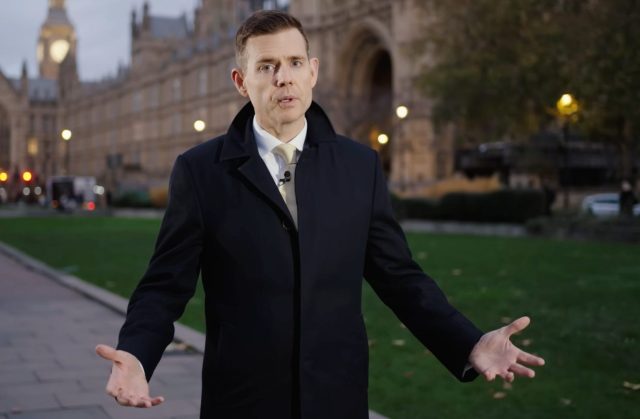
MattGPT: the tribal filter-bubble is good for business. (Credit: @drmatthewgoodwin / YouTube)





The content mill is a brutal master. There’s so much to read; the competition for eyeballs is red-hot; the pressure to produce, relentless. And now we’re competing with AI as well.
Given this, should we be forgiving of people who are caught cutting corners? The short answer is also a very online one: yes, but only if the culprit is on your political team. In line with this, recent revelations that political commentator and Reform Party activist Matt Goodwin appears to have used AI to write sections of in his latest book, Suicide of a Nation, may land differently depending on whether or not you otherwise enjoy Goodwin’s work.
It’s a safe bet that his haters will seek to weaponize the cruel but catchy moniker “MattGPT” to discredit everything Goodwin has ever touched. The academic-turned-pundit has since been spotted hiding comments pointing to evidence of ChatGPT in his book’s endnotes, which doesn’t help matters. But though this will all be music to the ears of those who already thought Goodwin a propagandist, race-baiter, or just “the Alan Partridge of the far-Right”, I doubt any of it will make the slightest bit of difference to his audience.
Goodwin himself has stated that the book is intended not for academics or wonks but a general audience, with the explicitly political aim of shifting the Overton window. But the likelier audience is less those open to persuasion, than those already on Team Goodwin. For Suicide of a Nation isn’t a book in the conventional sense, so much as a tranche of internet, lightly edited into book form. Even if the form implicitly lays claim to the more academic connotations conventionally associated with book-length writing, the people for whom it is compiled will read it as something more like a book-length social media post for an established digital fandom.
In this context, legacy book-type concerns such as exact quotation or factual precision are secondary to more net-native attributes, such as emotional intensity and a sense of epistemic validation. But lest you imagine for a moment that I’m suggesting there’s something unique to the Right about this, think again: whether we like it or not, this is the new normal.
The transition happened gradually, then all at once. It began to gather speed with the arrival of the first iPhone, which put on-the-go scrolling in millions of pockets, and scored its first political scalps with the 2016 election of Donald Trump — and, the same fateful summer, the Brexit victory that catapulted Goodwin to prominence. But full immersion in internet discourse was still optional until Covid forced everyone online. Since then, the world has gone wildly, iridescently hyperreal. In tandem, it’s become clear that a cluster of phenomena that used to be decried as “woke”, and treated as a distinctively Left-wing pathology, only seemed that way due to an accident of history.
Back in the 2010s, aspects of so-called “wokeness”, such as nuance-free sloganeering, binary friend/enemy thinking, tribalism, and purity spirals seemed to happen overwhelmingly on the Left. But really this is just what political debate looks like, under internet conditions — and the Left embraced internet culture before the Right.
And now that everyone is extremely online, everyone does politics in the “woke” style. By this I mean every topic is hyper-partisan, reduced to viral slogans and simplistic binaries, policed via social swarms and scapegoating, and utterly sure of its own epistemological foundations and moral rectitude. (If you don’t believe me, pick a fight with MAGA about Iran.)
Why? It’s a byproduct both of the way digital platforms shape their messages, and also of the way they shape us. The sheer volume of internet content incentivizes simplicity, brevity, and high emotion. The e-Right culture of “shitposting” is one variant on this theme, but you might also ragepost, or thirstpost — or doompost. You’ll get much more traction for posting a message that’s deliberately provocative or reductive, or otherwise bad-on-purpose to make people click.
The volume invites users to build up a picture of some issue or other by scanning for patterns across multiple pieces of short-form, highly emotive content. Whether it’s men dressed as women, genocide in Gaza, mass immigration or whatever, the patterns become governing signs for someone’s reality. In turn, high emotion and a generally agonistic tone encourages tribalism and moral certainty.
Perhaps unsurprisingly, this fries people’s ability to concentrate or follow long-form arguments. Nicholas Carr was already warning about it in 2010: in The Shallows, he describes his own faltering concentration as he shifted from reading long-form books to lateral, associative, multi-tab screen content, alongside studies that show how internet reading does reshape our patterns of thought along less analytic lines. Given this, perhaps we shouldn’t be surprised if, as the FT suggested last year, we may be past “peak brain power”.
Put this together and you have a world where creators are incentivized to make their content simpler, more emotional, and more attention-grabbing, even as the medium itself reshapes our minds in less analytic directions. This is all consolidated by algorithmic curation, intentionally monetized. For many it’s now the principal medium for social life.
The Left entered this mode of media consumption at scale before the Right, and the result was the 2010s “Great Awokening”. But the Right has now well and truly caught up: witness the convergence of activism, entertainment, and (maybe) crypto hustling that animates the Tommy Robinson fandom.
This is the context in which Suicide of a Nation should be read. It’s not meant to impress people who still get their ideas from long-form books. It’s meant to collate and summarize the online patterns noticed and amplified by primarily digital readers of UK anti-immigration content.
I mean this as a qualified defense of Goodwin’s book, on its own terms if not on conventionally bookish ones. On these older terms, conventional within mainstream print publishing, citing AI-generated fake “quotes” is obviously inexcusable. But there exists a large and avid audience for whom accuracy is by the by — and that can, on occasion, tempt academics into more heated and sometimes dubiously fact-checked territory.
This evidences a further affordance of digital communications: the power of audience capture. This simple but potent feedback-loop, whereby a creator gets approbation and money for a certain kind of content, powerfully incentivizes both making more of that content, and making it by degrees more extreme and catchy. More Trump-hating, more migration-hating, more whatever. As for the content itself, precision is less important than pattern recognition, emotion, and vibes.
The American commentator Heather Cox Richardson, for example, began as an historian but has mutated by degrees into an avatar of pure Trump loathing, and now regales her 2.9 million Substack subscribers with daily doomposts about America’s slide into fascism. By the standards of such tribal devotees, the Right-wing partisan response to the allegations against Goodwin should be an indifferent shrug. Who cares, as long as it’s directionally correct? In any case, under digital conditions, the footnotes are mostly there for decoration. Everyone who pays for your content is already in the tribe, and has already seen the memes.
Partisanship evidently hasn’t triumphed everywhere on the Left. Recently, Prospect magazine pulled an article criticizing me and another female writer, after the author, James Bloodworth, used an AI-hallucinated “quote”. By the same standards, should Goodwin fail to supply evidence of his reportedly AI-generated quotes, those on the Right who value truth would be justified in joining those on the Left who already treat his output with suspicion.
But arguably, what Respectable Book People think of Suicide of a Nation doesn’t matter much anyway. This is not a book written for academics, or intellectuals, or even really the kind of laypeople who check end-notes. It’s a fan event: more akin to a sing-along performance of The Rocky Horror Show than an argument. And its rhetorical end is less persuasion than epistemic reassurance: you’re not mad, other people see this pattern too.
Leaning into this kind of tribal filter-bubble, via the sweet embrace of audience capture, is good for business. Though still a minnow compared with Richardson’s 2.9 million readers, Goodwin has over 90,000 subscribers to his Substack newsletter. Even if the conversion rate to paid subscriptions is low (and there’s no reason it would be), an audience of that size will deliver a tidy monthly revenue. Similarly, at the time of writing Suicide of a Nation is in the Amazon top 10, meaning it’s selling hundreds or even thousands of copies a day. Goodwin self-published, meaning he will pocket 60-70% of the cover price for each copy sold. Do the sums. For that money, who cares what Politics Joe, or even Ben Sixsmith, makes of your argument?
But we should take note of what has been disregarded: implicit adherence to the legacy belief that the best vector for persuasion is facts and logic. If the chaotic new world of internet discourse tells us anything, it’s that this was only ever ambivalently true. Now, it’s demonstrably false. What persuades people now, and perhaps always did, is lots of short-form, emotive, relatable, story-based snippets of information, that coalesce over time into a coherent picture of “how things actually are”. Do that persistently enough, then reinforce with longer-form versions of the same reality-picture and a sense of belonging, and you’ll have a loyal movement on your hands — and, better still, they’ll buy anything you sell.
In this sense, Suicide of a Nation represents the apex, or perhaps nadir, of an intensely contemporary career arc: one that started in academia, spun out into polling and think-tankery, parlayed those achievements into an increasingly frenetic Substack, then added a grueling schedule of political campaigning and, somehow, also a new book. I can’t have been the only person wondering how Goodwin managed to fit it all in. The answer, apparently, is that he didn’t.
But you’d better get used to it. To the language, the emotion, the Manichaeism, and the cavalier attitude to footnotes. This is what political discourse looks like now. Anyone who is serious about political activism, or indeed propaganda, is already operating in this register — or if not, soon will be. The rest of us are just paddling like mad, to keep our noses above the slopaganda. And as for how any of it maps onto real-world policy, that’s anybody’s guess.
