




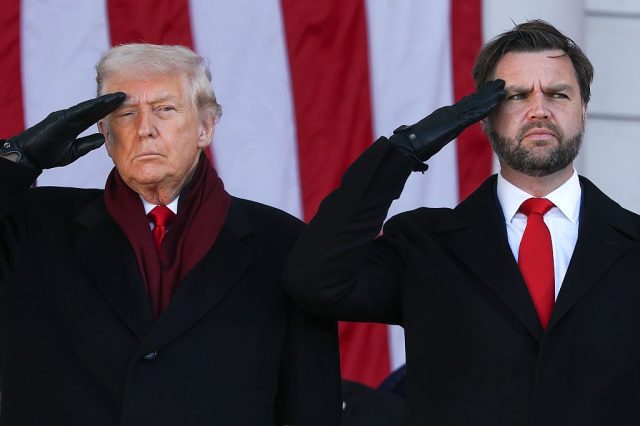
Whither the 'extreme skepticism' of intervention? (Credit: Anna Moneymaker/Getty)





President Trump’s regime-change war in Iran is already remaking the Middle East — and will have global ramifications whose scale and severity we can barely comprehend in these early hours. The Iran war also marks a similarly consequential turn at the level of ideas inside the Trump administration and the American Right more broadly: seemingly against all odds, it is the neoconservative hawks who have emerged as the winners of the Trump era, with the Trumpian intellectuals left holding the bag.
To put this in stark terms: somehow Vice President JD Vance, a fierce Trumpian critic of the neoconservatives, ended up in government at the highest levels, only to help implement the foreign-policy preferences of, say, John Bolton or Elliott Abrams. The Vance who once sharply critiqued a foreign policy of “moralizing” is overseeing strikes explicitly aimed at freeing the people of Iran.
In 2016, as it became clear that Donald Trump represented the future of the GOP, three paths presented themselves to respectable conservative intellectuals, such as those at the Wall Street Journal’s comment pages, where I was working at the time. The first was the path of slow, cynical accommodation: having opposed Trump to the last, as a heretic from foreign-policy hawkism and free trade, the accommodators slowly began to wonder: well, what can we get out of this guy?
Then there was the path of unbending Never Trump defiance. A subset of conservatives, especially those of a hawkish bent on foreign policy, resolved that they would sooner become politically homeless and embrace liberal media organs than bow to the vulgarian from Queens, who railed against “globalism”, called the Iraq War a “disaster”, and dunked on George W. Bush-era neoconservatives.
Among those at the Journal who took this approach was an energetic op-ed editor, Bari Weiss, and her mentor, the columnist Bret Stephens, both of whom decamped for the Left-of-center opinion pages of The New York Times soon after Trump’s first ballot-box triumph. I, too, belonged to this group initially. I endorsed Hillary Clinton in the paper and traded many an email with Bari and Bret venting our disgust at the institution’s leaders for choosing what we saw as accommodation.
But not all of the hard-line Never Trumpers would stay that way forever. There was also, finally, the path of the converts. These were right-wing intellectuals who, overcoming their disgust at Trump’s antics, tried to understand why the Republican base had elevated a populist former reality-TV star who challenged our conventions and orthodoxies. What had free trade and decades of a hyperactive foreign policy wrought for “flyover country”?
I was one of the Trumpian converts. Having endorsed and voted for Hillary Clinton, I would go on to conclude that the old, pre-Trump consensus had been a disaster. It had left American power overstretched abroad and hollowed out its domestic foundations: visible in the abandoned factories of the heartland, its streets now littered with the needle-mark-strewn, opioid-addicted bodies of the sons and daughters of once-proud manufacturing workers.
I spent much of the first Trump administration as the op-ed editor of the New York Post, a more populist tabloid and a favorite of the President, who would often clip columns I’d commissioned and mail them to their respective authors, signing them with a thick Sharpie pen and adding words of encouragement: “Attaboy!”
In my extracurricular hours, I served as the principal drafter and organizer of “Against the Dead Consensus,” a 2019 manifesto for the so-called New Right that blamed the Old Right — my comrades of just a few years earlier, figures like Bret and Bari — for failing to “retard, much less reverse, the eclipse of permanent truths, family stability, communal solidarity, and much else”. Conventional conservatism, my cosignatories and I charged, had “surrendered to the pornographization of daily life, to the culture of death, to the cult of competitiveness. It too often bowed to a poisonous and censorious multiculturalism.”
Conventional conservatism was scarcely different from liberalism. And it had allowed “an ideological liberalism seeks to dictate our foreign policy” — meaning we’d too often gone abroad seeking autocratic monsters to slay and freedom-seeking peoples to emancipate. Many of the signatories were converts: to the Catholic faith, but also the Trumpian one. Another convert who might as well have signed but didn’t (because we didn’t think to ask him) was JD Vance.
A Yale Law-educated venture capitalist, Vance was also the author of a best-selling memoir, Hillbilly Elegy, which soon became a go-to guide for coastal journalists figuring out what made Trumpian America tick. Although he poignantly described the miseries of Trumpian America, Vance was by no means prepared to throw in his lot with Trump in those years. On the contrary, his book’s diagnosis of what had gone wrong with his Appalachian kinfolk was very much aligned with that of the respectable conservatives: what ailed his people, Vance concluded, was a failure of bootstrapping self-help — not the GOP’s neoliberal trade policies and neoconservative defense policies. Trump himself, meanwhile, was a latter-day “Hitler,” as Vance told a friend in an infamous leaked text message.
Yet a few years later, just as I would strive to lend intellectual coherence to the Trumpian project (don’t laugh), Vance would emerge as a democratic tribune of Trumpian America. Eventually, he’d be elected a US senator from his home state of Ohio after a campaign that saw him crank up the Trumpian rhetorical quotient to 11.
Once in office, Vance sought to govern as a thoughtful populist, launching major legislative initiatives in collaboration with the economic progressives: a railroad-reform bill, an attempt at breaking the credit-card duopoly, a bid to lower insulin prices, and the like. While most of these initiatives would fail — falling victim to opposition not from the Democratic Party, but the Senate GOP’s free-market old guard — Vance would be tapped as Trump’s 2024 running mate. All along, he continued to sound anti-interventionist notes, not least on Iran. In 2024, for example, he declared: “Our interest, I think, very much is in not going to war with Iran. It would be a huge distraction of resources. It would be massively expensive to our country.”
But here we are. Trump has now launched an all-out, and deeply unpopular, war against the Islamic Republic, with Iranian “freedom” as its primary objective. Vance, though not exactly leading the charge on messaging, has been photographed running a sort of Team B situation room in Washington (the President’s own situation room is in Mar-a-Lago). Again, for those of us who have been inside these circles and debates, the ironies are mind-boggling.
How to explain them? I’d venture four reasons.
First, there are the structural realities of the GOP. Despite the realignment of the two parties — working- and lower-middle-class voters’ shift from Left to Right beginning in 2016 — the institutional party remains dominated by the old-line foreign policy: the think tanks, the senior staffers, the octogenarian senators for whom it’s always 1983.
Yes, the party has its “restrainers” — those who favor a less expansive foreign policy — and the “prioritizers” — those who want to pivot from Europe and the Middle East to confront China — including many in the Pentagon and the intelligence apparatus. But these are typically younger, and their influence in the Trump administration is dwarfed by that of the traditional hawks in the President’s orbit. People such as the acting national-security adviser and secretary of state, Marco Rubio, and the White House chief of staff, Susie Wiles.
Second, there’s the role of anti-woke-ism as new skin for old wine. The hawks — not least Weiss, through her outlet The Free Press — championed popular grievances with the inanities of the “peak-woke” moment and successfully married this to the same old agenda. Many of the would-be populists were all too happy to go along, hailing a once-more culturally muscular and unembarrassed America as it pursued the very policies that they’d deplored just a few years earlier. As one online wit remarked somewhere: “Good thing [Secretary of War] Pete [Hegseth] purged the trannies from the military so beefy white guys can do a regime change in Iran.” Based and red-pilled!
Third, there was the reframing of regime-change wars to mean only operations that put boots on the ground. In this telling, the true hallmark of the old failed neoconservatism was not its globe-spanning scope or its shoot-first-ask-question-later reflexes, but its idealism: its naïve faith in helping oppressed peoples and the deployment of troops for nation-building. Under the new dispensation, America would simply break things and leave it to others to pick up the pieces.
As Vance told me in a 2024 interview, the new Trumpian foreign policy would be “a mixture of extreme skepticism towards intervention overseas, combined with an extremely aggressive posture when you do intervene overseas…. Don’t punch often, but when you punch, punch really goddamn hard.” But this logic — that you aren’t a neocon as long as you don’t actually dispatch ground troops — soon became a beguiling invitation to punch quite often indeed. The “extreme skepticism” soon melted away; the second Trump administration has now launched interventions in no fewer than seven countries.
Finally, and most simply, there’s Trump himself: a product of a generation of Americans for whom the Iranian regime is — not unjustly — remembered for the 1979 hostage crisis and the 1983 Beirut barracks bombing. The Islamic Republic has historical agency, after all, which it used for nearly five decades to prosecute a strategically foolish ideological war against Israel and the West. And while Tehran doesn’t loom as a menace (or bogeyman) for younger Americans to nearly the same degree (or at all), that’s neither here nor there. Trump is the commander-in-chief, and he perhaps sees himself as the avenger of those older Iranian sins.
It remains to be seen whether voters in 2026 — and, more important for Vance, 2028 — will conclude that revenge was worth the candle.
Sohrab Ahmari is the US editor of UnHerd. His next book, on The Triumph of Normal, is forthcoming from HarperCollins.
 SohrabAhmari