




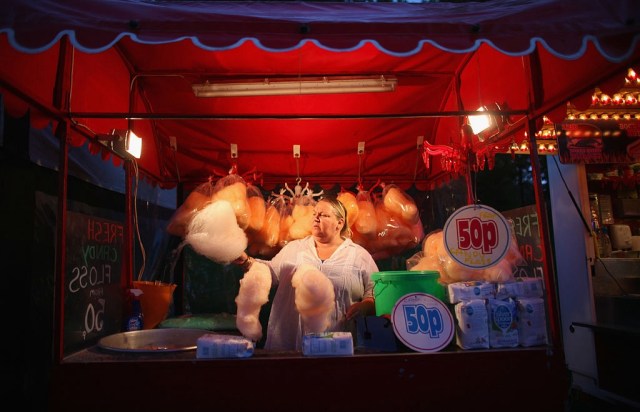
At the King’s Lynn Mart, even the food vans are a multi-generational, traveling family business. (Christopher Furlong/Getty)





“A way of life, I would call it.” John Green is crouching among the colorful figures of a merry-go-round, polishing the seats and conducting his final checks. All around us, fairground lights flash silently in the February sun. Within the next hour, King’s Lynn’s annual Mart Fair will be under way, marking the start of the traveling showmen’s year. Green’s face is ruddy and weather-beaten but there is a boyish glint in his eye. He is explaining that, for the families who work on these fairgrounds, this is more than a career, a trade, or even a vocation. “I’m like the fourth generation now, the fifth on my mothers’ side. 62 years I’ve been doing it.” I ask his age. “62!” he responds with a great peal of laughter.
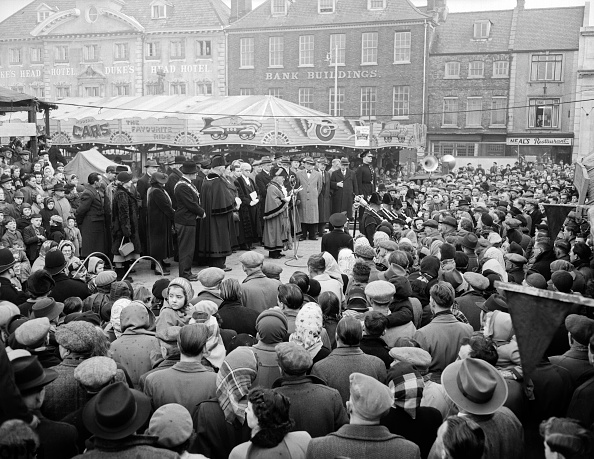
The next generations are here, too. Later I will meet Green’s son, Johnson, and his grandson, who at two months old has been judged too young to work. But first, the grand opening. The town’s mayor and accompanying dignitaries have turned up wearing gold-trimmed coats, bicorn hats and ceremonial maces. One carries a sword. Standing alongside a dodgem arena, they could be mistaken for entertainers at an amusement park, or perhaps time-travelers from the era when this square, known as the Tuesday Market, hosted public executions. I detect a hint of wistfulness in the 200 or so faces looking on, many doubtless recalling distant childhoods at this same fair. This part of Norfolk is one of the few places in Britain where you can ask an elderly couple whether much has changed in their lifetimes, and receive the answer “not at all”.
Now a vicar is reading some doggerel composed for the occasion, and the mayor pays tribute to a “remarkable and much-loved tradition”. There is a short, blaring rendition of “God Save the King”. Finally, the whole august party boards the dodgems, and a moment later, with club music pumping out, they’re racing around like a gang of sugar-crazed kids. The fairground kicks into action, a sickly blur of color and noise, a world devoted to the garish kitsch of childhood. Everything is spinning: teacups, barrels, miniature cars and trains, carousels, Ferris wheels, little helicopters branded with Disney characters.
It may seem strange to dignify this spectacle with the seal of heritage, but such is the contradiction of the showmen’s culture. Theirs is an ephemeral existence, traveling constantly, appearing in a blaze of fun that lasts a week or two and then moving on. And yet, their own understanding of this life is one of continuity and loyalty. John Green’s pedigree of multiple generations is the norm among showmen (a word, incidentally, which is used for women as well as men). This industry has, essentially, consisted of the same group of families for the past 150 years. Today, it numbers around 20,000 people, counting the showmen, their families and other employees. Each family charts its own course among the 2,300 funfairs staged in Britain each year, following routes established by parents and grandparents, some cleaving to a particular region and others roaming across the country. At the King’s Lynn Mart, even the hotdog vans are a multi-generational, traveling family business.
Such hereditary trades, once the default across much of the economy, are now curiosities in a fluid modernity where each individual is expected to plot a unique path through life. Fairgrounds are among the last remaining places where work is part of an identity that one is born into. “That position there was my great-granddad’s position”, Green says, pointing at a stall opposite his merry-go-round. He started contributing in earnest around the age of 10, when his parents announced, “right, double figures now, you’ll have to work”. He remembers helping his grandfather adjust to decimalization in 1971, when the number of pennies in the pound went from 240 to 100. When I ask Green why this way of life manages to endure, he raises another paradox characteristic of showmen: the combination of solidarity and liberty. “You meet friends”, he says. “I’ve got loads of friends all over the country, and if I was in trouble now, they’d be there.” But there is also “the freedom of life”. As Green explains, “if you don’t wanna work, you don’t work. So then you starve.”
I hear another, simpler explanation from retired showman Perry Day. “We were born into it,” he says, “conditioned into it.” Day cuts a demure figure in a long dark-green coat and a shirtfront adorned with tiepins. One of these, a golden medallion bearing the image of a helter-skelter, marks him out as a former chairman of the Showmen’s Guild, the official body representing Britain’s fairground business. All showmen, as far as I can tell, are members of the Guild. Perry is 78 and says he would still be working had he not developed diabetes, preventing him from driving a heavy goods vehicle. He and his wife, Margherita, still come to the King’s Lynn Mart every year. “We used to travel, me and Perry, everywhere”, Margherita tells me. “King’s Lynn, London, North Wales, Jersey, Leicestershire, Nottinghamshire… everywhere.” With the exception of two or three months in “winter quarters”, they were mobile all year long.
This arrangement remains typical. Many showmen also pause for a few months in the summer, when they run food kiosks or entertainment businesses in tourist spots. It’s not uncommon for families to own some property by way of a base, where the rides “sleep” during winter, but younger showmen, especially, live in their trailers full-time. These vehicles, increasingly, are not the customized wagons of old, but 40-foot mobile homes imported from America. On account of their nomadic lifestyle, showmen have long been mistaken for gypsies, an association they resent. “It’s a little bit heartbreaking, in a way,” says Johnson Green. “When you go to school you used to get bullied a lot. ‘Oh gypsy, gypsy, living in a tent, can’t afford to pay the rent.’” He goes on: “I’m not saying they’re bad people, but we’re doing something completely different.”
Being on the move does, however, create challenges when it comes to educating children. As Margherita Day explains of her own kids, “they was always behind, because they only went in the winter months for schooling. If we took them to other schools [while travelling], they’d just put them in the nursery class and let them do what they want. They didn’t know what to do with them.” So it was a big improvement when an innovative teacher devised work packs for the children, allowing them to stick to a syllabus even as they migrate from one school to the next. Then again, home schooling can still yield results: “My sister’s girl, she used to do her own work in the lorry on going away days, and she went to Oxford.”
The showmen’s retinue also includes workers who help to build, run and maintain the rides. These assistants, generally speaking, can be identified by a cigarette in their fingers and a conspicuous lack of dentistry. They do not belong to the ancient web of showmen’s families, but are often supported by it. Dylan, a 27-year-old who looks after the dodgems, is outspoken about his loyalty to the man he works for. “I had a bit of a hiccup as a kid. I got kicked out of my house… My boss said there’s a job for you here, there’s a place to stay, there’s everything sorted for you.” Dylan now has his own home and family in Essex, but still works at several fairs each year. “If he needs me,” he says of his boss, “one call and I’m here.”
Every family of showmen has its legends and lore. One of John Green’s great-grandfathers was apparently the first to bring cinema scopes to fairgrounds. Perry and Margherita Day have traced their genealogies back to the mid-18th century, where they found figures like Francis Wheatley, a celebrated painter and notorious rake. A later Wheatley is said to have had eight daughters, all of whom brought their husbands into the showmen’s community. Margherita Day is most proud of her great-grandfather, “a Leicestershireman who went to Balmoral with his menagerie show to entertain the princes and princesses of Queen Victoria”.
These are not frivolous tales. It is easily forgotten, after a century of radio and television, that the arts of entertainment were once a seedbed of extraordinary people, practices and skills. If you had gone to a popular fair in the 18th century, you’d have found fire-eaters, trick riders, jugglers, acrobats, and freak shows. Since medieval times, performers had appeared at the trade fairs which were mainstays of commercial life. These included London’s Bartholomew Fair, established by Henry I’s jester in 1120, or indeed the Mart at King’s Lynn, chartered by Henry VIII almost exactly 500 years ago. Thanks to its proximity to the Low Countries, Norfolk was once the commercial heart of Britain; its funfairs are a legacy of this prosperous past, no less than the handsome buildings at the quayside in King’s Lynn, where a ghostly quiet now reigns along the river Great Ouse.
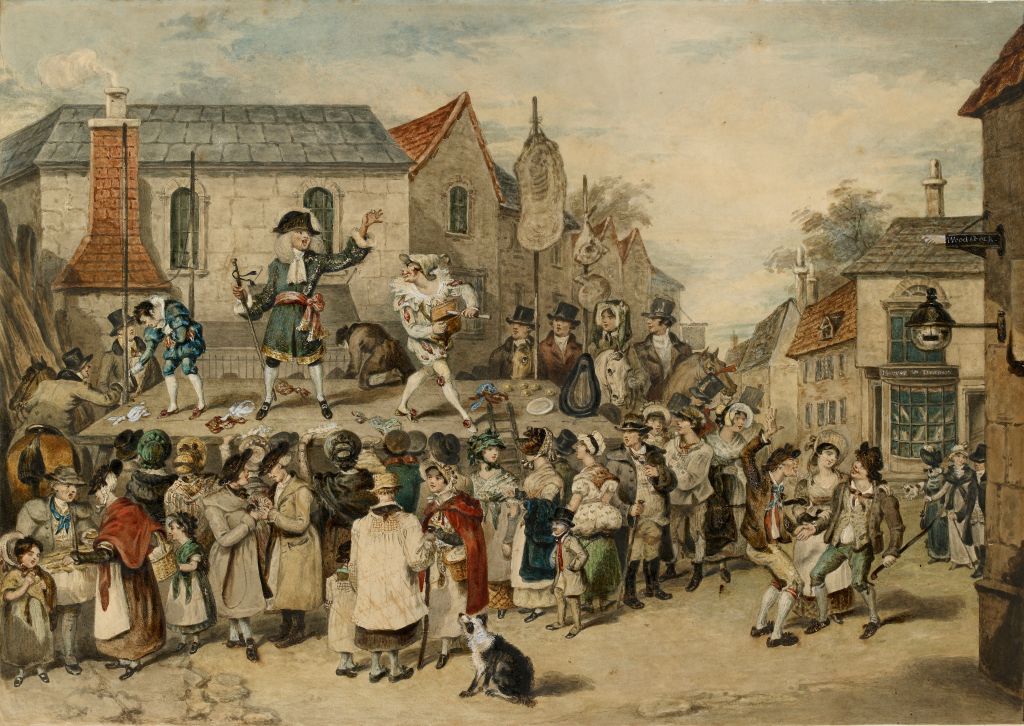
Satirical performances and ribaldry flourished at the fairs, and so, much as with social media today, nervous authorities and outraged moralists were always trying to shut them down. The raucous Bartholomew Fair finally succumbed to these forces in 1855. In the late 19th century, the crusading MP George Smith sought to restrict the itinerant lifestyles of the showmen, a battle which led to the formation of the Showmen’s Guild. One branch split off to form the circus, while some enterprising showmen used steam power to build thrilling mechanical rides. Foremost among them was Frederick Savage, a mayor of King’s Lynn, who invented mechanisms to make carousel horses gallop. For the next century, fairgrounds would display some of the country’s most creative engineering.
Here, then, is another contradiction: showmen are deeply immersed in their history, but have always been ready to embrace novelty and adapt to new circumstances. Even as safety standards have become stricter, the designers of white-knuckle rides have found ingenious ways to torture fair-goers with motion and speed. At King’s Lynn, they speak reverently of a brand new ride, ominously named “High Voltage”. (Yes, I held my breath and climbed aboard; yes, it was terrifying). Virtual-reality headsets and simulators are beginning to become part of the fairground experience.
It is natural to wonder, though, for how many more generations the showmen will stay on the road. While many showmen’s children have stayed in the family business, others have not. “Unfortunately, our children want things that we didn’t want,” says Perry Day, “as in, a good life, as far as finances go”. Day’s offspring didn’t stray too far though. His son is an artist who paints fairground rides, something which also happens to run in the family. According to Johnson Green, it isn’t unusual for showmen to swap their trailer for a “settle down business”, such as an amusement arcade or seaside café. His wife’s family were former showmen who ran ice-cream parlors in Skegness. But his sister has moved further from the fairground: “She went and got a job, she married a normal person. She’s settled down, happy. She just works.” He says many showmen never came back after the Covid pandemic, when they were forced to settle down and grew used to a stable income.
Less than a decade ago, the Government reported 7,000 fairs happening annually, three times the current estimate. In Norfolk, some of the old fairs are dying out as villages are hollowed out by second homes and holiday rentals, a development ironically driven by the area’s supposedly unchanging character. High fuel prices have squeezed showmen everywhere. But I suspect there’s a bigger threat to their future: what Johnson Green calls “the way the world is going”. Given that it’s now not uncommon to see toddlers in strollers staring numbly at a screen, oblivious to the world around them, one wonders if children will continue to be excited by funfairs, and if their parents will still bother to take them. “We’re the bottom of the food chain now,” Johnson Green says. “You got iPads, PlayStations, and kids are probably more indoor people than they are outdoor people.”
The image of an empty fairground suggests a depressing vision of the future: a society bereft of fun, with most people too distracted to even realize it. Nightlife is dying; pubs are continually bullied by a puritanical state; seaside towns are divided between extreme poverty and pompous art galleries; even music festivals are becoming glorified glamping trips for the middle classes. Funfairs are a reminder of how the festive spirit has been expressed since time immemorial: in a seasonal rhythm, within the local community, with young and old together. After a few hours of throwing darts, eating hot dogs, and grinning uncontrollably in the whirling arms of monstrous rides, I realize that the showmen are not the marginal characters I took them for; they represent a principle of merriment which is vital to a healthy society, but which may soon be gone for good.
Wessie du Toit writes about culture, design and ideas. His Substack is The Pathos of Things.
 wessiedutoit