




'These people in the moviemaking business really like it when a movie says that moviemaking and related things are important and redemptive' (Ellen DeGeneres/Twitter/Getty)





The Academy Awards always leave you split between talking about the movies and talking about the people who vote on the movies for the Oscars, “the Academy”. The “Best Picture” category offers an especially fruitful way for outsiders to address this muddle — thinking about movies, as a sort of critic, versus thinking about “the Academy”, as a sort of psychologist or sociologist. Voting on the movies themselves helps us see what kind of statements work for Oscar voters, what kind of worldviews they find pleasing, what attitudes they respond to.
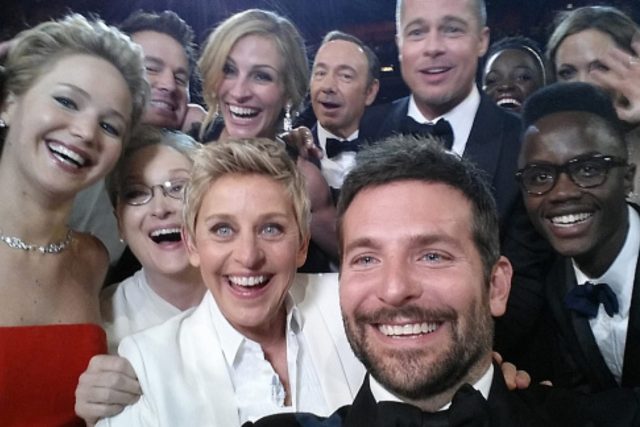
Academy voters like the kind of bland social critique that’s already a polite consensus among their kind of people. They like a solemn historical lesson, or, sometimes, a rousing historical extravaganza. They like movie politics that flatter their Hollywood politics. And, perhaps especially, these people in the moviemaking business really like it when a movie says that moviemaking and related things are important and redemptive, a source of moral light in the world. They like it when a movie says what Whoopie Goldberg once said of herself and her Hollywood friends when she was host of the Oscars: “Aren’t we great?”
Some years the movie that wins Best Picture is not only not the best picture. Sometimes it’s not even a good picture, and this apparent contradiction helps us in our sociologist’s work. It helps us measure the power of those Hollywood vanities. But in some rare years, the critic’s and the sociologist’s perspectives converge, or at least flirt. This is one of those years, when the nominee that’s arguably the best movie also deftly plays to the vanities of Academy voters, which makes it a strong favorite to win Best Picture. But this presents its own dilemma. When you’ve made a long habit of viewing the Academy’s choices with ironic if not smug detachment, of dismissing its judgments as middlebrow and self-serving, those occasions when you agree with the big choice can feel a little weird.
Of the various ways for a movie to win favor from Academy voters, the most reliable might be the direct flattery I refer to above, joining Whoopie Goldberg in saying to those voters, “Aren’t we great?” Alas, the one Best Picture nominee this year that seems to say this, that hints at the redemptive potential of moviemaking, is a smallish film whose dialog is mostly Norwegian — Joachim Trier’s Sentimental Value. But I don’t want to be too glib about Sentimental Value, because it’s a lovely, acutely moving film with brilliant performances. Thanks to its smallness and Norwegianness, though, it has only a tiny chance of winning. Still, if it does, it will be thanks to the fond things it says about the integrity of famous actresses and the redemptive power of moviemaking, in which case I will want to claim a little credit for saying, two days earlier, that those vain things sometimes make the difference.
The other nominee with a helpful hook in the professional world of acting and scripting and staging is Chloé Zhou’s Hamnet, an adaptation of Maggie O’Farrell’s novel about the death of William Shakespeare’s son Hamnet, which movie and film suggest inspired Shakespeare to write Hamlet. Now, Shakespeare carries definite weight with Oscar voters. Olivier’s Hamlet (1948) and the Romeo and Juliet update West Side Story (1961) won Best Picture, but the strongest evidence that Shakespeare and theater have beguiling power over Oscar voters is John Madden’s Shakespeare in Love (1998), which took Best Picture and six other awards despite being a bit of a trifle, built on a bit of a gimmick.
Hamnet is something like the opposite of a trifle, but it does carry the whiff of a gimmick. It is a movie of two halves, the first a story of love and family told in the style of Terrence Malick — murmuring, earthy, elliptical. But where Malick (at least at his best) makes a sort of poetic lightness of these features, the first hour of Zhou’s film is sodden and portentous, if also visually gorgeous. It feels a little too much like a setup for the second hour, which is an almost unbearable sketch of parental grief. But Zhou does have a lovely eye, and the slightly overwrought poetry that turned me off might be just the thing for Oscar voters seeking a semblance of gravity. Also, Jessie Buckley is just magnetic as Shakespeare’s wife Agnes. It’s a bold move to nudge history’s greatest writer aside, but Buckley makes that move pay off.
Buckley probably has a better shot at Best Actress than Hamnet does at Best Picture, but the Shakespeare connection may not be enough for her either, because in that category she’s up against Emma Stone in Yorgos Lanthimos’s Bugonia. Then again, Stone’s won two Best Actress awards in the last decade, the second only two years ago, which might cause the Academy to shy from her. For her part, Stone is a total hoot in Bugonia, in which she plays the CEO of a pharma giant who’s kidnapped by a rural lunatic (Jesse Plemons). I wish Bugonia were as good as she is, because it has huge potential, but it blows a brilliant plot twist with hippie preaching that largely undermines its own subtle comedy. Bugonia won’t win Best Picture, but not because of the hippie preaching. In fact, the hippie preaching is probably a plus with Oscar voters, but it only comes in at the end of the movie. Bugonia won’t win because it’s sort of oblique and a little grubby, neither redemptive of spirit nor flagrantly arty. It’s just not very Oscar-y.
Then there’s Joseph Kosinski’s F1. It’s never occurred to me to love the Oscars’ 2009 change from five to 10 Best Picture nominees. I just thought it was a marketing device. But I love it this year, because without it we wouldn’t have F1 amid the nominees. I love this nomination for its hints of blitheness and randomness, of someone high up saying “Why the hell not?” I’ve taken to fantasizing about F1 actually winning, and everyone in the theater being like “What?” instead of clapping. A crowd-pleasing popcorn movie about car-racing, with Brad Pitt playing himself in Once Upon a Time in Hollywood, winning Best Picture. F1 almost certainly won’t win, despite being a perfectly executed crowd-pleasing popcorn movie, but a guy who disdains the Oscars can still hope.
Another hoped-for winner for me would be Train Dreams, Clint Bentley’s beautiful adaptation of the late, great Denis Johnson’s beautiful novella about a logger in the American northwest who, through the love- and death-haunted adult life, watches the steam-powered 19th century become the electrified 20th. I’m not sure Train Dreams is quite good enough to deserve to win — I don’t even know what it even means to “deserve” to win this contest as I’ve described it — but I can serenely set aside these questions in the knowledge that Train Dreams has no chance.
Another film enlisted to fill out the 10-nominee scheme while having no chance of winning is Guillermo del Toro’s Frankenstein, but I’m much less fond of Frankenstein than I am of Train Dreams, or indeed of every other film in this capacious category. Frankenstein lost me at the very beginning, when Danish sailors iced-in off the Baltic coast of Russia bring an injured man aboard who turns out to be Victor Frankenstein (Oscar Isaac), after which the ship is attacked from the ice by Frankenstein’s famous monster. Amid all this, Frankenstein starts telling his life story, from the very beginning, and the captain whose ship is being attacked is like, “Go on, I’m listening”. Del Toro’s whole movie is touched with this foundational nonsense. I’m being disdainful towards Oscar voters, but I do credit them with preferring coherence in a story, and Frankenstein has little of that. What it has that puts it under Oscar consideration is the technical stuff, elaborate sets and grisly visual effects and some interesting historical costumes, and one heroic achievement in makeup, which pertains, obviously, to the monster, beautiful Jacob Elordi being made monstrous and kind of ugly but also, somehow, still beautiful. The most I’ll say for Frankenstein is that it almost certainly deserves the makeup award.
Another notable achievement in makeup in a Best Picture nominee, on another actor of laughable beauty, occurs in Josh Safdie’s Marty Supreme, which gives Timothy Chalamet’s exquisite face the pizza treatment. But unlike Frankenstein, Marty Supreme has a few things going for it that give it an outside chance to win the big award. It has an iconic American setting attractive to Academy voters, postwar lower Manhattan, and it’s wrapped around a showy but also genuinely great lead performance by Chalamet, a likely winner for Best Actor. And the movie carries bold ambitions that it realizes almost perfectly. It’s a sweaty, white-knuckle affair, like an action movie set in a manic person’s undershirt. I have not yet discovered the mood setting in which I like Safdie films as much as I admire them, and I’d bet, somewhat ruefully, that the standard Academy voter shares my ambivalence. That Chalamet’s titular Marty is an obnoxious, amoral figure probably works against the film’s Best Picture chances but, ironically, ups Chalamet’s chances for Best Actor.
Kleber Mendonça Filho’s The Secret Agent is another actor-centered Best Picture nominee. But where Chalamet talks like an auctioneer through Marty Supreme, Wagner Moura gives a laconic, almost drowsy but somehow riveting performance as Armando, an academic in hiding from government thugs in Seventies Brazil. The Secret Agent resembles Marty Supreme in that it immerses you in a beautifully built world from the last century and that, set in Recife in northern Brazil, it’s pretty sweaty. It’s also a sprawling and unnerving portrait of Brazil’s military dictatorship in its shabby corruption and low-rent political terror. What’s impressive about The Secret Agent, as a political film, is how un-insistent it is, how relaxed it is in unfolding both its political tableaux and its personal drama, and how it uses this slow pace to create real tension. It’s a noble film without really trying to be. Indeed, if it tried harder and more cloyingly for political nobility it might have a better chance with Academy voters.
The two likely frontrunners for Best Picture — Ryan Coogler’s Sinners and Paul Thomas Anderson’s One Battle After Another — are also political films: and the political messages of both are agreeable ones in liberal Hollywood. Their Best Picture chances are thus improved by the dynamic of political self-flattery I mention above. But there’s an interesting twist in this Best Picture showdown, in that the better film has the sillier, more decadent politics.
One Battle After Another is overtly political, featuring several set-pieces in which likable revolutionaries work against US immigration agents to protect vulnerable migrants. Sinners, by contrast, does not have political action on its narrative surface, as something its characters are doing or talking about. Instead, it uses a story about blues music and vampires as a bitter political allegory. Sinners is a film about what people these days call “cultural appropriation”.
Accusations of “cultural appropriation” are often best met with an eye-roll. But the cultural appropriation that Sinners deals with is not frivolous. It’s a huge fact of American and British popular music. That’s why Sinners has vampires. On one hand, the film’s vampire conceit makes total sense. The music industry really did use white artists to extract value from black musical forms, as if vampirically, value that never made its way back to the forgotten geniuses who created and refined those forms. This vampiric extraction is almost too vast, and too ubiquitous, to comprehend. Whole musical genres grew from it.
So, conceptually, the vampire thing hits home. But dramatically, it introduces a note of whimsy, of irony, of arbitrariness, which cuts against the historical texture and gravity that the movie conveys so powerfully in its first half. Sinners remains entertaining as it becomes a vampire movie, and it does get you thinking about the vast apparatus that turned the music of black suffering into money for white people. But it also breaks its own movie spell a little, makes you think of Ryan Coogler as a sort of Great Oz busily manning the controls, right over there behind the curtain. Still, the movie did set a record with its 16 nominations, and this might give it a peremptory aspect of greatness.
Then again, perhaps the politics of Sinners are too well-grounded, even for the Hollywood liberals. Maybe a movie about cultural vampires hits too close to home for people in the entertainment business. Maybe they’re more comfortable with the fluffy anti-Trumpism of One Battle After Another.
It may seem strange for me to claim that One Battle After Another is both a sillier, more decadent movie than Sinners — and also a better one, indeed the best movie in the Best Picture Category, but that is my claim. That’s how much of a formalist I am, and how much I reveled in the formal virtuosity of Anderson’s movie, even as I note the emptiness of its characters’ politics. It stages a curious political conflict in which a cadre of idealistic people are trying to foment a revolution on behalf of the status quo. French 75, the revolutionary group in question, are fighting to protect the idyll of sexual freedom and liberal consumerism, supported by abundant low-wage migrant labor, that already abides in Western societies.
There’s no talk of class politics, no ideas of redistribution. There aren’t even any airy academic harangues about “power relations” or “structural racism” or “patriarchy”. Besides a reasonable call to be nice to migrants, no one makes any concrete demands or proposals. No one lays out the counterfactual vision of revolutionary change, because, again, this is unnecessary. The revolution is on behalf of the factual, which means it’s not even a revolution. It’s a counterrevolution. Even if you believe that Trump and other populist movements threaten this condition of liberal comfort, you have to admit that using revolutionary methods to preserve it makes little sense, in practical terms especially — revolutionary play-acting being the most reliable way to turn populism into fascism.
But as a pretext for making a movie that’s really about something else besides a silly revolution, it makes a ton of sense. Partway through One Battle After Another, the revolution starts to peter out, and it becomes a movie about a father’s quest to protect his daughter from a bad guy, and it stages a dancerly series of gripping, beautiful, sometimes very funny scenes to tell this story. One Battle After Another is skillful, inventive, exuberant moviemaking. I feel bad for people who got offended or deluded by its ostensible politics and missed its delirious fun.
This fits with my overall argument to claim that the ostensible politics of One Battle After Another, its fluffy anti-Trumpism, will help it win Best Picture on Sunday. It’s true that, more than any other nominee, it feeds the feel-good politics of Hollywood back to Hollywood, and that this gives it a huge advantage with Oscar voters. I might also say that it deserves the Best Picture Oscar thanks to its artistic merits, but, as I said, I don’t know what deserving a Best Picture Oscar even means, or what artistic merits have to do with it.