




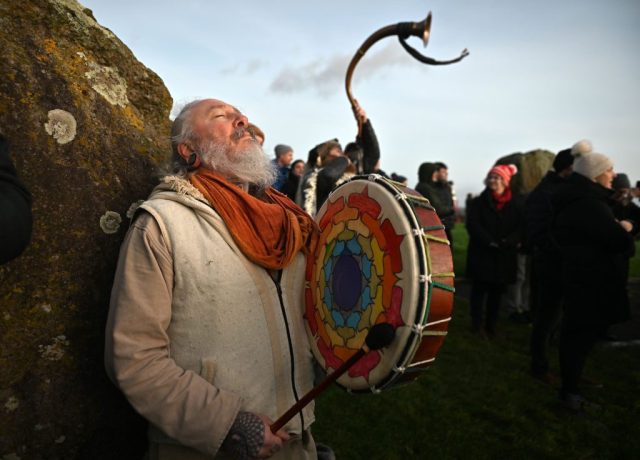
'Myths are a home for us. Some say they are our very bones.' (Charles McQuillan/Getty)





It’s often suggested, in these times of permacrisis, that we need a new story. Keir Starmer needs a new story, liberal democracy needs a new story, the environmental movement, the tech industry, Britain, America, Christendom, humanity — everyone needs new stories. It’s perhaps why corporations are so keen to recruit “chief storytellers” — the better to reframe their narratives.
To a degree I’m sympathetic — I am, after all, a professional storyteller. Chaotic times create a desire for innovation, to “think” our way out of our problems. But some of that chaos has very deep roots. And for the first time in my life, I’ve been thinking that we are exposed to too many stories. Stories that sell counterfeit directives, tales to seduce not to court.
Ours is sometimes called a “Hermian Age” — you may remember Hermes is the Greek god of the storytellers and instant communication between people. But, friends, draw closer. We’re not addressing the fine print in Hermes’s contract. His connection is only successful soul to soul. If the soul is not roused, Hermes is simply not present. We are living in a facsimile of that rapidity. Our ears are filled with story — but the stories we need now are not new stories, but the old stories, the ones that turned up about 3,000 years ago. Myths. Over 30 years of telling and teaching folklore and writing many books on the subject have convinced me of this.
Here’s a story about a story. I’m driving a man I know, Gary, back to his house on a Plymouth council estate. He’s off drugs, off servicing men behind the bus station, out of the gang his brother runs. But only just, these things being a magnet he keeps floating towards. Sometimes he wants to talk to me about his life, sometimes not, and the change can be in a fraction of a second. Last time we did he threatened to hurl himself into the fast-moving current of a river we were passing. But today’s different, today he wants a story.
I tell him a tale about a girl leaving a village for good, and not one pair of eyes is on her wishing her well. At this he moans for a bit, rocks a bit, then makes a grab for the gear stick, tries to uproot it from the stem and bring the car off the road. I pull over and he starts pummeling his own head. “Get it out of my head,” he says. “Get the story away from me, it’s in me, I don’t like it, what have you done?” This from a young man who watches horror, porn, and plays violent video games on an almost hourly rotation.
A tiny folk tale has unearthed something in its terrible simplicity that’s gone straight to his heart. “That’s me, the girl is me, no one, no one, is looking out for me.” I hug him for a moment and tell him, I am. To get to you, they have to come through me. Whoever they may be. He cries then opens the car door. It’s January, and it’s dark. A great blast of freezing air gallops into the car. For a moment he’s lit up under a streetlamp before darting into the shadows. I will never see him again.
There’s no one in this whole wide world that isn’t carrying a story. You could be a president, a yoga teacher, a junkie, and you have this one completely unique thing in your pocket. Your story. And myths help us to move a mere story — an account of something bad that happened to us — from the confessional to the majestic, from persona to presence. Tristan and Isolde is still playing itself out in fraught love affairs, Beowulf is called forth in the sheer guts of trying to piece yourself together after a rough divorce.
I see it as my job — my civic duty, my privilege — to track the myth hanging onto the wingtip of the personal anecdote. When we use myth in this way, we make connections with the little I and the big We — and in doing so, shrug off a little unnecessary loneliness. In place of isolation, we now have the camaraderie of situating ourselves within a bigger story.
This is no small thing we’re doing, anchoring ourselves to the most extraordinary sources of wisdom. Myths are north stars to any culture deserving of the name — culture coming from the Latin, colere, which means to till the ground. To make a culture you dig down into a story. That story needs to be robust enough to explain a few things while also accommodating mystery. Myths hold together heaven and earth, they are a crossroads between the timeless and the timebound. Myths are the connecting tissue between us and the universe. Myths can be the words that underpin a ritual, or actually are a ritual themselves. They often explicate our origins, the gods, the visible and invisible worlds. They have images so emphatic and nourishing that humans can organize their philosophies around them. They afford dignity and purpose to the reactive experience of living. They intrigue us, they excite us, they deepen our understanding of the ordinary. They make luminous.
Myths are the original ecstasies: tales ground down by the gleaming teeth of wolves, containing the whispers of a Ghanaian grandmother; fulsome with the blue longings of the moon. Such stories shouldn’t behave or play nice. They slip the trap of allegory and pad off over the snow, leaving us baffled and delighted. When they fulfill this mystical mandate, you get what could be called a “Sacred Story”. It’s a tale that’s not transactional but transformative, that takes rupture and gives it rapture. It’s what we’ve always done. From the very beginning of things, we’ve tended to imagine in story. Thousands and thousands of years before cuneiform tablets, we stuffed wild, useful ideas into stories so they could be passed from generation to generation.
Of course, everything has its darker aspect. These days we most often associate myths with fiction — a myth is another word for a fib, a lie. For me this is a thin and inaccurate reading. This is modern advertising aggressively selling stories with the aim of possessing your imagination — a toxic mimic. For more on that kind of thing, seek out Roland Barthes, sipping his coffee and scowling at trees.
The other position — shared by cultures across continents — is that myths arise when you go walkabout. When you take off — and shake the civilized off you. If you walk long enough, a mountain may say something to you, a bird may sweep by with some gossip, you may lie down by a river and get dreamt. Humans weren’t the center of the imagining — but we were awfully good at picking up the news. It was the Earth that thought in myth, and we used to have the smarts to interpret that heavenly braille. A myth worth its salt was more than just human. It, in some tangible and mysterious way, spoke across species. A storyteller wasn’t just an entertainer, they were in touch with the ineffable.
Storytellers know that there are many types of time too — indeed, one of the powers of myths is that they pull us out of our hurried sense of time, our sense of not having enough of the stuff. There’s the kind that glows on your phone, the kind that pings and tells you that you have a Zoom call in 10 minutes. The Greeks call that “Kronos” time, and it has its function. But there’s another type — “Kairos”, which lifts us into the dimensions of a myth. The stories we tend to remember have some transformational rather than transactional at their core. As I often say, a combination of the timeless and the time-bound. Too much of the former it can feel perennial but not urgent, too much of the latter it lacks the dignity of the great themes.
Myth is about connotation not denotation; it’s about symbols not signs. People are snooty these days about metaphors, but I’d say that’s nonsense. A metaphor is a symbol that doesn’t tell you quite what it is, allowing an indefinite number of associations to flood in. It’s how poems work. It’s how we find something to nest within when we fall in love. We need wiggle room for our imagination. I could tell you that myth is a beautiful lie that tells a deeper truth; I could tell you that myth never was and always is; I could tell you myth is truth without the use of facts, but actually, no, even those diminish it, make it smaller somehow. After replying thousands of times to the question I will just settle with this: ‘Myth is a Sacred Story.’
Some of the most sacred of those stories circle around the tale of a dying and resurrected king — a king who carried a great burden for his people and turned that burden into an extraordinary act of love. And some of us believe that the most sacred story crash-bang-walloped into the kind of time we can all register: ours. This is where myth collides with history. I’ve long held the strange idea that the arrival of Christ begins in the middle of Homer’s Odyssey. When Odysseus visits the Underworld, Achilles tells him: “Sooner be a slave to a poor man than King of the Underworld.” The game is up for the old order. With these words, from the greatest of Greek heroes, the world turns. Kleos — imperishable glory — is the deepest ambition of a warrior. When Achilles says it is without meaning down in Hades, something utterly new is being announced. A shield is hurled on a stone floor. A fresh consciousness. Yeshua, the God-Man is coming. The last shall be first.
So where to begin with the kind of myths I think we need? I want to bring in an idea that I’ve worked with for years as a wilderness guide. We could call it the Old Idea. That idea is that our soul — or most of it — lives outside our body. This is a big break with the Western notion of interiority as the primary poetic truth. Less of the therapy couch, “my truth,” the interior franchise of fairy tales, me, me, me.
This is not the same thing as an ad campaign for Nike telling us we can be anything we want. No. Myths tell us we are to be something quite specific.
In the simplest terms they tell us that we are profoundly connected to the stuff of Earth — storms, roosters, oaks, pomegranates — but that a great withdrawing has taken place. A divorce. It seems the price for commercial expansion is a certain kind of imaginative pulling back, a concerted withdrawing of the wider, wilder, world-soul. With this in place, less consciousness and then less conscience is required from our actions.
I’m not suggesting abandoning science and psychology — but I am sure that our senses are hinting at something bigger. We are meant to take up more spiritual space. Matthew Arnold in his poem “Dover Beach” lamented this evacuation by comparing a melancholy, roaring tide leaving the shore. But, of course, tides come back. In a pre-Copernican world, everything was interior; we viewed our gods in star formations, even our very fates were writ large and circling over our heads. We were enclosed in soul. To see a grizzly bear at the water hole was to encounter a spirit; when thunder boomed it was because our heart was broken — obviously. Everything out there was telling us about in here. Our body was the beautiful, lonesome crossroads between the two. We don’t have unique access to our soul; it rests in condor nests and gambling dens in Russian villages, slipping back into our body with kohl-streaked cheeks just seconds before we wake up. It’s not entirely human.
Far from being untruths, myths have traditionally been forefront in the shaping of human beings. They show us what to defend, what to care about, the need for pluck, sacrifice, and generosity. In the writ-largeness of their narratives we can locate our own stories, like a river finding the sea. They are a home for us. Some say they are our very bones.
***
Liturgies of the Wild is out now. Buy tickets to Martin Shaw’s upcoming UnHerd Academy talk on mythology here.