




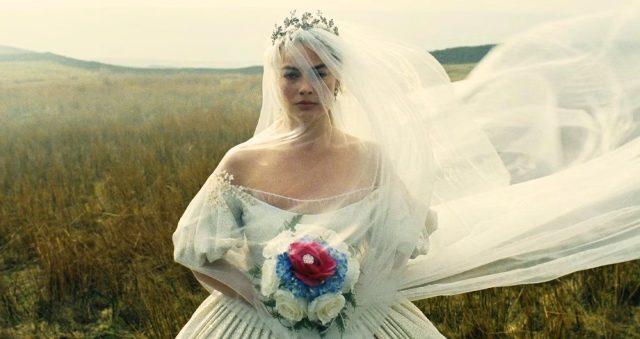
'This generation just doesn’t trust marriage' (Wuthering Heights)





It’s remarkable, if you think about it, how much of what we call “society” is about building containers of various shapes and sizes, both literally and figuratively. The houses that shelter us from the elements, the churches where we worship. Social mores and laws exist to contain our more depraved impulses, and prisons to contain the people who give into them anyway. We contain our memories in photo albums and our remains in memorial urns; we also, of course, have dustpans in which to collect the pieces when one of these shatters on the floor. Humanity is a messy, chaotic, fragile enterprise, and things are always breaking. Dishwashers. Wine glasses. Bones. Promises.
The prenuptial agreement is also a container of sorts, the kind you preemptively clap over a bomb before it explodes, to minimize the blast radius. When I got married in 2008, signing one of these would not have occurred to me. Prenups were for people who were coming to their marriages with something to lose, a fortune either made or inherited before the spouse came along. The rich divorcee, looking out for the interests of children from his first marriage; the heiress with family money and anxious parents; the elderly billionaire who wanted to hedge his bets against having a tragic accident while on honeymoon with his 25-year-old trophy wife. (The protagonist of my upcoming novel, a wealthy tech founder, has a prenup with an adultery clause: if her husband cheats on her, he won’t see a dime.)
But now the prenup is getting a glow-up, especially among Millennials and Zoomers who are signing them in droves. Brooklyn Beckham famously has one, as do Mark Zuckerberg and Kim Kardashian; Taylor Swift, after her fairytale engagement, reportedly brushed the stars out of her eyes and got busy with a contract to protect her fortune. But it’s not celebrities, who’ve always signed these agreements, who are responsible for their sudden popularity; it’s everyone. A recent poll found that 41% of engaged or married Zoomers, and 47% of Millennials, have entered into one.
The advent of the digital economy is no doubt a factor here; an article from The New Yorker notes the proliferation in recent years of “new apps such as HelloPrenup, Wenup, and Neptune that fast-track the process; the latter has couples discuss their finances with an AI chatbot before being matched, by algorithm, with a lawyer”. Surely, though, it isn’t only this. Algorithms and apps represent the supply; the demand, on the other hand, is cultural. The money quote comes from a 38-year-old consultant named Kaylin Dillon: “This generation just doesn’t trust marriage.” In other words, signing a prenup isn’t about protecting your assets. It’s about guarding your heart.
Perhaps this was predictable. What more inevitable fate for a generation raised on a steady diet of safetyism, complete with the notion that every interaction should have an escape hatch to protect one from emotional harm? A generation so hell-bent on litigating disappointment that they invented the concept of “nonconsensual ghosting”; whose playdates were arranged by their parents and whose messy breakups were mediated by deans; in whom has been inculcated such a horror of failing at anything, ever, that they have learned to live in a state of perpetual caution while eschewing vulnerability at all costs?
For 10 years in the 2010s, I wrote a teen advice column; about halfway through that decade, I started to notice a disturbing uptick in the number of letters, usually from girls, asking how a person might pursue romance “without getting hurt.” My answer, which invariably horrified them, was that this was impossible — that getting hurt is table stakes for getting to fall in love, which is why it’s lucky for us that falling in love is so terrific.
But the contemporary young person doesn’t necessarily see it that way. The decline of social trust — not just in marriage, but in other people; the rise of online communities where women gather to annihilate the reputations of the men who disappoint them; the lingering sense, in the wake of the MeToo movement, that men are so predatory and heterosexual relationships so fraught with danger that they’re hardly worth the trouble: these, to quote one Jon Bon Jovi, give love a bad name. And having been encouraged to gamify everything from their workout routines to their sexual encounters in search of safety and predictability, of course young people remain drawn to the friction-reducing promise of prenups, to the suggestion that we might never get our hearts broken at all if we just find the perfect container to cushion them, the perfect set of rules to govern their affairs.
It’s just that insofar as it works, it’s a great way to ensure you never feel much of anything, bad or good; certainly, you won’t experience the transcendence that all the songs and stories are about.
And it’s hard to think of a more potent illustration of the notion of setting yourself up to fail than entering a marriage with one eye already on the door, already thinking about what you want to take with you when you leave. To be planning how you’ll break free of your vows before you ever make them; to be asking yourself, “What do I want to take away from this?” instead of “What do I have to give?” The couple planning to wed should be like two people building a rocket to the moon, practically delirious with excitement for the journey they’re about to embark upon and faith in the person they’ve chosen to make it with. To introduce a prenup is to shatter the fantasy with pragmatic fatalism, redrawing the rocket to include a nice big escape pod — whose inclusion not only suggests the inevitability of failure but also paradoxically weakens the structure that was supposed to transport them to another world in the first place.
None of this is to say prenups shouldn’t exist. I’ve read enough murder mysteries and celebrity divorce memoirs to know that pre-marital contracts have their uses, just as I’ve read enough about the plight of women in the era before no-fault divorce to understand why lowering the bar to exit a bad marriage was a good development. Ironically, the rise of the contemporary prenuptial agreement may even signal a return to tradition, insofar as it suggests a view of marriage more in common with that of ancient people — who saw it as a means to transfer property, consolidate wealth, and form strategic attachments between families to accrue power and resources — than with the modern romantic.
But that traditional, transactional approach to marriage was a product of a time, and a system, in which women’s rights were limited; in the girlboss era, in a society organized around equal rights and individual self-actualization, it suggests a totalizing inability to let our guard down even when it comes to love, to family, to lifelong commitment. And if the impulse to contractually protect ourselves from heartbreak and betrayal is understandable, there are nevertheless tradeoffs to changing the way we think about our commitments to each other, to adopting norms that undermine their seriousness and strip them of their magic right out of the gate — because isn’t the entire idea of marriage to build something lasting, something that isn’t easy to dismantle, something it would cost so much to walk away from that you’d do it only as a last resort? Isn’t that why we mark the act of commitment with ritual, tradition, and an enormous amount of cake; why we make our vows in sacred spaces, in the sight of God, in front of our families and our communities? The purpose of all this ceremony isn’t just to celebrate love, but to make a promise for which you will, and want to, be held accountable.
The obvious defense of prenuptial agreements is that having one is simply good sense, on the order of having car insurance or a fire extinguisher in your kitchen. The trouble is that what’s sensible when it comes to fire safety can look terribly cynical when it comes to love — maybe even fatally so. Because to really make a go of it in love, in marriage, does require a certain sort of delusional belligerence. Not just to make the delirious leap together, but to keep leaping, like fools, forever, because the foolish act of leaping is everything. It’s the material the rocket of your marriage is made of; it’s the fuel that makes it fly. And maybe it’ll take a while to get there, and maybe it won’t always be easy, but who cares? Yes, who cares, when you’re going to the moon!
Kat Rosenfield is an UnHerd columnist and co-host of the Feminine Chaos podcast. Her latest novel is You Must Remember This.
 katrosenfield