




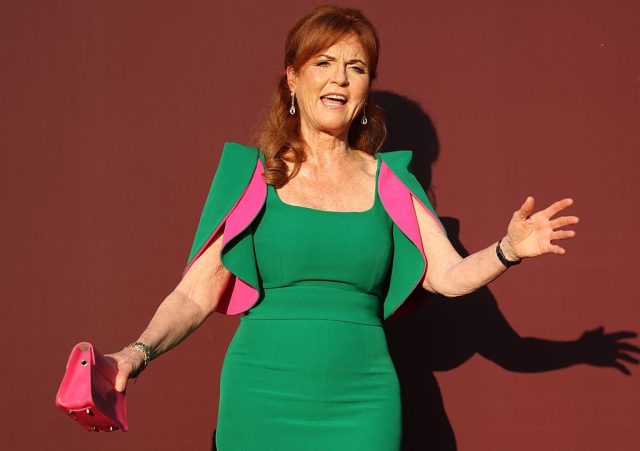
'Her 2000 collaboration with WeightWatchers was literally called Reinventing Yourself.'(Valery Hache / AFP / Getty)





Once upon a time there was a disgraced ginger Royal living in Montecito, and it wasn’t even Prince Harry. It was his aunt. According to her own book Finding Sarah, the then-Duchess of York spent two weeks in the Californian luxury community in 2010, trying “to calm the rough waters of my mind and soul”.
She had just been caught by journalists trying to sell foreign access to her princely husband for £500,000, and needed a reinvention story fast. She was eating compulsively and full of self-loathing. As she recorded dramatically in her diary at the time, reproduced in her book: “I don’t know how I will earn a living any longer. I need to rest, but I have to buy food… I must trust… God will provide what I need.”
God turned out to take the form of Oprah Winfrey. As we have learned from the new release of Epstein files, just after Fergie’s unfortunate encounter with the Fake Sheik, the financier emailed Ghislaine Maxwell with a link to an article about the sting: “I do not want this to lead to me.” Quite why he should have thought it would lead to him is unclear. But in any case, he was soon able to report happier news: his friend the impecunious Duchess was now “being sheltered under Oprah’s wing… Oprah decided she had talent and skill that could be used on her network”.
And indeed, some months later, a five-part series and book were commissioned by the media tycoon, entitled Finding Sarah: From Royalty to the Real World. The idea would be to capture an inner journey from disaster to self-understanding; from privileged cluelessness to inner wisdom born of adversity. Ferguson would be berated on camera by various therapists and financial advisors; do some “soul-searching in the desert” — surely better than in the dessert — and traipse for miles through the Canadian arctic, looking for herself. She would also get hypnotized and meet a horse-whisperer. As Winfrey, in classic kindly-but-firm mode, told the gushing royal in a call at the start of the series: “all you’ve got to do, and trust me with this, is to get really real.”
Hence the visit to Montecito, a miniature epic in itself. Hanging out with “a friend and spiritual counselor” called Anamika, the Duchess recorded she was there to work on her “ego”. Presumably to convey the depths of that struggle, another diary entry was included: “today the ego feels like a metal mask around my brain and head… It caused a buzzing in my ears. I started to get so angry and wished it would go away.”
Later in the same visit, apparently no longer beset by distracting buzzing sounds, things started to look up for our heroine. Staring into the abyss of her own soul, she became inspired by some Whitney Houston lyrics: “I tumbled but I did not crumble.” “Listening to this powerful song,” wrote the then-resident of the Royal Lodge in Windsor, “I pulled my shoulders back… and remembered the words of a refugee friend in Sierra Leone: ‘They can take my country, but not my soul’.”
Resilience unlocked, the chapter ends with an unexpected philosophical encounter. Conveniently popping up with some heartfelt peasant wisdom, a humble security guard at LAX airport tells the Duchess: “My name is Morgan, and I am from Wales. And I say every day that it is our duty to be happy.” Luckily for Fergie, she has finally met a duty she seems able to fulfill.
But writing her diary on the night of the Oprah deal months before this, she already seemed to be rallying. “Phew… we signed with OWN (Oprah Winfrey Network) last night. A whole new start.” And it certainly was. Until then she had been drowning in debt, thanks to compulsively profligate habits. There were exotic holidays, with missed flights and endless excess baggage fees; imperious demands to staff for watercress on ice at 4am; insisting breakfast be laid out for her “in three different locations each morning so she could have a choice”.
Also according to Andrew Lownie’s entertaining biography Entitled — from which these last details are taken — she was being sued for non-payment by her lawyers, and owed thousands to others. Creditors included an artist she had commissioned for a painting, a photographic studio in Woking, and even — plot twist! — a “Malibu-based spirit guide, known as Anamika”. And as the DOJ files now make clear, in 2009 she had also been emailing Epstein about money (“I urgently need 20,000 pounds for rent today”), and had taken her young daughters to visit when he was still under house arrest for sexual crimes against minors. There is no suggestion of criminal wrongdoing on the Duchess’s part; but on the other hand, there is a strong whiff of being a narcissistic venal moron.
Along with a gift of £1.5 million from her ex-husband, the money from the OWN deal put an end to all that misery, at least temporarily. But the connection with Epstein didn’t make it into the Finding Sarah book, and nor did it seem to come up in accompanying interviews she did with Oprah. In May 2011, Ferguson emailed Epstein: “I just want to make sure you know I am going on Oprah tomorrow. And she is going to ask me about my debts, the entrapment of last year and the press about you in Jan… I just want to make sure you are aware of this and seek your advice on how you would like me to answer.” In response, Epstein advised Ferguson to say he had been unfairly characterized as a pedophile, “repaid his debt to society and… sought forgiveness”.
He needn’t have bothered; the question did not appear in the final edit. There is no suggestion here that Epstein had any influence over Winfrey, nor that there was any meaningful connection between them; the internet’s attempts thus far to establish otherwise seem to be fake. Still, an opportunity was missed by someone enormously influential to interrogate a supine Ferguson about what she knew of Epstein’s crimes, and about the extent to which her royal influence was still greasing his wheels. That line of questioning looked like an open goal, and producers appear to have been aware of it; but in practice, there is apparently a limit to how “really real” you can get.
Presumably it would have over-complicated the simple — and extremely lucrative — narrative of redemption. Energized by the fascination with tearful sofa confessions as well as a spate of makeover shows, personal reinvention was massive in the early 21st century. You could get a new house, new wardrobe, new body, new teeth: so why not a new soul too? Later in the new DOJ files, Epstein asks Deepak Chopra: “Should we bring together Woody and Oprah?” Perhaps he had in mind another miraculous reinvention, though this one appears to have been a step too far.
The trope is all over the case, viewed in retrospect. Many of the major players have risen phoenix-like from the ashes several times. The scabrous man at the heart of it was readmitted into parts of high society after his first arrest. The former Prince Andrew was widely considered a waste of space until he joined the Navy, then became a hero, then became a waste of space again when he left. Ferguson was once so unpopular during the Nineties, that — again according to Lownie — the Friargate Museum in York “removed her waxwork from its collection, recycling it as Nell Gwynn”. Even so, she bounced back afterward to something approaching public affection.
Her 2000 collaboration with WeightWatchers was literally called Reinventing Yourself, and there was yet another slim volume, published just two weeks before the cash-for-access furor, poignantly entitled What I Know: Simple Lessons Learned the Hard Way. And of course, the other notable British person caught up in Epstein’s circle is Peter Mandelson, a man with more regenerations behind him than Dr Who. Each new Mandelson fall from grace was absolutely irrevocable, until it wasn’t. Undisclosed loans, major conflicts of interest, dodgy passport applications, free cruises; they all just bounced off.
In the case of Ferguson — and perhaps Mandelson too, in his recent stint as US Ambassador — the fact of intercontinental ricochet must have helped. When a native son or daughter’s reputation is toast in Blighty, just head to the States and sell something with no currency whatsoever back home — the very fact of your Englishness. The covering up of personal failings seems to go better when your listeners think of you as a character from Love Actually.
Rejuvenation accomplished and back at home in the rain, your newfound Yank-reflected glory will move weaker-minded Brits to consider you redeemed too. As Andrew knows to his cost — and Keir Starmer might be about to find out — homegrown displays of self-justification and pleas for forgiveness don’t tend to go very far here with a skeptical public. But when they come pre-approved Stateside, somehow the bullshit element can get obscured.
In its time, the Oprah industry beloved by millions of women across the globe — the shows, the magazine, the book club — was criticized for its emphasis on individual responsibility, hiding the detriment of structural conditions like poverty or racism. A more basic point is that rarely was real responsibility preached at all. Instead, there was a cult of monstrous self-involvement, full of magical thinking and vacant platitudes like “look inward — the loving begins with you”, and “turn your wounds into wisdom”.
Once named out loud on the couch, personal flaws were treated as usurpers, inevitably rooted in past trauma, occasionally overwhelming you. In Finding Sarah, giddy from the attention of various Oprah-approved therapists, Ferguson is always blaming her “people-pleasing” tendencies, seemingly envisioning them as entirely separate homunculi that have inexplicably got hold of the inner joystick. And the solution is always more self-acceptance and self-forgiveness, not less.
For Oprah was first and foremost a businesswoman, and her aim was always to capture consumers. She did that best by providing salacious glimpses of the stars and feel-good fairytales about redemption, not difficult nor complicated moral lessons. And if, in the process, she ended up inadvertently laundering the reputation of a pedophile rapist at one remove — specifically, by laundering the reputation of the princess who was taking his money and inviting him to Buckingham Palace for tea in return — then perhaps she now tells herself that it is all OK; that she can offset the mistake with good deeds like it was a carbon footprint. After all, self-forgiveness in her world comes fairly cheap.
Or maybe she has calculated that, with the right sort of careful treatment, it will make for the mother of all confessional formats later on. A wide-eyed Fergie will rise from the dead once more and sit on the sofa, saying she’s terribly sorry and blaming the incessant buzzing of her ego, or those irrepressible people-pleasing tendencies. Sources say the Palace is already worried she intends to take another massive wodge from Oprah to spill the beans on Andrew’s sexual interests, but there is “not much they can do to stop her”. That watercress is not getting iced by itself; and nor is the public hunger for tearful self-abasement and spiritual metamorphosis going away anytime soon. Come to think of it, it might be a good time for that museum to put Nell Gwynn back into the melting pot.
