




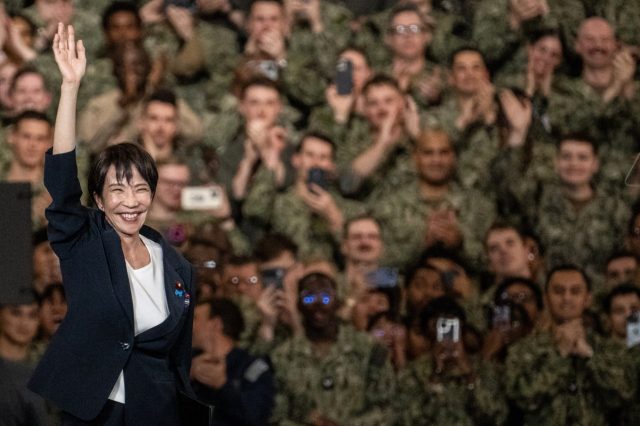





Sanae Takaichi made history last October by becoming Japan’s first female prime minister. Just over a week ago she made it again by leading her ailing party – the Liberal Democratic Party (LDP) – to a landslide victory in a snap election, winning a larger proportion of seats in Japan’s powerful lower house than any other party since the end of World War II. The LDP now enjoys a “supermajority,” meaning that, if necessary, it can override the upper house in pushing policies through the Diet.
Commentators agree that most of the credit here is due to Takaichi herself, and to those around her, for making a wildly successful gamble on her personal popularity. “Sanamania” gripped the country during the short election campaign as people queued up to buy Takaichi’s trademark black leather handbag and her famous pink pen. While Japan’s humiliated opposition, the Centrist Reform Alliance, picks itself up off the floor, the country’s currency is riding high — suggesting at least modest market confidence in what Takaichi’s reign might bring.
The question now is what Takaichi may do with her mandate. The last time a comparably emphatic victory was won in a Japanese election, back in 2012, it marked the start of Shinzō Abe’s long and decisive premiership. Those hoping for strong leadership on Japan’s domestic challenges — its intertwining demographic and debt crises — and on regional tensions in the Asia-Pacific, will be looking to Takaichi to deliver. She is due in the United States in mid-March to meet Donald Trump; a few weeks later, President Trump is expected to make his highly-anticipated visit to China. A reset in East Asia is on the cards — but what does Takaichi want?
The Prime Minister’s reputation is that of a China hawk. Last November, she angered China’s leadership by appearing to suggest that Japan’s Self-Defense Forces might be deployed in the event of an armed Chinese attempt on Taiwan. This violated a long-standing Japanese policy — mirroring that of the United States — of strategic ambiguity when it comes to what the country might do in the event of a “Taiwan contingency,” as the standard euphemism goes. The Chinese response was swift: a ban on Japanese seafood imports, the shutting down of Japanese films and music concerts in China and hints dropped about restricting supplies of rare-earth minerals to Japan.
Evidence from the campaign trail, however, suggests that Takaichi’s refusal to apologize for her remarks helped her cause with the Japanese electorate. Public opinion on China is hardening, while long-standing opposition to the Self-Defense Forces — particularly among older Japanese, committed to post-war pacifism — has softened in recent years. This will give Takaichi confidence in continuing the pivot, from defense to active deterrence, that she inherited from her predecessors.
Takaichi has already brought forward a target of spending 2% of Japan’s substantial GDP on defense, from 2027 to March this year. She is lavishing money on south-western Japan, near Taiwan, and on sites around the country’s coastline. Japan is also making heavy investments in aerial, surface and underwater drones, alongside long-range strike capabilities including American Tomahawk missiles. Japan’s comparatively small domestic defense industry is now being developed at pace. Mitsubishi Heavy Industries enjoyed a landmark win last year when it was awarded the contract to build Australia’s next-generation frigate.
For Takaichi, these moves promise a triple benefit. They signal to China that Japan is serious about its defense. They reassure an ever-transactional Donald Trump that, as requested, Japan is doing more towards its own security. And they build Japanese resilience for the day — should it ever arrive — when American interest in the Asia-Pacific region begins to recede.
Even if its interest fluctuates over the years to come, the US will always have to pay careful attention to what is happening across the Pacific. The downgrading of the threat from China in the latest US National Security Strategy no doubt came as a shock in Tokyo, but the basic underlying geographic and strategic realities haven’t changed. Japan remains the most important link in the “First Island Chain”, which runs from the Kuril Islands down to Borneo and constrains Chinese access to the Pacific. The US-Japanese aim remains, for now at least, the cultivation of a coalition that is capable of balancing out Chinese economic and seaborne military power in the Asia-Pacific and maintaining freedom of the seas.
Key to these efforts are the Quad (Japan, the US, India and Australia), ASEAN (the Association of Southeast Asian Nations), and a series of bilateral relationships including Japan-Vietnam and Japan-Philippines. Japan has been remarkably successful in cultivating regional relationships in recent years, using Official Development Assistance (ODA) to fund the building of ports, railway systems and more in countries like Vietnam. Japan also has an ODA-funded agreement in place to fund the building of six patrol vessels for the Vietnam Coast Guard. In the Philippines, Japanese finance is contributing toward new roads, new bridges and the Metro Manila Subway Project.
A major question for what may become a historic premiership is what use Takaichi has for the past. Looming over Japan’s relationships with China, Korea and its Southeast Asian neighbors is the grim and ever-contested history of Japan’s 20th-century empire. A regular refrain in postwar Chinese critiques of Japanese defense spending, right up to the present day, has been that it risks awakening a dormant militarism. Those critiques hold less weight now that China is expanding its naval and nuclear capabilities at a rapid rate. But attempts by Japanese governments as recently as the Seventies and Eighties to woo Southeast Asian neighbors with economic assistance foundered on a perception of Japanese self-interest — even, in some quarters, neo-colonialism. Originating with postwar reparations, much of that aid and investment looked suspiciously like an attempt to find profitable outlets for Japanese export goods, helping it to rebuild its war-ravaged industries.
Japan has had a happier history with Southeast Asia in the decades since, but Takaichi’s personal convictions demand that she look backwards as well as forwards. She has declared her desire to revise Japan’s American-authored postwar constitution in order to clarify the role of the Self-Defense Forces. She is a member of Nippon Kaigi (Japan Conference), a powerful conservative lobby group dedicated to a traditionalist vision of Japan with the Emperor at its core. And she is now mulling a first visit as prime minister to Tokyo’s Yasukuni shrine — a lightning-rod issue in East Asia. The shrine’s original purpose was to honor Japan’s war dead from the Boshin War of 1868-9 but it also commemorates those who died in Japan’s mid-20th century wars. Any potential visit pits those in Japan who wish to honor their war dead with those in countries like China and Korea who focus on the fact that among the 2.4 million souls enshrined at Yasukuni are convicted war criminals from World War II.
Relitigating these controversial episodes and cultural consequences — which many in Nippon Kaigi equate with excessive Americanization following Japan’s defeat in 1945 — may well prove counterproductive. If Takaichi wants to revisit that period, she would be better off studying the intensifying perception in Japan, around a century ago, that it was becoming encircled by hostile powers: Soviets, Chinese nationalists, Europe’s Asian colonies and the United States. China may soon find itself in a similar position. It may feel it is surrounded by insufficiently friendly countries just at the point where an aging population and a slowing economy suggest that the window for reorganizing its neighborhood is beginning to close.
A careful reading of the past may also help Takaichi and her administration think through China’s likely long-term intentions. This is a topic on which analysts around the world are deeply divided. There are those, in the United States especially, who believe that Chinese reluctance to pronounce on the internal affairs of other countries is about current capabilities rather than political culture. Once its military is able to project power in the way that the United States can, and European nations once could, then we will begin to see a more interventionist China.
Another way of reading the past and present is that the benefits of territorial or maritime expansion are not what they once were. Power and prosperity in the mid-21st century rest more on economic and commercial leverage than boots on the ground. Taking direct responsibility for other countries’ affairs is both risky and costly, and Takaichi’s conclusion may be that China seeks prestige rather than empire. Rather than replace the US as global policeman, it may simply want to do away with that role, exchanging a postwar international culture of liberal cooperation under American auspices with one defined by national self-interest and multipolarity. But this may happen slowly. China will want to avoid the risk of upsetting its highly globalized economy and meanwhile allow the impression to set in that it is a natural rather than a managed transition.
Perhaps Japan could live with this. It could maintain credible self-defense while continuing an economic partnership with China that is currently valued at around $300 billion per year and involves deep integration of Chinese and Japanese manufacturing. It is worth remembering that for all the appearance of an unassailable position in China’s national life, the principal source of the Chinese Communist Party’s appeal is its ability to raise living standards and restore Chinese pride internationally. Takaichi’s own party dominated Japanese politics for nearly four decades on much the same basis, beginning in the mid-1950s. She knows only too well how quickly public support can drop away once people no longer see the expected returns. There is a limit to how far China and Japan’s political arrangements can usefully be compared. But the CCP’s leadership appreciates that when it comes to getting people to do what they want, even a very high-tech stick requires a little carrot alongside.
For now, then, it is in both Japan and China’s interests to continue their economic co-operation, even while Japan and its partners try to balance out Chinese attempts at gaining economic leverage in parts of Asia, Africa and South America via loans, investments and supply-chain dependency. Japan is already at the forefront, globally, of reducing reliance on China as a supplier of key components and raw materials including rare earths. That leadership role may expand under Takaichi.
There is one last way in which Takaichi might usefully look back in order to forge a path forward. It is not so much a clear-cut lesson as a question: at what point does a relationship between rival nations shift from prioritizing prosperity through economic co-operation to allowing strategic aims or fears to dictate their actions? And what, if anything, can Takaichi do to prevent that shift occurring when it comes to Taiwan? If hers ends up being a lengthy premiership, it is highly likely that the Taiwan question will be “resolved” on her watch.
For all the anger in China when Takaichi made her comments last November about the Self-Defense Forces becoming involved in a conflict over Taiwan, the chances of Japan remaining unaffected by a Chinese attempt on the island are slim. War games consistently emphasize the importance of Japan as a re-supply base for US forces responding to such an attempt and as a source of essential supplies for the Taiwanese population in the event of a Chinese maritime blockade.
There is a chance that China may yet engineer a peaceful takeover of Taiwan. The island’s domestic politics are divided and China is making ongoing efforts to normalize such an outcome both in Taiwan and internationally. This, however, would hardly bring tensions in the region to an end. Japan would face the very dangerous scenario of having the People’s Republic on its doorstep — visible, on a clear day, from the south-western Japanese island of Yonaguni.
This would be worrying enough for Japanese security. But the next question would be whether or not China’s strategic aims end there. From the Chinese point of view, taking Taiwan is a matter of bringing a renegade province to heel rather than expanding its borders. In time, however, that same logic could be used to make and perhaps enforce a claim over some or all of the Okinawan islands — of which Yonaguni is one.
At present, such claims appear periodically in Chinese media and academic writing, rather than in government pronouncements. Still, they are encouraged by China’s leadership at times of tension with Japan, including late last year in the wake of Takaichi’s comments about Taiwan. And for analysts who suggest paying more attention to the balance of military power than to political rhetoric — or indeed to what historians or legal scholars might argue about Okinawa — it is not beyond the bounds of possibility that soon after talk of a “Taiwan contingency” ends, talk of an “Okinawa contingency” might begin.
Even if China had no intention of pursuing a sovereignty claim on the Okinawan islands, the stoking of nationalist sentiment in China would be useful to the CCP while the effects on Japan could be profound: a drop in international investment and a constant sense of threat — after all, if China’s leaders proved willing to act on their Taiwan rhetoric, why wouldn’t they do so on Okinawan rhetoric too?
Takaichi’s political leanings mean that the past is often on her mind, as it was for her mentor Abe. As she sets about reviewing Japan’s National Security Strategy this year — while continuing to woo Donald Trump and perhaps thawing her relationship with Xi Jinping — we must hope for a creative and purposeful approach to Asia’s history. The wrongs and the suffering of the 1930s and 1940s are not to be forgotten. But the stakes are now too high for indulging in the weaponization of those wrongs and that suffering. Rather than refighting the last war, we must focus on preventing the next one.
 drchrisharding