




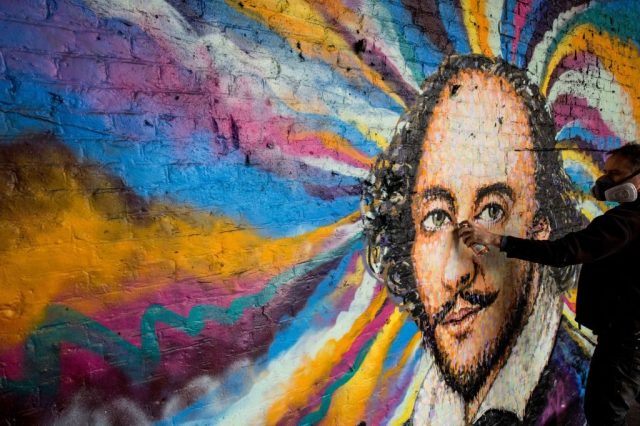
Irene Coslet is the latest Shakespeare conspiracist (Chris J Ratcliffe / AFP / Getty)





One of the curiosities of the culture war is that we are often compelled to restate the obvious. Books have been written to remind the public that evolution is real, that human beings cannot change sex, and that most citizens prefer liberty to tyranny. In accordance with this trend, it seems prudent now to point out that William Shakespeare was not a black woman.
Such an asinine statement has only become necessary because of the appearance of a new book, The Real Shakespeare: Emilia Bassano Willoughby, written by a feminist scholar called Irene Coslet. A combination of outrage and incredulity has ensured that it has received widespread media coverage. Articles have been published in The Telegraph, The Standard and the Express, among numerous other outlets. I even discussed the book during my appearance this week on The Joe Rogan Experience, the biggest podcast in the world. Whatever else you might say about Coslet, she has played this beautifully.
That said, nobody has yet raised the possibility that Coslet may not actually exist. At a time when wild conspiracy theories are uncritically accepted, and activists are busy “decolonizing” every great achievement of Western civilization, I can see why a polemic about a black female Shakespeare might seem a viable commercial project. But we should not dismiss the idea that Irene Coslet is a pseudonym for a humorist seeking to excoriate the fraudulence of academics with a monomania for identity politics. The Real Shakespeare is so shoddily written and evidence-free that it seems implausible it would have reached the publication stage unless there was some kind of mischief afoot.
Consider the author’s credentials. The website of the publisher, Pen & Sword, informs us that Coslet is an “expert” with “several degrees”. Though in her publicity photograph she appears to be in her early twenties, she has apparently “studied feminism for 20 years and has been involved in the promotion of gender equality in multiple organizations and countries around the world”. Was she a feminist from the crib? And why does such a pioneering globetrotter have no online presence or appear in any academic databases? No articles, no conference appearances, not so much as a Facebook post.
All of which is entirely apt for a book that explores the notion of false identities. My request to the publisher for more details on the author’s background was met with silence, and so I suppose I should proceed with generosity and assume that Coslet is a real human being who is making a genuine case. After all, the London School of Economics claims her as an alumnus, and has posted an article to publicize the new book which is worth reading just to give you a flavor of the absurdity of its central thesis.
Emilia Lanier (1569-1645), née Bassano, was a poet of Jewish heritage whose purported Mediterranean complexion has been interpreted as suggestive of Moorish ancestry. This point has been seized upon by Shakespeare conspiracists ever since the historian A.L. Rowse in the Seventies tenuously identified her as the “dark lady” of the sonnets. Coslet insists that Lanier “was a Moor”, but no evidence for this has ever been discovered and, of course, none is provided in The Real Shakespeare.
Surely the contention that Shakespeare was a black woman is inevitably undermined when the proposed candidate wasn’t actually black? Similarly, Coslet’s claim that Lanier could not write under her own name because at the time “women were marginalized, silenced, and certainly not allowed to write and to publish” makes Lanier an odd choice given that she was a published poet. Her volume of trudging verse — Salve Deus Rex Judaeorum (1611) — should be evidence enough that she was no Shakespeare.
Still, Coslet knows best. She opens her book with a pencil drawing of the “real Shakespeare” that unequivocally depicts the bard as a black woman. And what is the origin of this incredible find? Well, it turns out that Coslet drew it herself, and that “sketching was an integral part of the Author’s research in the recovery of Emilia Bassano”. Who needs primary sources when you can create your own?
By now we are firmly in the realm of satire, whether intentional or otherwise. The self-congratulatory capitalization of “Author” is perfect. So too is Coslet’s use of the royal “we” in her breakdown of the chapters (“We will demonstrate that the mother of the English-speaking world is a tawny-black, Jewish woman”). The peak of her audacity is reached when she repeatedly draws comparisons between her own work and the “paradigm shift” actuated by Copernicus in the field of astronomy.
It gets better. Coslet refers to her own method of excavating the plays for biographical clues as the “correct paradigm”. For good measure, she throws in the writer Robert Greene as another of Lanier’s male pseudonyms, one she “adopted in her early career, to have her works published, before she became Shakespeare”. Having decided that Lanier must be Shakespeare, Coslet realized that “if it true [sic], then there must be a way to prove it… To my surprise, the methodology worked”. Peter Wason, the psychologist who coined the term “confirmation bias”, can rest easy in his grave.
The theory that Lanier was Shakespeare is not original to Coslet. It was first proposed by John Hudson in Shakespeare’s Dark Lady (2013) which, though more elegantly written than Coslet’s book, also claims that “racist and sexist assumptions” underlie the view that Shakespeare was a white man. Like Coslet, Hudson argues for a new “paradigm” in solving the authorship question. Specifically, documentary evidence is to be rejected in favor of speculation and the interpretation of the canon through an autobiographical lens. Hudson explains that his previous job had been “creating new paradigms and new industry models in high-tech industries”. It turns out that such skills are not transferable to literary scholarship.
To give an example of Hudson’s preposterous “paradigm” — which is really just the ancient error of assuming that authors are always writing about themselves — he finds clues in Shakespeare’s works that reveal not only that Lanier wrote them: but that she was having an affair with the reputedly gay playwright Christopher Marlowe and became pregnant with his child. “If we read the poem A Lover’s Complaint autobiographically,” Hudson writes, “it would appear to be a poem about a girl betrayed by a man rather like Marlowe.” Well, I’m convinced.
But for sheer entertainment value, Hudson is dwarfed by Coslet. From her immortal pen I have learned that “Shakespeare was well aware of sounds, and how sounds can be used to convey meaning”. And did you know that “scholars have realized that Shakespeare spoke fluent Hebrew”? Coslet neglects to specify which scholars have made this astonishing claim; such trivial details aren’t important. Then there is her contention that “the myth of Stratford man fits perfectly into the patriarchal narrative” that “a businessman can turn into an artist if he puts his mind to it”. What kind of obscure patriarchal narrative is this? And wasn’t Shakespeare an artist before he went into business? Never mind. Let’s not get bogged down in all these pesky “facts”.
The evidence is there if you really want to see it. One of Coslet’s great discoveries is that the face of Emilia Lanier is hidden within the engraving of Shakespeare in the first folio of 1623. One need only fold the image in a certain way and — hey presto! — “the magic happens” and “the face that has been hiding behind the portrait” is revealed. Coslet doesn’t offer a diagram of the effect, which would of course be too easy, and instead spends 19 pages explaining how the process works.
And, of course, there is the obligatory anagram. These dyed-in-the-wool Stratfordians had better come up with a reason why the letters of “Shakespeare” can be rearranged into “a she speaker”. Case closed, surely. Though if we’re really going to play this game, it might be worth pointing out that Irene Coslet is a precise anagram of le crétin ose, which is French for “the idiot dares”. Is she trying to tell us something?
My favorite part of The Real Shakespeare is when Coslet tells us that her theory came to her in a dream. This is her account of the moment she realized she had been chosen as the anointed vessel of revelation:
“In 2018, something happened that changed my life. I was going through a period of transition. It was one of those chaotic times in life. I was getting ready to move abroad. I was in the middle of move [sic] and I was packing. My luggage was scattered everywhere in my room. Completely overwhelmed, I decided to take some rest and just lay down on my bed for a second. In that moment, as soon as my head hit my pillow and I closed my eyes, a bolt of lightning came out of nowhere. These words hit my mind: ‘Shakespeare was a woman’.”
At this point, we must begrudgingly offer our congratulations. Whether Coslet is a satirist or simply delusional, she has against all odds found a publisher for her book and achieved the kind of publicity for which any new writer would sacrifice many a limb. It could be that this conspiracy theorist is so ingenious that she has gulled me into concocting one of my own. But whatever Coslet’s intentions, she (or he) definitely knows how to sell a book.
