




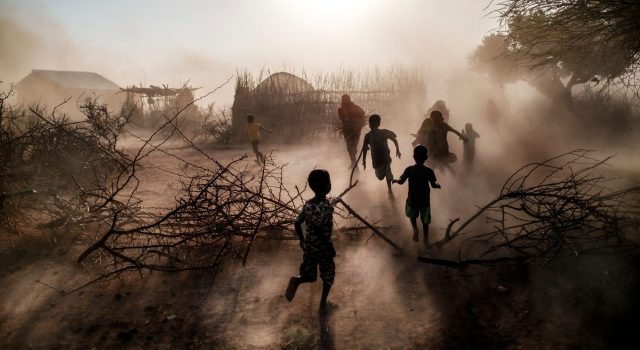
What happens the day the taps run dry? (Eduardo Soteras/AFP/ Getty)





It is no coincidence that the world’s first cities were built where water was abundant. From the Nile and the Yangtze to the Thames, reliable access to freshwater allowed settlements to grow into cities. Water not only mattered for drinking, but for hygiene, waste removal, agriculture and transport. Rivers were arteries of commerce as much as sources of life: where water flowed, cities prospered; where it failed, they declined. Anyone who saw the Nile, wrote Herodotus 2,500 years ago, needed only the most “basic powers of observation” to realize that Egypt was “the gift of the river”.
Today, we are already in the midst of a deep and deepening crisis of water availability. Though more than 70% of the world’s surface is covered by the stuff, almost all of it is seawater. In fact, on average, only around one in every 10,000 drops is accessible freshwater that humans can easily use. Demand for it has surged as global populations have grown, diets have changed and cities have expanded into arid regions from Riyadh to Mexico City.
With cities expanding faster than the water systems that sustain them, what was once a mere constraint has become a defining crisis of the 21st century. At the same time, the ways we live have depleted water sources or made them unusable — either because of pollution, because groundwater is being extracted faster than it is being replaced, because rivers are being dammed and diverted, or because natural buffers like wetlands are being reclaimed for other uses.
In 2023, the UN World Water Development Report warned that humanity’s relationship with water had become dangerously extractive, describing modern water use as “vampiric” and noting that around 3.5 billion people already experience severe water stress for at least one month every year. The problem has only become worse since the UN study was written.
A major report by the United Nations University Institute for Water, Environment and Health published last month put it bluntly: we have now entered an era of “global water bankruptcy” in which societies are living beyond their hydrological means. Today, it notes, nearly three quarters of the world’s population lives in countries that are water-insecure or critically water-insecure; around 2.2 billion people still lack safely managed drinking water; groundwater depletion and land subsidence are already irreversible in many regions; and shrinking lakes, rivers and glaciers mean future supplies will become more scarce even if demand stabilizes.
Over the past 18 months, there has been much talk about how rare earths will rule our century. Yet with half of the world’s 100 largest cities located in areas of high water stress, and many inhabitants seemingly oblivious to the risks, urban planners and policymakers are increasingly talking about “day zero”: the moment our taps run dry. The consequences could yet define our age — arguably far more than neodymium or cerium ever will.
Already, the signs are ominous. In 2017, for instance, Cape Town came within a hair’s breadth of becoming unviable, with city officials poised to shut down water infrastructure and tell inhabitants to gather rations from distribution points. Other major cities — as far afield as São Paulo and Istanbul — have struggled too, with some reaching genuine crisis. In June 2019, for instance, all four of the city’s main reservoirs in Chennai ran dry, forcing the Indian city’s 11 million residents to queue to wait for a small allocation of water brought in by trucks. In December, meanwhile, Tehran’s supplies came perilously close to exhaustion; Iran’s president, Masoud Pezeshkian, even talked of having to evacuate the capital.
It is not just far-off places that are at risk here. Strikingly, a host of cities in well-resourced countries are also finding themselves under pressure — including Los Angeles, New York, London. The case of the UK is instructive. Last May, Steve Reed, then the environment secretary, warned that “rapid population growth, crumbling infrastructure that has been left to decline, and a warming climate mean the UK could run out of clean drinking water by the middle of the next decade without a major infrastructure overhaul”. Such concerns are not new. As far back as 2010, almost a fifth of the territory of the European Union, and more than 10% of its population, were already exposed to water scarcity.
How, then, have we got to a position where global freshwater demand is expected to outstrip demand by 40% not in some abstract future — but in just four years time, by the end of this decade?
There are multiple overlapping factors at play here. The most obvious is demographic. The global population has more than doubled since 1970, meaning there are billions of new consumers of water for drinking, sanitation, food and energy. Patterns of consumption have also changed. For instance, data centers require vast volumes of freshwater to cool their servers. That figure already stands at roughly 560 billion liters a year, and, as cloud and AI workloads expand, could double by 2030. Just one facility gobbles up millions of liters of water a day, the equivalent to the annual household needs of tens of thousands of people.
It is hardly surprising, then, that engineers and policymakers have begun to explore radical alternatives — from relocating data centers to cold climates, to offshore platforms, or even to space, where cooling could be achieved without competing for scarce resources on Earth. The problem, though, is that for every step forward, humanity takes two back.
After all, massive man-made interventions in water systems mean that resources have been reallocated, redistributed and diverted, transforming ecosystems in potentially dangerous ways. China has built, on average, at least one large dam every day since 1949, and indeed now has more large dams than the rest of the world combined. But these dams can cause issues all their own. While they provide hydropower and irrigation, they also trap sediment, alter river flows and reduce downstream water availability, often exacerbating shortages for farmers and cities far downstream.
Alongside this, the past three decades have seen the fastest and greatest urbanization in history. More than half of humanity now lives in cities, with many expanding into regions that were never hydrologically suited to support large populations. Urban growth concentrates demand, often far from reliable surface water, leading cities to rely heavily on groundwater. That is not helped by inefficiency: in the UK, for example, an estimated three billion liters of water are lost every day because of leaks and decades of under-investment in pipes and treatment systems. Pricing too often fails to reflect scarcity, while governance struggles to keep pace with growth or adequately regulate water companies. The result is widespread inefficiency and uncontrolled extraction, with water treated as an inexhaustible input rather than a finite asset.
Indeed, the scale of groundwater extraction has reached levels that are reshaping the planet itself. Scientists have shown that so much water has been pumped from the Indo-Gangetic plains in northern India that the redistribution of mass has measurably shifted the Earth’s rotational axis, contributing to the movement of the geographic poles by several centimeters per year — something that has an impact on GPS accuracy, satellite navigation, and the precise measurement of time and space on which modern technology depends.
One small comfort, at least, is that such upheavals — in principle if not scale — only fit the pattern of history. One of the earliest recorded wars, fought more than 4,500 years ago between a pair of Mesopotamian city states, was triggered by disputes over irrigation canals and access to river water in the fertile lands between the Tigris and Euphrates. Stone inscriptions describe the destruction of dikes and canals as acts of aggression. From the very beginning of recorded civilization, then, control of water meant power, prosperity and survival: and denying it to others was a means of coercion.
Combined with those bubbling demographic and technological pressures, it’s unsurprising that this ancient pattern has only accelerated. Since 2022, incidences of water-related violence have almost doubled worldwide. These incidents range from attacks on pipelines and dams to protests that turn violent when communities lose access to drinking water or irrigation. In central Nigeria, for instance, clashes between farmers and pastoralists, driven in part by shrinking rivers and degraded grazing land, have killed thousands over the past decade, with entire villages burned and populations displaced. In Ukraine, meanwhile, the destruction of the Kakhovka dam in June 2023 unleashed catastrophic flooding downstream, cut off drinking water to large parts of the south of the country, and demonstrated how water infrastructure itself has become a direct weapon of war.
Looking ahead, several flashpoints stand out. The Indus basin is among the most dangerous. Under the Indus Water Treaty, India and Pakistan share one of the world’s most complex water systems. Signed in 1960, and often cited as a rare success of Cold War diplomacy, it was among the earliest major transboundary water treaties registered with the United Nations. Yet now, rising demand, glacier retreat in the Himalayas and infrastructure development upstream have all put the treaty under strain, with water increasingly framed in nationalist terms on both sides of the border. “I would like to tell the younger generation how this country was ruined,” as Narendra Modi put it in May 2025, adding that reading the Water Treaty today would leave Indians shocked. Combined with similar sabre-rattling from Pakistan, and things could easily escalate — with consequences that could easily transcend the Himalayas.
There’s scope for diplomatic blunders elsewhere, not least in northeast Africa, where Ethiopia’s Grand Renaissance Dam is reshaping power dynamics along the Nile. While Addis Ababa has viewed this enormous project as essential for development and energy security, Egypt has long feared existential threats to its water supply: over 90% of its freshwater comes from the river. Despite years of negotiations, no comprehensive agreement has been reached, leaving water as a persistent source of diplomatic and potentially military tension.
In the autumn of 2025, Egyptian Foreign Minister Badr Abdelatty warned the UN Security Council of Ethiopia’s “unilateral actions” and affirmed that Egypt “will not allow its water rights to be compromised and will take all measures guaranteed by international law and the UN Charter to defend the existential interests of its people”. Such statements are not just warnings — but implicit threats of armed conflict.
And if that again hints at how human foibles can mix with water politics to worrying effect, Western countries aren’t immune either. One might look, here, at water agreements between the United States and Mexico over the Colorado River and the Rio Grande, and which are being tested by prolonged drought, shrinking reservoirs and competing demands from agriculture, cities and natural ecosystems. Especially in the age of Donald Trump, where coercion is an increasingly popular tool for settling disputes, it isn’t hard to see how treaties signed way back in 1944 are either deemed void — or else renegotiated to American benefit and Mexico’s loss.
Another complicating factor is the way global climate patterns are shifting, unevenly and unpredictably. Some areas are experiencing far wetter conditions than historical norms, while others are becoming markedly drier. The problem is not simply scarcity, but volatility. Rain increasingly arrives in the wrong places, at the wrong times and in the wrong quantities. Long-standing assumptions about seasonality — when rains come, how long they last, how rivers respond — are breaking down.
These swings matter because infrastructure, governance and social systems are built for averages, not extremes. Pipes, reservoirs, canals and drainage networks were designed for a climate that no longer exists. To return to India, having effectively run out of water in 2019, Chennai upgraded its reservoir systems — only to be hit two years later not by drought, but by devastating floods.
The good news is that many of the technical tools to address water stress already exist. Desalination has expanded rapidly, particularly through advances in reverse osmosis that dramatically reduce costs and energy use. Wastewater recycling, stormwater capture, smart metering and leak detection can stretch existing supplies much further. Artificial intelligence and advanced modeling offer the possibility of optimizing distribution, forecasting shortages earlier, and managing systems dynamically rather than reactively.
Yet technology alone is not enough. Today’s world is also one of predation, in which vulnerabilities are increasingly easy to identify and exploit. Water infrastructure can be sabotaged, politicized, weaponized — as has happened in Gaza and Ukraine. Data systems can be manipulated. Dependence on single sources or cross-border flows can be turned into leverage. All the while, global governance looks fragile. International cooperation is strained as the world order buckles and cross-border solutions, essential for rivers, aquifers and shared basins, appear increasingly precarious.
Some may still hope that markets or innovation will quietly resolve the problem, and extraterrestrial data centers may yet do something to help. But water does not behave like other commodities. It is local, finite, and political: unlike rare earths or hydrocarbons, water cannot be stockpiled at scale, substituted or shipped across oceans to smooth out shortages; it must be consumed where it falls or flows. So when water is scarce, there is no global market to arbitrate supply — only hard decisions, made locally, about who goes without. In a century defined by ecological pressure, then, water sits near the top of the hierarchy of risks. This is not because it is unsolvable, but because it is foundational.