




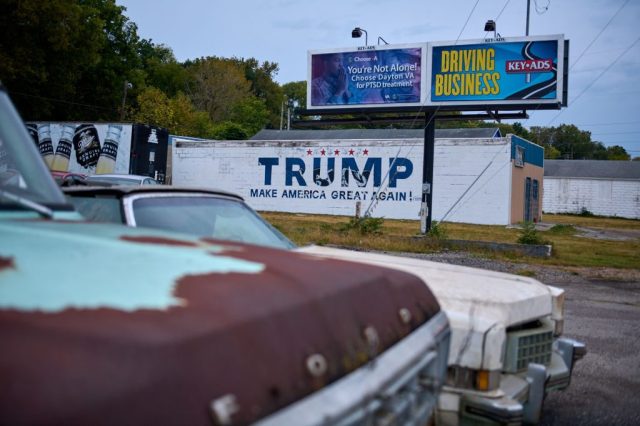
Springfield, Ohio. (Dominic Gwinn / Middle East Images / AFP / Getty)





“They’re screwing over their own constituents,” said a House Democrat about the Republicans on Tuesday. There are street protests against ICE and real fury at the administration’s handling of the Epstein files. But the first chink in Donald Trump’s hitherto impregnable Congressional armor came from elsewhere. The tariff agenda has now run into obstacles which look likely to only get bigger.
Earlier this week, House Republicans moved a motion which would have put off a vote on Trump’s tariffs. Three of their members, however, crossed party lines to join all their Democratic colleagues to block the motion. The Democrats will now be to table motions to roll back the tariffs and, in fact, did so promptly, passing a resolution the next day to terminate the ones imposed on Canada. And while the measures are unlikely to succeed — Trump can simply veto the resolutions, even if the Senate can be persuaded to back them — the Democrats will keep jabbing at this fissure like a boxer targeting an opponent’s eye’s wound. They won’t stop driving home the message that Republicans are on board with Trump’s trade war.
It therefore seems likely that more Republican dissidents will surface in the months ahead — the total already rose to six on the Canadian vote — because the tariffs are becoming a political albatross. With polling suggesting that a large majority of Americans, and even a quarter of Republicans, oppose tariffs, the future of Trump’s trade policy is undecided.
The risk that the Republicans would lose their slender majority in November’s House elections was always high. But until recently it was considered a near impossibility for the Republicans to lose the Senate majority. Now, though, the betting markets give Democrats a better than one-in-three chance of seizing the upper chamber too, and the odds have been slowly narrowing. Amid this febrile atmosphere, a growing number of Republicans caught between the monster of Trumpian wrath and the whirlpool of an angry electorate are opting to take their chances taming the latter.
Quite apart from the fact that Trump’s tariffs overturn decades of the party’s free-trading principles, Republicans are also uneasy with them for the simple reason that they’re not doing what they’re meant to. If the President has always held one belief consistently, it’s that tariffs could make the American economy great again — reducing the gaping trade deficit, returning manufacturing jobs to America and boosting workers’ wages, all while costing Americans nothing, since foreign producers eager to sell to America would have to pay them.
But none of these things have happened yet. Assessing the state of the US’s trade deficit isn’t straightforward, since the figures can vary from month to month, not least when trade policy is as volatile as it has been since last April’s Liberation Day. However, the US’s most recent figures suggest the trade deficit isn’t improving.
The same is true of the employment situation. Plainly put, manufacturing jobs show no sign of coming back. On the contrary, manufacturing employment continued falling through Trump’s first year back in office while in the wider economy, good jobs are getting harder to find. As Wednesday’s employment report revealed, in all of 2025 only 181,000 new jobs were created in the US, a monthly average that would have translated into a rapidly rising unemployment rate were it not that Trump’s immigration crackdown has removed so many workers from the workforce.
That, the administration retorts, is just the point — the deportations are reserving jobs for Americans and thereby boosting their earning power. But in fact, instead of workers seeing gains, the labor share of income has fallen to an all-time low. Wage growth slowed throughout 2025; especially for workers at the lower end of the income scale, the sort of voters who played such an important role in bringing the MAGA coalition to power, it is now barely keeping pace with inflation.
Most ominously, there’s no reason to expect a manufacturing renaissance will come at all under existing policies. For all the White House’s grandiose boasts about the massive investments other countries have pledged in the US — the amount varies but most recently Trump offered a figure of $18 trillion — construction of new factories is currently declining, with no end in sight.
As for being costless, ever since Liberation Day the administration has pointed to a steady inflation rate as proof that the critics were wrong, Americans aren’t paying higher prices for their imported products. It’s true that since Trump started his trade war, consumer price inflation hasn’t got worse. But as the recent producer price index revealed, businesses are paying higher prices. Research by the Kiel Institute has shown that almost the entire cost of tariffs has been absorbed by businesses, with foreign exporters paying an average of a paltry 4% of the cost of tariffs. Federal Reserve economists have come up with a similar estimate.
It makes sense that businesses should have chosen to absorb the tariffs rather than pass them on to their customers. When the Liberation Day tariffs were first announced, importers rushed to frontload shipments before they took effect, building up good stocks then running them down over the next several months. Thereafter, given the legal challenge to the tariffs before the Supreme Court and Trump’s frequent flip-flopping, with postponements, carve-outs and changes to rates amid trade deals, businesses were reluctant to raise prices and lose market share to rivals, only to find their own tariffs were later lifted.
However, the longer the trade war persists, and that it grows apparent the tariffs are here to stay, the pressure on businesses to pass costs onto consumers will rise. Ironically for the administration, a heads-they-win-tails-we-lose logic may now apply here. As things stand, working Americans have borne the brunt of tariffs not through price increases but through wage growth that has trailed the booming asset gains of richer Americans. The effect has shown up in retail sales that appear to be weakening, all while consumer credit is rising, suggesting ordinary Americans are feeling stretched.
But amid stronger-than-expected job gains in the most recent employment report, some (if not all) economists now think 2026 may finally see an improvement in the earning power of working Americans. But if such came to pass, it seems likely that businesses would feel more confident to raise prices, secure in the conviction that consumers will be better able to afford them.
We might then expect consumer inflation to begin rising in the coming months. This wouldn’t come as a surprise to everyone. Adam Posen of the Peterson Institute for International Economics has consistently maintained that it would take about a year for tariffs to work their way into consumer prices and if they do, whatever workers gain in better wages may get eaten up in higher prices. What would make such inflation especially fraught is that the inflation rate on the basket of goods consumed by working Americans is higher than that on their wealthy compatriots, who are benefiting disproportionately not only from comparatively lower inflation but from rising stock markets.
Donald Trump’s remarkable achievement was to build a political coalition that united two classes once seen to be in conflict — owners and workers. Owners with deep pockets powered the Republican Party’s fundraising edge, which currently sees the party raising twice the funds of the Democrats. Meanwhile the working class, and especially the white working class, which traditionally was a Democratic constituency, were won over by his populist pledges and provided the bedrock of Republican support.
The owners are as happy as ever — why wouldn’t they be? Their asset values and profits rise by the day and their taxes are falling. But workers appear to be growing disgruntled. What may yet save the Trump coalition is that the attachment of the white working class to the Republican Party appears to be as much cultural as economic, so voters may be willing to swallow their discontent. On the other hand, Trump’s success owed also to his ability to motivate low-propensity voters, and rising discontent at their economic lot could cause many of them to just stay home in November.
If the Republicans consequently lose control of Congress in November, Trump’s entire agenda will get bogged down in inquiries and legislative obstruction. When Bill Clinton lost Congress in the 1994 elections, his political program largely came to an end, and he was forced to govern as a soft Republican. Trump wouldn’t likely shift towards the other side, but he would find his room for maneuver, particularly on the home front, constantly reined in. Democrats could de-fund ICE, launch impeachment proceedings against administration members, block his appointments and pass anti-tariff resolutions.
Along with immigration, trade was to be a signature policy that defined the second Trump administration. At the moment, he appears to be losing control of both narratives, with polls suggesting growing disapproval of his performance on both immigration and the economy. He has less than nine months to turn that around, and for that to happen his policies will need to deliver on the pledges he made. When it comes to tariffs, he needs manufacturing employment to pick up, wage gains to grow and inflation to stay low. Right now, the omens don’t look good for him.
But then, if a week is a long time in politics, nine months could feel like an eternity — for better, or for worse.
John Rapley is an author and academic who divides his time between London, Johannesburg and Ottawa. His books include Why Empires Fall: Rome, America and the Future of the West (with Peter Heather, Penguin, 2023) and Twilight of the Money Gods: Economics as a Religion (Simon & Schuster, 2017).
 jarapley