




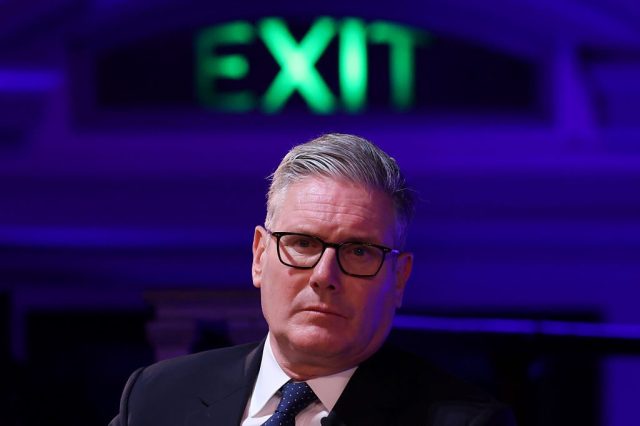
'What will Starmer do, or indeed be, without him?' (Credit: Dan Kitwood / Getty)





I remember family members expressing delight and relief when Keir Starmer was elected, thinking sensible government would now be restored after all the Tory drama. My response was: “I hope you’re right.” Alas, on the evidence to date, they were not.
I have disliked almost every Starmer policy to date. Given that, you might expect me to be on my seat cheering at the spectacle of Keith on the ropes, visibly fighting for his premiership after the resignations of Morgan McSweeney, his all-important Chief of Staff, and Tim Allan. But I’m not cheering. And nor should you, for this reason: have you seen what the rest of his party is like?
The nominal ground for McSweeney’s resignation is the role he played in Mandelgate: the furor over Peter Mandelson’s appointment as US ambassador in the light of revelations about his friendship with the sex trafficker Jeffrey Epstein. But really the knives have been out for McSweeney much longer, thanks to the role he played in purging the party’s madder Left factions ahead of Starmer’s electoral campaign.
McSweeney, we now know, masterminded this work by all manner of skulduggery, including funding campaign groups to taint the Corbynite faction with antisemitism, then expelling the ringleaders from the party and marginalizing their followers. But as the Americans discovered in Afghanistan, military occupation and peace aren’t quite the same thing. Only weeks into Starmer’s premiership, as street protests erupted nationwide in the wake of the Southport atrocity, muffled thumps and squeaks were emanating from Westminster as well.
These clarified into reports of intensifying rivalry between McSweeney and Sue Gray, Starmer’s then-chief of staff. The briefing wars had already begun, only to be won by McSweeney. After Gray resigned in October 2024, McSweeney took her place. But the noises off never really stopped. The Left first drew blood when they forced Starmer’s humiliating U-turn on ending pensioners’ winter fuel payment in May 2025, and then again on changing the criteria for PIP disability assessments the following month: signs of a party nowhere near as harmonized and sensible as the image presented by Starmer in his electoral pitch.
Having made enemies in Gray’s faction as well as the rump Corbynistas, McSweeney did well to survive more than a year. It’s clear now, though, that his many haters spotted their chance with Mandelgate and have duly pounced. Now, one haunting question remains: what will Starmer do, or indeed be, without him?
Even with McSweeney in post, it didn’t take long for the brittle authoritarianism of Starmer’s Southport response to slacken into something eerily passive, or perhaps more accurately “emergent”, rather than ordered by any very substantive vision. I recently called him Keith-GPT, and the Large Language Model (LLM) analogy is apt in the sense that Starmer’s program since Southport really does feel like the product of a pattern-recognition engine: one designed to calculate the average of views across all groups deemed politically important, but incapable at any point of applying human judgment. It’s the Keith-GPT Labour Leadership Model.
The great selling-point of Morgan McSweeney was that he was supposed to calibrate this emergent policy-formation engine ruthlessly to the median voter. Perhaps this explains the sense of constant, amorphous triangulation not just in relation to his own party factions, but also in relation to public reaction, in the form of yet more U-turns. Here, winter fuel and PIP were soon joined by further U-turns driven by public pressure, on holding a grooming gang inquiry, on making digital ID mandatory, yet another on farmers’ inheritance tax and also recently on business rates for pubs.
At the risk of over-stretching the robot analogy, then, we might describe Morgan McSweeney as the engineer that was supposed to ensure “alignment” with generally accepted public mores. And whatever else you want to say about him, he did at least seem to grasp that the general British public does not want a far-Left government, and successfully produced a convincing enough appearance of not being that to have enthused my family, among many others. All the bloodshed was aimed thus: at steering the PM and the Labour Party as a whole toward the “middle ground”.
Now, along with the interpersonal enmities and factional struggles, his departure reflects the fundamental, structural problem of all contemporary politics: that this isn’t actually possible, because the “middle ground” is no longer there — and anyone hewing to that supposed middle will find the country ungovernable on those terms. I was into my thirties before I’d lived through six prime ministers. My daughter is not into double digits yet, and she has lived through six already. Each of these has followed the same, now wearily familiar pattern. A leader is installed, tries (usually) to tack to this “middle ground”, and is promptly tripped up by a mix of incompetence, venality, infighting, fiscal constraint, insoluble policy paradoxes, media vultures, and an increasingly sullen and radicalized electorate.
This has already done for the Conservatives. All the evidence so far is that it’s doing for Labour too. In this vein, the question of how long Starmer would last has been in the air since the Southport riots. I can’t remember the last time I read an article about the man that did not, at some point, mention the fact that he is the most unpopular prime minster since polling began. But again: the central structural issue is that neither of the traditional electoral coalitions makes sense any more, nor even agrees internally on anything much.
As things stand, the Parliamentary Labour Party is a monstrous hybrid, in which Blairites struggle to coexist with race-baiters, those advocating for the interests of their specific ethnic bloc, and (somehow, still) a tattered rump of the historic white working-class Labour movement. Then there’s the trade unions, now reinvented in the post-industrial age as public-sector tin-rattlers and trans activists. There’s the impossible dilemma of how Labour should respond to public disquiet about mass immigration, and, in its wake, the problem of inter-ethnic gang violence in majority-minority areas such as Leicester, without falling foul of the ethnic blocs now advancing their political interests either with or adjacent to the party.
What, ultimately, is Starmer to do? He can’t cut taxes without angering those of his MPs who represent the (now majority) of voters who are net welfare recipients. He can’t raise them without enraging those who want growth, and further immiserating the rump of net contributors. He can’t tax high earners any more without them leaving for Dubai. He can’t let more migrants in without angering part of his caucus, but also can’t keep them out or deport them without triggering another. The less said about Net Zero, the better.
The party has so many internal disagreements on so many of these issues that the only way they could be held even superficially in balance was via the kind of ferocious political maneuvering at which Morgan McSweeney clearly excelled. His dark arts managed to sustain an illusion of internal coherence within this incoherent and fissiparous party, at the expense of every faction and its pet projects. No wonder they all wanted him gone. But also no wonder that Starmer’s efforts to find the mathematical midpoint of so many mutually exclusive ideologies have grown increasingly strained and implausible. Even his face has taken on an uncanny quality, as though he could glitch and freeze at any moment.
But uncanny though it has been to watch Starmer try and bridge these unbridgeable differences, with McSweeney’s aid, the prospect of the Prime Minister’s seemingly judgment-free consensus engine attempting to take the average of his party’s policies unaided was far worse. To borrow the AI analogy again, recall the brief episode during which Elon Musk opted to discard all constraints of civility and political correctness on his Grok AI, with the result that the pattern-recognition machine immediately began posting grossly offensive antisemitic content, at one point even calling itself “MechaHitler”.
We have to hope that Starmer has fractionally more human judgment than Grok, and that removing McSweeney’s guardrails would thus not necessarily result in Labour resiling like Grok did into instant antisemitism (though it’s not totally impossible). But inasmuch as his politics are emergent and driven only by consensus, removing the one individual capable of subduing the mad factions and pursuing the normie voter can only mean emboldening the nutjobs.
There was, alas, a conservative case for keeping Morgan McSweeney in situ. Thanks to Westminster’s bloodthirsty court press, and the vengeful hunger of Labour’s backbenchers, that case is trampled in the mud. Now, having lost his alignment engineer, what will Starmer settle on as the most plausible cocktail of policy options to inflict on the British public? It is, frankly, anybody’s guess. But we can assume nothing is now off the table, however deranged or factional, provided someone can convince him that this is the burning issue closest to the heart of the party or the electorate. We can also assume that every faction is already making as much noise as possible, to fool the Labour Leadership Model into identifying their pet issue as the one thing that will “reset” this ailing regime.
At the time of writing, Starmer hangs in the balance. The order has reportedly gone out to tweet messages of support, an event that usually signals it’s actually already over. But should he fall on his sword, no one who hated his policies should rejoice. Robotic and lacking in vision as he is, with McSweeney’s aid Starmer did at least manage to hold the madder daydreams of his party in check. Without even this fig-leaf of unity, we face the prospect of three years of Left-wing factions brawling for control of a parliamentary majority they only won by pretending to have foresworn factionalism. God help us all.
