




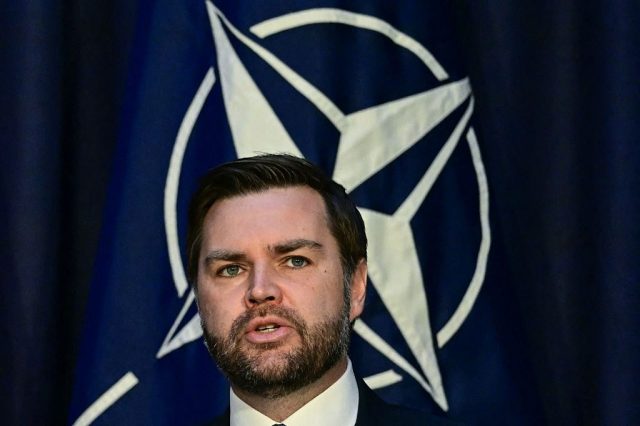
JD Vance unleashed a broadside at the EU at last year's Munich Security Conference. Photo by Scott Olson/Getty Images





In the 20th century, it was customary for Latin American military juntas to start a putsch by seizing control of the national broadcasting company. This often happened during the night or in the early hours of the morning. On 11 September 1973, Augusto Pinochet and his troops took over the radio and TV stations in Chile by 8am. On 24 March 1976, the leader of the Argentinian military junta captured Isabel Perón at 1am. By 3.10am, all TV and radio stations started to play military marches.
The actors have changed since then and so have their methods. What is unchanged is the idea that political power is about the control of the media. This is why the US and the EU have been engaged in a raging dispute over social media regulation and content moderation since JD Vance criticized the Europeans at last year’s Munich Security Conference for suppressing free speech.
Last week, the EU told TikTok it must become less addictive to its users or else face heavy fines. In December, the EU imposed a fine of €120 million on X for failing to moderate its content as required by the EU’s Digital Services Act (DSA). Very Large Online Platforms (VLOPs) like X, Facebook or TikTok are obligated to employ fact checkers and post community notices to highlight fake news. In France, failing to do so counts as a criminal offense. A French prosecutor has recently summoned Elon Musk to a hearing in Paris. Pavel Durov, the Russian founder of Telegram, was arrested upon landing in France in August 2024.
The Europeans have totally misjudged what is going on. For the Trump administration, European censorship rules of US social media is the single biggest issue in transatlantic relations. Donald Trump and the hard-Right in Europe owe their ascent to digital media. The ability to bypass the oligopoly of the legacy print and broadcasting media was critical to Trump’s two election victories. The EU’s old establishment parties are fighting a desperate battle to keep digital forces at bay. Just look at what’s happened to the venerable Washington Post. In 2017, when Trump came to power for the first time, the paper gave itself the motto “Democracy Dies in Darkness”, a cry of despair. Now, it’s fired 300 journalists. The decline of the traditional media and the rise of the MAGA movement are linked.
In continental Europe and the UK, the old media oligopoly is more robust than in the US, but it is much weaker than it used to be, and is getting weaker every year. By and large, the political establishment still controls the legacy media. The legacy media, though, is losing control of the narrative.
This is the context in which the DSA should be understood. It forces large social media companies to issue DSA-compliant community guidelines to which users must agree. It does this with the help of so-called “trusted flaggers”, which are often NGOs and are nominated by national governments. One such organization is HateAid, a German group which was recently subjected to US sanctions. The trusted flaggers act as the internet’s truth commissars, identifying what they perceive to be violations of the rules. They directly alert the platform, and the European Commission monitors whether the company reacts to the warnings and can impose penalties as it did against X.
Washington is now preparing to respond. The FT reported last week that a senior state department official, Sarah Rogers, met with Right-wing think tanks in Europe to discuss funding to spread the MAGA gospel or, as she put it, American values. At its core this US-EU dispute is about the diffusion of MAGA political themes in Europe. Think tanks and civil society organizations play an important role in the public discourse. In Europe, they are mostly on the Left.
That story chimes with the leak late last year of a draft version of the administration’s National Security Strategy. The final, official version was already hostile towards the Europeans. It talked about civilizational erasure, and criticized transnational bodies — meaning the EU — which are “transforming the continent and creating strife, censorship of free speech and suppression of political opposition”. The earlier draft went further, though, containing a passage in which the US committed itself to pry countries away from EU membership. While that was not included in the final version, Rogers’s comments suggest that this is indeed the policy.
The Americans have other instruments at their disposal. Trump could impose his favorite instrument: tariffs. He could do so even if the Supreme Court were to rule against the legality of his Liberation Day tariffs. Retaliatory tariffs against countries that discriminate against companies fall into a different category.
The companies themselves might push back. EU legislation applies only to companies and their subsidiaries with a physical residence in the EU. X or Meta might close down their European offices, forgoing some revenue in the process. That might be a price worth paying to safeguard an otherwise lucrative business model. The EU does not have alternative providers.
European voters might also rebel against the bloc. With its data protection legislation, AI and crypto regulation, the Digital Services Act, and the Digital Markets Act, the EU has built a kind of Luddite wall against 21st-century technologies, most of which originate in the US. The idea of Europe as a museum or a tourist destination may be charming; it is not, however, a sustainable economic model. The more the Commission decouples from modern technologies and services, the more unsustainable its strategy becomes.
This political battle is about agenda-setting and control. It is not really about free speech — that is a straw-man debate. It is true that the Europeans are restricting the spread of Right-wing content and turning people into criminals for posting a tweet. But Trump’s America is not exactly a bastion of free speech either. Last year, Rümeysa Öztürk, a Turkish PhD student at Tufts University, was arrested and earmarked for deportation for writing an article in which she criticized her university for how it handled pro-Palestinian protests. She was held in a detention camp until a judge ordered her immediate release. Marco Rubio said at the time: “We gave you a visa to come and study and get a degree, not become a social activist that tears up our university campuses.” The US is in no position to teach the Europeans about free speech.
Philip Graham, the previous owner of The Washington Post, once called journalism “the first rough draft of history”. As historians know only too well, historical drafts often get completely rewritten over time. What appears true today is often revealed as false tomorrow. The idea that we can put somebody in charge of the truth is absurd. Yet it is no less absurd than the attempt to restrict foreign students in the US to write articles in student newspapers.
The reason why the EU will lose this battle is straightforward and has nothing to do with free speech. It will lose because the US is the senior partner in the bilateral relationship. It is Europe’s tragedy that it made itself reliant for its defense and technology on somebody with whom it no longer shares its basic values.
The DSA is a rebellion, but it falls into the category of failed putsches. It recalls the Spanish military’s attempted seizing of the Spanish parliament in 1981. The putsch failed because the junta did not control the narrative. It ended after only 18 hours when King Juan Carlos I went on national TV to denounce the putschists and ordered them to go home.
Forty-four years later, the Europeans no longer have such power, and they won’t get it back.
