




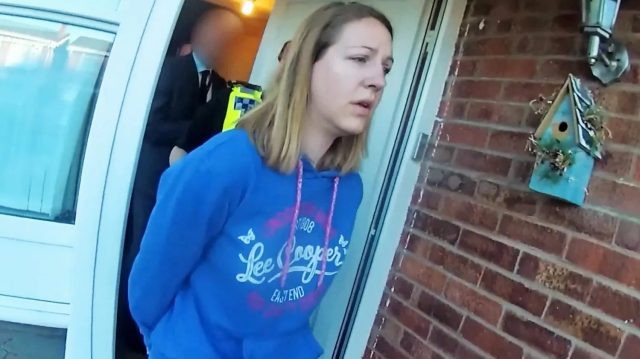
Could this sad sack really have done this? (Cheshire Constabulary/PA)





The officers descend on the cul-de-sac. It’s early in the morning, and as they make their way into the house a woman pleads, “No!” Her daughter sits in bed, groggy and stunned in a gray dressing gown. A policeman apologizes for waking her up. Before being led outside, she asks: “Please can I see my cat?” The big orange tom meows as she kisses him. “You know I didn’t do it,” she tells her parents. “I know you didn’t! We know that!” cries the devastated mother. On the driveway, as officers fit the handcuffs, Lucy Letby tells her “don’t look”; “just go”.
So begins The Investigation of Lucy Letby, Netflix’s inevitable true-crime take on the former nurse convicted of killing seven babies and attempting to murder seven more at the Countess of Chester Hospital. It is by now a story familiar to readers around the world: Letby, 36, is serving 15 whole-life terms for the murders. The blank-eyed mugshot from which most will remember her is used in the documentary’s title card, overlaid with infamous, supposedly confessional scrawlings on a Post-it note found among her things. This footage has itself been the subject of media furor in the past week, after Susan and John Letby told The Sunday Times that they were not aware producers were showing the inside of their home; watching the arrest back “would likely kill us”, they said. Netflix’s dramatic opening scene, grief cracking through the quiet of a suburban morning, “is a complete invasion of privacy”.
I doubt many viewers will see it as such. Few could feel anything beyond curiosity at this rare humanizing vision of a woman who has for so long been presented as a symbol of perfect evil. This gawky, lanky, weird lady, living with her parents in a pink-and-purple bedroom, is softly talked down to by young female officers who try to find her shoes. This is not a supervillain; this is a timid odd bod overwhelmed by her own gruesome actions, led away with a lump in her throat like a little girl frightened of going on a school trip. It’s painful and private, yes, and therefore madly compelling: how could this sort of person do that? The woman’s diary had a knitted dog stuck to the front, for god’s sake. On her bedroom wall, a framed motivational quote ordered the nurse to “leave sparkles wherever you go”.
Here lies the intrigue of Lucy Letby: completely unreadable, so banal yet so deranged, so weak and yet so predatory. Dr John Gibbs, an avuncular colleague, tells us in an interview from a hospital corridor that “there was nothing about her that made her stand out to me”. A mother, recalling Letby’s care of her baby “Zoe”, says that all the nurse did was stand with a clipboard, “watching us”. Later, in the courtroom, she was caught “staring” at her once again.
Letby is Shakespeare’s Iago plonked in an NHS ward in middle England: a “motiveless malignity”, as Coleridge put it. The villain of Othello dissolves upon discovery, robbing the audience of the satisfaction of understanding him: “Demand me nothing. What you know, you know.” To a perplexed public, Letby shares cunning Iago’s inscrutable id — a vacant, quiet girl with sly rot underneath. The filmmakers pointedly leave her final words as “no comment”; Letby is a true agent of chaos, appearing not to know herself why she does what she does. The fact that even the producers do not seem to understand her emboldens the Letby-truther camp: if this nurse had meant to kill, surely she’d have revealed, even inadvertently, a reason?
The more we know about Letby, the more she seemed like a woman possessed. The scribblings on that Post-it note were like the ramblings of a self-hating teenaged girl: “I am evil”; “I did this”; “I don’t deserve to live”; “I killed them on purpose”; “I am a horrible evil person”. “Horrible” is perhaps the most telling word Letby could have used: instead of swearing, she uses a limp playground insult, the kind that is growled by a grump in a Roald Dahl story. Even when appearing to confess to a string of infanticides, Letby is as weak as primary-school squash. In the moment when the viewer is meant to understand her, she dissolves: could this really be the “poisoner on the ward” mentioned by one police officer, the diabolical dame of a penny dreadful? Could this sad sack, for whom “horrible” is the deadliest swear and whose duvet set says “sweet dreams”, really have done this?
The motives proposed by prosecutors have been as follows: that Letby wanted the sympathy and attention of a male consultant on the ward; that she wanted to play God; that she hated herself and felt murderously inadequate; that she was thrilled by parents’ despair. Of these, the infatuation theory is the most exciting — after all, the unnamed alleged love interest prompted the first “flicker of emotion” from Letby, as The Independent put it, in the entire trial. Only text fragments support this hypothesis, with no direct proof.
Yet instead of answering the question viewers really want to know — why? — Netflix’s producers focus on whether Letby could have done it at all. It’s a compelling case: statistical evidence of shift patterns misused; a medical paper misinterpreted by an allegedly unreliable expert witness; survival rates on a par with, rather than dwarfing, those in the rest of England and Wales. Letby’s great champion, the criminal barrister Mark McDonald, pours scorn on the trial and is somewhat convincing. The viewer is left with an itch of doubt: selling the documentary as an “unsolved mystery” rather than “the anatomy of a killer” is catnip to the truthers.
Letby has come to play a strange role in the British — and even the global — imagination. This is no Myra Hindley, a peroxide anti-Marilyn; if anything, Letby more closely resembles Grantham hospital’s own killer children’s nurse, “Angel of Death” Beverley Allitt, for whom Munchausen-by-proxy answered a lifetime of mediocrity and insecurity. But Letby, now the most prolific child serial killer in modern British history, eclipses Allitt precisely because of her tantalizing blankness, the ease with which we can project nightmares of putrefied femininity onto her long and sullen face.
It is far more frightening to imagine bloodlust in an everywoman — one who misses her two cats, Tigger and Smudge, and weeps in her girlish bedroom. Seven babies who never went home demand the unmasking of pure evil, rationalized and banged to rights and locked away for life. Letby denies us this catharsis. Instead she infects us with her own lingering insecurity — and the painful admission that sadism could be everywhere and in anyone.
