




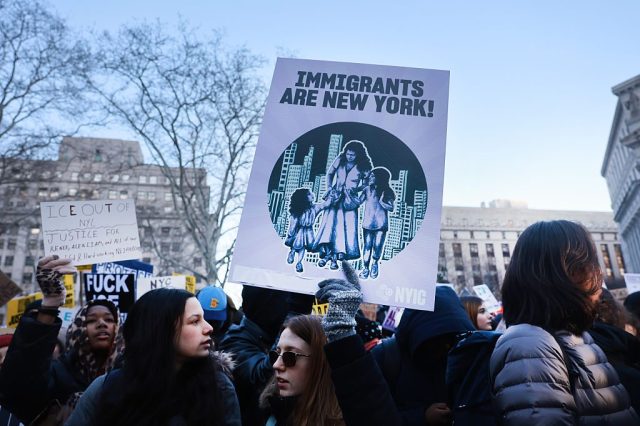
New York City has been the scene of turmoil over migration. Photo by Spencer Platt/Getty Images





Brooklyn resident Brandon Holley met Babacar*, an illegal migrant in his early twenties, in the parking lot of a Lowe’s hardware store near her home in February, 2024. Babacar was hanging around the store hoping for day work. When he saw Holley wrestling 40-pound bags of soil into her truck by herself, he went over to help her. Babacar is from Dakar, and spoke only French, which Holley does not speak well. But she liked Babacar, and hired him to help her with some gardening work for the next three weekends. They became friends, she says, “working all day together in the hot sun”. When she discovered that he was sleeping in the subway during a mandatory break from eligibility for the city’s shelter system, she offered him a room. For 18 months, Babacar lived with Holley, her husband, and her teenage son. He now has legal working status and a place of his own. “I realize it was advantageous for him to meet us,” Holley tells me, “but my life would be so much worse without him.”
Such arrangements are the subject of A Better Life, a new novel that sends up migrant-hosting in New York City. The book’s author, Lionel Shriver, is a writer of literary thrillers, and has never been one to shy away from the big political issues. She was an early and brave voice of dissent against political correctness and “own voices” in fiction. And she was canceled in 2016 for wearing a sombrero during a speech defending the fiction writer’s right to “be an appropriator par excellence” because stealing, prying and presuming are essential tools of the trade. A Better Life takes a harsh view of precisely the type of Brooklyn woman Holley represents.
The novel’s main character, Gloria Bonaventura, is a divorced bourgeoise liberal in the arts. In response to New York’s Biden-era migrant crisis, Gloria takes in Martine, a migrant from Honduras. In Shriver’s eyes, Gloria is silly and a little desperate: she has a business hand-knitting stuffed animals and cashmere “packers” for transgender men, and spouts obtuse clichés: the migrants, she says, “just want to participate in our democracy, work hard, and raise a new generation of Americans”. The novel is written from the perspective of Gloria’s adult son Nico, a self-described incel who is still living at home, unemployed, four years after his college graduation, and who resents the intrusion of Martine into his home. Gloria soon describes Martine as a member of the family, but Nico fears his mother is being taken in.
Shriver is a smart and compelling writer, a cut above most novelists working today. By mining the headlines on the migration crisis, she produces an excellent thriller. Martine, it turns out, has criminal gang-member relatives who prey on the book’s liberal do-gooding characters with ease. The set-ups are funny — Gloria stocks Martine’s kitchenette in the basement with a bougie spread of “salted almonds, rosemary potato chips, whole-grain crackers and corn nuts,” for example, and puts the fluffy towels for company and “Cornish hedgerow” bath gel in her guest’s shower. And the plot twists are satisfying, but the novel also asks potent questions on migration. What is lost when we invite “too many” others into our country? Who really belongs here? And if we’re being taken advantage of, who is at fault?
Through Nico, the incel son, Shriver explores such questions. He’s not, as the cliché might have it, a hateful racist, but rather a young man who, after a youth of promise and privilege, has become strangely stalled in life. He is living in his mother’s home while drawing money from a small inheritance, and has the explicit goal of doing nothing. He watches YouTube, orders DoorDash and has a standing date with internet porn every night at midnight. He believes that he’s happy: in his view, his peers are empty strivers; his mother and sisters are moral neurotics; and by contrast his activities are a rational response to his comfortable economic situation.
The migration wave, however, creates the competitive conditions that finally encourage Nico to pursue a more fulfilling life. Martine’s arrival pushes him out of his basement room and back to his childhood bedroom, forcing him to confront his failure to launch. Then, her surly and possibly dangerous brother Domingo moves in, intimidating Nico out of his own living room, and causing him to contemplate his manhood or lack thereof. After an escalation of violence and intrigue, it’s a toss-up as to who “deserves” Nico’s mother’s Brooklyn mansion: its original occupants, or Martine and her crew.
Shriver allows herself an extremely non-PC ending (the immigrants are everything we feared, basically), but the book’s larger take is ambivalent. Nico’s father, Carlin, a Right-wing journalist, laments that whites of European origin are being replaced (not a conspiracy theory, just a fact, he says) by people they have nothing in common with. Carlin’s friend Vernon, a documentary filmmaker, expands on the point, arguing that “the country’s been so successful not because it’s so ‘diverse’ but because it is, or used to be, relatively homogeneous.” However, if Nico is a symbol of the whites of European origin in the 2020s, this vaunted European “culture” has devolved into entitlement, DoorDash and masturbation — so the argument feels perhaps deliberately weak. As one of Martine’s friends puts it: “Migrants do all the work? Then USA belong to migrants. Maybe you Americans are the freeloaders.”
The novel appears at a time when illegal migrants have once again become a flashpoint in America. But while it succeeds at giving voice to ideas that are usually forbidden in the Left-leaning world of literary fiction, its various forms of satire, especially the characterization of Gloria, are limiting. It’s enjoyable to poke fun at an imaginary insufferable liberal woman, but it’s simply not true that one side of the debate is wholly ridiculous: nothing is ever entirely black and white. And the ways in which the women who host illegal migrants aren’t ridiculous are worth exploring.
In addition to Holley, I spoke with two other Brooklyn women who have also hosted migrants at some point since 2023: Louise Bauso, a high-school teacher, and Sarah*, a social worker. Bauso is the founder of Red Hook Mutual Aid, a “hyper-local” neighborhood organization. At the height of the migration crisis in 2023 and 2024, she tells me, men, mainly from West Africa, who were being housed in the Brooklyn Navy Yard not far from her Red Hook neighborhood, would be lined up 25 deep outside her organization’s free store.
Bauso ended up taking in two asylum seekers from Guinea, boys aged 18 and 16, in the winter of 2023-2024. As she describes it, they’d somehow started “diligently” messaging the mutual aid line every day, asking for assistance with transfer to a youth shelter. They were soon due to lose their spot in an adult city shelter, because the city at the time had a 30-day rule. When you had stayed for your allotted 30 days, you had to leave and be re-admitted, a process that could take weeks. On the day the Guinean teenagers lost their housing, they called Bauso. She met them for the first time at a coffee shop. They’d been turned away by all the city agencies, Bauso says, and “they said, ‘We don’t have anywhere to go, we don’t know what to do. It’s cold’”.
She took them into her 850-square-foot railroad apartment with few interior doors, where they slept on her sofa on and off for three months. “It was an extreme thing to do,” she says, “and not everyone understood it.” When pressed to explain her choice, she says, “They were literal children, and so young-looking. They had to stay with me. I had nowhere to send them.”
Bauso says the experience was “definitely complicated”. She was never afraid for her safety: “These are young Muslim men. They pray every day. They are really trying to be good, good people.” But she had to teach them to cook and clean, and the need in the city was so great that eventually she found herself putting up as many as five migrants at a time.
The women I talked to had different takeaways from their experience hosting. For Holley, those 18 months were enriching. Reflecting on her relationship with Babacar, Holley says: “I love him; he’s like a son to me.” “I only had one child,” she says, “and it turns out I had room for more.” Holley and her husband have become friendly with Babacar’s large extended family over Zoom, and hope someday to go to Dakar to meet them. She wishes more people were aware of the ongoing opportunities to help. In particular, there is a short supply of Americans willing to be legal guardians to minors.
For Sarah, the experience was a little more difficult. She hosted a Guinean man in his early twenties for eight months after he lost his place in a shelter. She enjoyed hosting, she tells me, and her guest was no trouble, but her teenage daughter wanted her privacy back. Eventually, due to lack of patience from family members, Sarah had to tell the young man it was time to find another place. She still has regrets about asking him to leave. “I’m sure he was confused by it,” she says. He now has documentation allowing him to work, and has two jobs and an apartment with a roommate. He and Sarah still keep in touch. His tax documents came to Sarah’s house, and they recently attended a chili cook-off together.
What strikes me about all these stories is the reordering power of direct personal charity. All of these women, when presented with a crisis, made a choice to do something. They may all share a commitment to social justice, but the larger issues of the kind we debate online, and that Shriver brings to life in her novel, felt much less present in their retellings than the moment of human need, and the innate human desire to respond. All three spoke of the unfolding situation of a particular person, rather than an ideology. Holley’s reasoning — “We had a spare room and he needed a room. It was really just luck” — was typical.
To encounter a human being in a situation of crisis, and to stop to help them, is a rare moment of stepping outside our usual self-centeredness, and it tends to be oddly humbling. And every woman I spoke with seemed humble — not flighty, not silly, not entitled, not like Gloria. They didn’t say so, but they did something that, in the Catholic tradition at least, is a virtue — and is even more virtuous when it isn’t named. An understanding of this virtue is missing in A Better Life. “Charity” of a direct personal kind doesn’t offer a simple answer to the contentious question of what to do about immigration policy — or at least it won’t to everyone — but in practice it equalizes us, and creates common ground. To dwell on it in a real way, acknowledging its concreteness and its challenges, but also its value, would make a better life for migrants and citizens alike.
*Some names have been changed at the subject’s request.
