




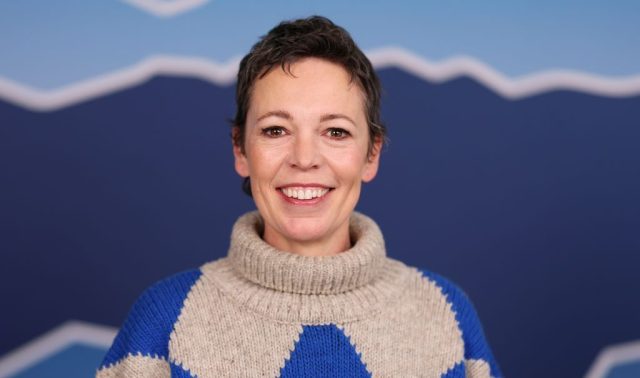
'Why are the éminences grises of the British entertainment industry so intent on sticking their oar into the culture wars?' (Mat Hayward/Getty for IMDb)





“Now, Olivia, any thoughts on that sit-down with Them?” One imagines Mx Colman parked in front of a decaf dirty chai in a Primrose Hill coffee shop, swamped in an ethically sourced jumper knitted from the wool of dyslexic sheep. She is in London to chat to her agent before a big publicity blitz for her latest film Jimpa; once this beastly business is over she’ll be zooming back up the M11 to her listed Norfolk barn conversion — back to civilization. “Them who?” she’d snap. “The non-binary mag,” replies the weary agent. “The film’s a turkey; we need something that’ll blow their socks off, get people talking. It might be a good chance to, you know, wade in...” The actress’s eyes glint behind some ridiculously large specs. Genius, she thinks. What this nasty debate needs is a heaped tablespoon of the old Colman compassion.
Or, at least, that’s how I assume such a toe-curling blunder must have come about. For the luvvies’ Favorite windbag declared, in an interview to promote her new film about the mother of a non-binary child, that she had always, in fact, “described myself to my husband as a gay man”. The feeling of being “sort of non-binary” herself had mysteriously derived from “arguments with people” (oh what dinner-table conversation her three poor children must endure). Shrugging off any specifics, Colman put it in a way so tantalizingly vague that headline writers could not resist turning it into “a big sort of title”, despite her pleas; “I feel like I have a foot in various camps.” This Colperson rejects your silly little boxes.
Under normal circumstances, a woman in a heterosexual marriage who had given birth three times declaring herself a gay man might have prompted the arrival of men in white coats. At the very least, her shameless appropriation might have ruffled feather boas at the Royal Vauxhall Tavern. But these are not normal circumstances; we are dealing with acting royalty who has even acted as royalty, a beloved treader of the boards with clipped tones and a Cambridge degree, a Peep Show alumna and envoy to Hollywood. This is a woman whose lip-wobbling is Oscar-worthy; let her wang on about how having short hair makes her an exception among AFABs if it makes her feel better — it’s 2026, after all.
Except it matters to point out what a load of credulous bollocks this all is. Colman has found herself in a hyperprogressive muddle: in an effort to waft away ludicrous stereotypes about femininity, she has reinforced them. Like most celebrities hoping to court the liberal vanguard, she has found herself a handmaiden in the contemporary rebirth of anti-woman logic. Not to mention the drive-by erasure of the homosexual male experience, of which Colman necessarily understands nothing. Decades on from the gay-rights movement, it’s all too easy to take for granted the hard-won privilege of being believed and accepted for your very real sexuality — which resists nebulous vibes-based self-identification. The fact is that owing to her inordinate privilege (remember when we were all so preoccupied with that?) Colman is insulated from the real-world consequences of pushing gender woo-woo; she is unlikely to find herself face-to-face with female inmates, for example, or women in rape crisis centers. No — the gender-critical cohort which is interested in the feelings of vulnerable women are dismissed with saintly bafflement: “I don’t know how you explain to them what understanding and kindness is, and love,” Colman said during the same media blitz this month.
Her inability to explain her position won’t stop her from trying. Luxury beliefs emanate almost exclusively from Colman’s haut monde; the more incomprehensible they are, the more valuable, because they reinforce the elite’s monopoly on moral and intellectual reasoning by shutting out the mystified lower classes. Colman has fallen victim to a process which the feminist commentator Jen Izaakson has anatomized: as absurd progressive politics trickle down to the “lumpens”, the elite opinion-formers must make ever-more bizarre amendments to retain their superiority. So it is that a woman who has never even made the effort to “transition” can call herself a gay man. Don’t get it? Well, you’re probably a bigoted chav. Leave the thinking to us, love.
Realism and experience are not among the entry requirements for the luvvie club; all you need for that is an aristo drawl and an obsession with “empathy”. The only yardstick for intellectual coherence is whether a comment would spoil the cheese course at a smart dinner party. At home, purring British actors have rarely been taken seriously as moral arbiters; their power is principally global. For nobody so readily swallows the half-formed thoughts of a British actor than a Hollywood entertainment reporter; they seem unable to resist the charming accent, the big glasses, the Hugh Grant hesitations. Americans on X responded to Colman’s disclosure with raptures of delight: one wrote that it was “so unbelievably important to me” while another took it further: “Any tongue that rises against Olivia Colman shall fall.” What reads to an Englishman as unadulterated knobbery may sound, to the ears of a bronzed Californian, like the kindly warblings of a wise duke. Criticism in such a dynamic amounts to brutish cruelty, or worse, lèse-majesté. After all, aren’t the likes of Colman and Ian McKellen — who recently clambered onto his own soapbox with an immigration-themed monologue on The Late Show With Stephen Colbert — just so bloody quaint? But this studied softness is in fact a steely ploy: what professes to be compassion is in fact a rigid defense against debate; courageous stances are in fact craven deflections.
McKellen’s recitation of a speech from Sir Thomas More, attributed to Shakespeare, concerned the then-Sheriff of London’s attempt to placate crowds rioting against immigrant workers on “Evil May Day” in 1517. These were skilled weavers and dyers from the Low Countries, French artisans, Lombards and so on; prosperous, connected recipients of legal privileges granted by the Crown. The riots concerned ruptures in class, patronage and labor anxiety, not race. Nevertheless McKellen’s invocation of the “wretched strangers / Their babies at their backs and their poor luggage” drew somber applause from a studio audience who took it as a perfect analog for immigration riots in America and the UK today. Sounds about right, Sir Ian. Open borders it is!
Why are the éminences grises of the British entertainment industry so intent on sticking their oar into the culture wars? For the older cohort, militancy is the result of a political lag. The progressive battles of the Seventies to Nineties — skewering Thatcher, gay rights, non-conformity — have all been won. Other favorite causes such as Vivienne Westwood’s climate change crusade (the subject of years of commendable ego-pricking by Private Eye) have been absorbed into the mainstream, so have lost their iconoclastic power. Old templates for protest crave new complaints; gender identity and mass immigration just happen to be there for the taking, regardless of whether Colman and McKellen understand them or will ever feel their consequences. No matter that American politics bear little resemblance to those in Britain; as emissaries of an apparently more sophisticated and compassionate world view, these actors see it as their responsibility to set this young, naughty nation on the right path. In a world of nodding agents, producers, arts journalists, activists, these stars really can say any old rubbish. But really, must they?
