




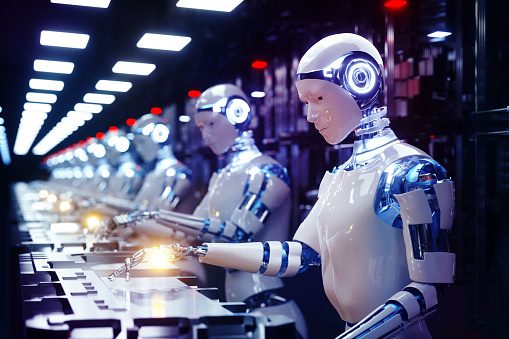
This is light years beyond mere surveillance capitalism. (Andriy Onufriyenko/Getty)





Janus, the Roman god of beginnings and endings, did not have two separate heads, but rather was two faces bound together into one divine being. One looked to the past, the other to the future. AI, too, comprises two faces bound into one supremely powerful machine network. And this duality holds the key to the most frequently asked questions today: is AI a bubble waiting to burst? Or is it about to prove naysayers wrong by steaming ahead? The correct answer is yes to both.
AI’s backward-looking face, weathered and lined with memory, is indeed a bubble about to burst. This side of AI is engaged in standard capitalist commodity production. A ChatGPT subscription is a commodity like any other: like a subscription to The New York Times, a car insurance contract, or a lease on some car. But in January last year Chinese start-up DeepSeek disrupted the AI-commodity market with a free service far less costly to produce and as good quality as ChatGPT. It was then that Big Tech realized their prospects as suppliers of AI-based commodities (or subscription services) were over.
There is now clear evidence that companies such as OpenAI which are in the business of selling AI subscriptions have been excessively marked up. As the costs of Large Language Models (LLMs) increase exponentially, the subscription revenues increase more or less linearly. This is unsustainable and there always comes a moment when the unsustainable can no longer be sustained. At that point, AI’s wrinkly, backward-looking face will sag, maybe die altogether.
What about AI’s second face? After the DeepSeek moment fired the starting gun, AI firms began to shift their technologies from the economy’s capitalist market sector to the pre-existing technofeudal economy. Well before LLMs could emulate human-like interaction, cloud capital interfaces such as Alexa, Siri, Google’s Assistant or Amazon’s web-based algorithm had already empowered Big Tech to extract significant cloud rents from the rest of us. Once you entered amazon.com, you exited capitalism. But now AI’s second face allows Big Tech to escalate its extractive powers.
Consider what an advanced AI-powered version of a bot like Alexa will very soon be able to do. Not only will it know you perfectly but it will be able to speak to you in a manner that is virtually indistinguishable to that of a human as well. It will remember everything you’ve ever said, done or wished for, and it will be able to go back years. It will have perfect recall of your whims, musical sensibilities, shopping habits and disappointments. It will keep you company in both good and bad moments. It will be able to predict when one of its recommendations will jar with you. It will take you to the brink of your tolerance without crossing your red lines.
This is light years beyond mere surveillance capitalism, an earlier system where machines spied on you so that advertisers could target their marketing material. With an AI-enabled interface, Amazon, Meta and Google will soon interact with you in ways that today seem as unfathomable as computer scientists found eight years ago the spectacle of AlphaZero teaching itself from scratch how to play chess by itself, shifting beyond all 3,000 years of human chess within 24 hours.
With this kind of power hidden under their human-like bonhomie, Alexa-like AI bots will speedily cultivate in you a neuro-dependence. They will become indispensable to your psyche. Switching to a competitor’s competing bot will be almost unthinkable — closer to a heart-wrenching divorce than to finding another e-shop to buy stuff from. At that point, all hope that market competition has a future dies.
Massive economies of scale are synonymous with natural monopoly — it’s one of the few useful things we teach economics students at university. That’s the reason why we cannot have several water companies competing in the same city, laying down different water pipes that run through our streets and walls. For similar reasons, a handful of Big Tech hyper-scalers own and control the means of production of AI. For any company or startup wanting to build a serious AI capability, accessing these hyperscalers’ infrastructure is not just convenient, but a fundamental necessity. This gives them immense influence over the pace, cost, and direction of AI’s second face.
Forward looking, clear-eyed, expectant and immune to the AI bubble’s bursting, AI’s second face is eyeing paths not yet taken into a near future that we can scarcely imagine. More intriguingly, it is focusing on a realm that has little to do with what we can usefully describe as capitalist markets. We have plenty of proof that this is already happening. A good case in point is Instacart, a corporation which has brought brick-and-mortar groceries into the technofeudal sector, spreading AI-enabled cloud capital across thousands of retailers, of all sizes and localities. The result is a form of price discrimination so extreme that it annuls the most basic features of a capitalist market.
This practice of “perfect price optimization” is now emulated by every major retailer in the United States and beyond. Instacart not only extracts what economists call “consumer surplus” (the difference between the price that the consumer pays and the maximum price the consumer is willing to pay) but, far more importantly, it renders price competition next to impossible. Able to recollect every consumer’s behavioral pattern, it follows a pricing pattern that prevents you from comparing prices across persons or timeframes within, but also across, shops and platforms. As if that were not enough, Instacart enables physical retailers and digital platforms alike to collude — sometimes unbeknownst even to their managers — in ways that the naked eye cannot discern. The system is designed to be unseen, indiscernible; an irresistible solvent of anything that can be described as a market mechanism.
AI’s second face, the technofeudal one, is prevailing and will continue to do so after any bust of the AI bubble. It could not be otherwise. Given a choice between the precarious profits that any start-up, like DeepSeek, can dissolve overnight and the cloud rents that AI-enabled machines can lock in for the long run, Big Tech opted for the latter. Any company that, today, continues to try to profit by supplying AI-based commodities will either have to switch to extracting cloud rents in the technofeudal sector or perish.
What does this mean for us, for humanity’s future? The tech-optimists are convinced that AI will usher us into new vistas of pleasure, productivity and wealth. But I cannot share their cheerfulness.
Here’s why. The economy’s traditional capitalist and AI-powered technofeudal sectors are engaged in a dynamic conflict: value is created in the latter and usurped by the former. When profitability in the capitalist sector rises above some threshold, AI-powered cloud capital overaccumulates in the technofeudal sector and the rate of cloud rent extraction eventually falls. And when the AI-cloud-rent extraction rates fall below some other threshold, productive capital (including AI-driven machines) is drawn to the capitalist sector, thus pushing down the rate of profit. And so on.
It resembles a clash between predators and their prey. When the predators feast insatiably on their prey, the prey dwindles causing the predators to starve, eventually. The prey population then recovers only to give the predators another opportunity to gobble them up. Is there an end-state to this cyclical dynamic? I think so: systemic collapse.
The intuition behind my bleak prognosis is simple. Big Tech’s greatest achievement is the success of its machines and AI-algorithms in recruiting billions of us to work for free — posting videos, writing reviews, submitting texts — thus increasing its capacity to extract cloud rents. But what happens as the ratio of AI-driven cloud rents to Big Tech’s wage bill increases? Society’s aggregate spending power falls, the trajectory of the capitalist enterprises’ profit rate dips and, eventually, Big Tech’s cloud rents also decline. The volatility and secular stagnation that was always endemic to capitalism will, in this manner, graduate to a doom loop of collapsing cloud rents and capitalist profits.
That’s the story of AI’s second face and how a stupendous technology with Promethean capabilities will end up, in all probability, Daedalian. In ancient myth, Prometheus personified the hope that technology would be humanity’s enabler. Though Promethean himself, Daedalus, the genius engineer who built the Labyrinth for King Minos to contain the Minotaur, became trapped in his own edifice. Even when he invented flying machines for himself and his son Icarus to escape from Crete, it ended in tragedy. So too today with AI. Promethean engineers invented and developed it only for AI’s second, uglier, face to imprison them — as well as the rest of us — inside a hyper-complex, enveloping, labyrinthine technological system.
And so when friends ask me why I bother with electoral politics, which they know I dislike intensely, I reply that there is only one route from the Daedalian prison to the Promethean ideal: radical democratic politics. “Which means what?”, they ask. It means starting with small regulatory steps, like legislating interoperability or rescinding legislation that heightens Big Tech’s exorbitant power, before moving on to the grander tasks of building a digital monetary commons and re-thinking property rights over data and cloud capital. Only then will we have a shot at turning AI into humanity’s benign enabler.
Yanis Varoufakis is an economist and former Greek Minister of Finance. He is the author of several best-selling books, most recently Raise Your Soul! A personal history of resistance.
 yanisvaroufakis