




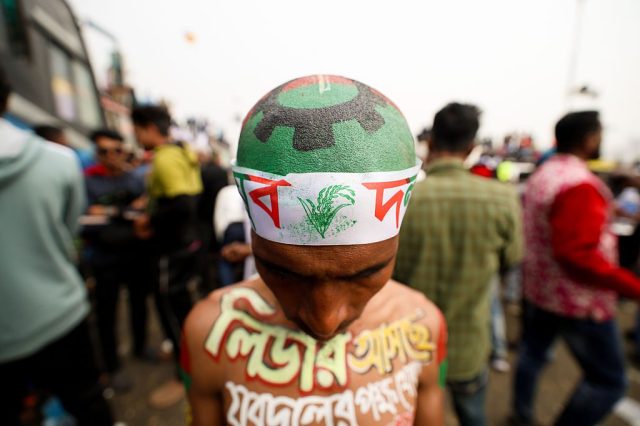
A BNP loyalist. (Anadolu/Getty Images)





From afar, Bangladesh’s upcoming election appears as an old morality play, staging Sensible Centrism against Unhinged Islamism — the dependable binary that reappears time and again along the crescent from Morocco to Malaysia. Some 128 million voters are expected to trudge to polling stations tomorrow, two in five of whom have never experienced anything resembling a free and fair vote. Some 150 parties have registered, with the predictable result that ballot papers are long enough to double as picnic rugs. Yet in Bangladesh itself, the prevailing mood is not anticipation but ennui, as voters contemplate a Hobson’s choice dressed up as pluralism. This is democracy as pageant: grand, noisy, faintly impressive — and entirely beside the point. Nothing, in truth, is at stake.
The likely victor is the center-right Bangladesh Nationalist Party (BNP), comfortably polling north of 50% and now led by Tarique Rahman, the sleek-haired heir and near-stranger to his homeland after 17 years of English exile. His admirers both at home and abroad cast him as a chastened liberal: a steady pair of hands, sobered by history and burnished by absence. His voters, who will back him faute de mieux, remember rather more. During the BNP’s spells in office in the Nineties and 2000s, power rested with his mother, Khaleda Zia — the formidable widow of the soldier-president Ziaur Rahman, assassinated in a failed putsch in 1981. She broke the glass ceiling as Bangladesh’s first female prime minister and broke records soon after, presiding over a country that managed the rare feat of being ranked the world’s most corrupt for four consecutive years by Transparency International. Rahman himself was later described in leaked diplomatic cables as a walking emblem of kleptocracy. Memory, however, is a luxury in Bangladeshi politics.
The principal alternative is the Jamaat-e-Islami, the once-banned Islamist party now enjoying a brisk revival under the leadership of Shafiqur Rahman, a solemn scold, skull-capped and maned. Buoyed by a disciplined grassroots machine and an electorate weary of secular strongmen, it polls at 30%. After 15 years of Sheikh Hasina — daughter of the nation’s founding father, Sheikh Mujibur Rahman, and long the imperious matriarch of Bangladeshi politics, presiding over electoral farce, colossal corruption, and systematic repression — a turn towards piety has an obvious appeal. The Jamaat insists it has reformed — no theocracy, no Taliban theatrics — yet urban liberals rightly remain unconvinced. It is surely no coincidence that the party of the mullahs has not fielded a single female candidate, while also flirting with limiting women’s working hours. Then there is the amateurism: hardly surprising for a party that has never run anything larger than a student union. Still, in rural Bangladesh, where the state has faded into a footnote, the Jamaat’s draw is less ideological than practical. To the local peasantry and déclassé salariat alike, Islamism carries the warm glow of welfarism.
Hovering uneasily on the margins is the National Citizen Party (NCP), the political afterlife of the Monsoon Revolution that toppled Hasina in July 2024. The NCP casts itself as the custodian of revolutionary virtue, staunchly anti-corruption and stoutly pro-free speech. Its ebullient leader, Nahid Islam, is conspicuously young — 27 — an age that can read as either bracingly fresh or mildly terrifying, depending on one’s appetite. Bangladesh, it turns out, has little of the Gallic taste for jeunisme. Popular approval has followed a familiar roller-coaster: at the height of the student protests in September 2024, the party’s predecessor briefly polled an eye-watering 35%, only to slump to barely 2% a year later.
Uprisings, as ever, do not translate neatly into votes. Chronically underfunded and organizationally thin, the NCP has compounded its troubles by entering an electoral mésalliance with the Jamaat — a union that has already alienated many supporters, particularly those for whom the Jamaat’s opposition to Bangladesh’s independence in 1971 remains scarcely forgivable. Senior figures have defected in protest, muttering that an anti-corruption movement has yoked itself to an Islamist machine it neither commands nor quite trusts. The alliance has secured the NCP a meager 30 seats, a thumping return to earth for a party born of street-level heroics.
Presiding over this fragile interlude is the caretaker prime minister, Muhammad Yunus, Nobelist and neoliberal. Installed as a compromise by hot-headed students and cautious generals after Sheikh Hasina’s violent fall, the octogenarian microfinancier cuts an almost comic figure amid the mêlée, a technocrat without a popular mandate who has clung on for 18 months, preaching reform to a political class that has elevated evasion into a civic art. His proposed constitutional changes — term limits; an upper house; new anti-corruption machinery — are logical enough, and will almost certainly be endorsed in the accompanying referendum. Whether they will survive first contact with lived reality is another matter. Bangladesh has never lacked for handsome constitutions; it has merely struggled to obey them.
The economic backdrop is bleak. Food inflation has hovered near 13% under Yunus; flooding has battered rice production; and the Adani Group, which supplies roughly a tenth of Bangladesh’s electricity, has begun curbing power exports from India over unpaid bills. Communal tensions have sharpened, too, with attacks on Hindus — some 8% of the population and disproportionately associated with Hasina’s discredited Awami League — puncturing the interim government’s claim to calm stewardship. Yunus’s preferred party trick has been to rattle the begging bowl abroad rather than tackle the altogether trickier proposition of taxing his own citizens. Dhaka is already propped up by a $1.2 billion American aid package and a $4.7 billion IMF bailout, with Washington assisting efforts to recover an estimated $17 billion siphoned abroad under Hasina’s rapacious rule. It will almost certainly need more. Should Western lenders or India lose patience, China stands ready, dangling a further $5 billion.
Yunus himself remains a curiously divisive figure. A darling of Western chancelleries and long the object of Hasina’s personal vendetta — she believes the Nobel Prize ought properly to have been hers, for having eventually called time on the massacre of tribal groups in the Chittagong Hill Tracts — he was welcomed at home precisely because he belonged to neither of the rancorous political dynasties. His Cabinet leaves little doubt as to his instincts: clanking heavily with military brass and technocrats inclined towards privatization, though leavened with an ecumenical clutch of box-ticking human rights lawyers and environmentalists.
Hasina’s Awami League, the agent of Bangladesh’s liberation from Pakistani overlordship, has now been banned outright. Her collapse, when it came, appeared abrupt only to those not paying attention. The fuse had been smoldering for years; July 2024 merely supplied the spark in the form of the resurrected Quota Reform movement. The civil service reservation system, devised after independence in 1971 to reward liberation fighters, had long since curdled into a system of hereditary entitlement. Over the decades it came to swallow ever larger portions of public employment (at one point, only 20% of jobs were “merit based”), even as graduate unemployment ballooned. Hasina’s inspired decision to extend these privileges to the grandchildren of freedom fighters proved a bridge too far. The resulting protests were beaten down with the usual admixture of police batons and Awami bruisers, only to resurface with tedious regularity.
In 2018, Hasina attempted a tactical retreat, abolishing the quotas altogether in the hope that the movement would obligingly pack up and go home. For a time, it did. Then, in a final act of institutional self-harm, the Supreme Court reinstated the system in July 2024, siding with aggrieved nepo bureaucrats. Hasina responded with characteristic grace, branding the protesters Razakars — the name reserved for those who collaborated with Pakistan’s genocidaires in 1971. The slur landed like a lit match in a petrol station. Protests swelled; curfews were imposed; the internet went dark. Party cadres and security forces fanned out, shooting indiscriminately.
By this point, repression was less a tactic than a reflex. Hasina’s government had perfected a system of secret prisons like the notorious “House of Mirrors”, where dissidents were tortured, bitten by insects, and prepared nightly for execution, before being dumped in fields at dawn. At least 1,400 people were killed in the final crackdown; dozens more vanished into the state’s oubliettes. Even when the Supreme Court hurriedly revised the quotas once more, restoring merit as the dominant criterion, the concession came far too late. Bangladesh was already ablaze. Hours before fleeing to India, Hasina pressed the army to fire again on the crowds. This time, the generals declined. The tinderbox finally went up — and the regime with it.
Last year, a special tribunal sentenced Hasina to death in absentia for crimes connected to the crackdown. Dhaka requested her extradition and Delhi, pointedly, declined. She is, after all, India’s creature. Geography ensures that Bangladesh must always reckon with its Himalayan neighbor; under Hasina, reckoning slid into outright deference. Her government signed spectacularly lopsided energy deals with Indian firms, including an agreement with Adani Power that obliges Bangladesh to pay for electricity it may not even use, and cheerfully backed a coal plant beside the fragile Sundarbans mangroves. In June 2024, she granted India tariff-free access to Bangladeshi railways, allowing Indian trains to trundle across the country — the final straw that helped ignite the Boycott India movement and confirmed, for many, that sovereignty had been quietly mislaid.
The stench of Hasina’s regime drifted as far as Hampstead. Last year, a Bangladeshi court sentenced her niece and Labour MP Tulip Siddiq to two years’ imprisonment for corruption linked to a land allocation scheme allegedly facilitated by her aunt. The verdict, delivered in absentia and unlikely ever to trouble her liberty, was airily dismissed by Labour as politically motivated. Siddiq resigned her ministerial post under pressure but remained defiant, thanking “distinguished lawyers” — among them that legal maven Cherie Blair, no less — for highlighting the deficiencies of Bangladesh’s justice system. Starmer, perhaps sensing a diplomatic tarpit, declined to meet the country’s interim leader during a London visit aimed at clawing back the billions siphoned off under Hasina’s venal rule.
Between a tainted dynast and an amateur Islamist, a youth movement belatedly discovering the price of compromise and a banned incumbent, Bangladesh’s electorate is offered not so much a choice as a sorting exercise. The real contest — over the political economy of plunder — has been deferred once again. For years now, Bangladesh has been evangelically sold in the NGO archipelago as a neoliberal miracle: 7% growth, humming garment lines, microfinance lifting the benighted by their bootstraps. The balance sheet now tells a less flattering story. State revenues languish at around 7% of GDP (the British figure is 39%), derisory even by Asian standards, leaving the government dependent on regressive taxes and foreign handouts. A recent Bangladeshi white paper concluded that the growth figures were massaged perhaps too enthusiastically by Hasina’s economists, and that between 2009 and 2023 some $230 billion was spirited out of the country through illicit channels: a steady annual hemorrhage of roughly 3 to 4% of GDP.
This was crony capitalism with gusto. Banks were treated as private larders; infrastructure projects became toll booths for ministers and their cronies. The garment sector — the backbone of exports — relied on wages so low that tea plantation laborers, earning barely two dollars a day, could feel positively cosseted. Trade unions were strangled. After Rana Plaza, an eight-story factory building, collapsed in 2013, killing more than 1,000 workers, the response was not reform but rubber bullets, arrests, and the discreet disappearance of labor organizers. Bangladesh now routinely features on lists of the world’s worst countries for workers. The indifference extends abroad. Migrant labor is one of Bangladesh’s most lucrative exports, its workers lionized as “remittance warriors” while being quietly abandoned to Saudi serfdom. When the bodies of abused domestic workers are repatriated from the Gulf, ministers shrug; deaths, it is suggested in Dhaka circles, are an acceptable overhead. In 2022 alone, nearly 4,000 Bangladeshi migrant workers returned home in coffins.
This election will alter nothing of consequence. The BNP may win, the Jamaat may surge, and a few students may scrape into parliament. Power will change hands, perhaps even politely. But the bargain — cheap labor, hollow institutions, money siphoned abroad, dissent managed — will endure. None of this diminishes the courage of Bangladeshi voters, who have braved bullets before and may yet do so again. Elections matter enormously, which is precisely why they are so carefully stage-managed in Bangladesh. The banners will come down; speeches about renewal will be made. And as Tomasi di Lampedusa had it, everything must change so that everything can stay the same.
Pratinav Anil is the author of two bleak assessments of 20th-century Indian history. He teaches at St Edmund Hall, Oxford.
 pratinavanil