




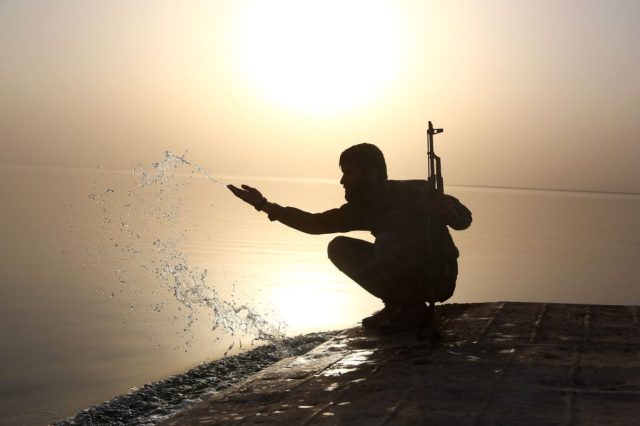
'The remorseless logic of a country, like neighboring Lebanon and Iraq, held hostage by its own tangled demographics.' (Delil Souleiman / AFP / Getty Imges)





It is generally expected that, whatever the ostensible cause of a civil war, in a country divided on ethnic and religious lines the fighting will sooner or later assume an interethnic or sectarian flavor. The Autonomous Administration of North and East Syria (AANES), now having surrendered its autonomy under assault from the Syrian state’s new jihadist-derived government, was, whatever else it may have been, an attempt to rebut this grim logic. Indeed, the dusty and unprepossessing plains of the Syrian Jazira — the northeastern portion of the country, east of the Euphrates — served for more than a decade as an unlikely political experiment in the management and defusion of ethnic conflict.
Whether noble or naive, this project now looks doomed as AANES’s great power backers turn their fickle attentions to Damascus, and the Damascus government has in turn successfully reasserted its control through military coercion. Within a matter of days, as its Sunni Arab levies turned their affections to their ethnic kin in Damascus and their guns on their former allies, Northeast Syria switched from a bold experiment in multi-ethnic governance to a desperate, rearguard battle for Kurdish cultural and political autonomy. The war, at its presumed end, reverted to the dynamics of its earliest days, when Ahmed al-Sharaa, then leader of the Syrian al-Qaeda faction Jabhat al-Nusra, had attempted, along with the Free Syrian Army (FSA) rebels and tribes of changeable loyalties, to seize control of the oil-rich, and newly Kurdish-run region, Syria’s breadbasket.
Simultaneously rich in resources yet neglected by its central government, and host to the country’s richest mix of ethnic and religious minorities, alternately the tools and the victims of the central state, the Syrian Jazira had always run according to its own dynamics. Both colonial French and independent Syrian administrations in distant, Levantine Damascus expended significant, if sporadic, effort in absorbing this neglected region of Mesopotamia within the modern state system, privileging one ethnic group against another for reasons of statecraft, and building model towns and vast dams, as evocative in their current dilapidation of failed modernities as the ancient tells dotting the landscape, now repurposed as gun emplacements, are of earlier lost civilizations.
Perhaps the AANES experiment can now be added to this melancholy list. Birthed from the fusion of Kurdish nationalism and Marxist-Leninist thought that initially drove the Kurdistan Workers’ Party (PKK) independence movement, the AANES, a project of the PKK’s Syrian sister organization, the Democratic Union Party (PYD), performed an attempted shift to anarchist political theory. The thought of the American writer Murray Bookchin, as reworked by the PKK’s occluded godhead figure Abdullah Öcalan from his Turkish jail cell, was its most notable innovation. Echoing Öcalan’s rejection of the PKK’s previous project of independence for the Kurdish nation, the AANES presented itself as an explicitly multi-ethnic, multi-sectarian state in which the greatest possible autonomy was devolved to religious and ethnic communities, beneath the benign framework of Jazira’s de facto autonomy from Damascus. In practice, the quasi-anarchist devolution of power resulted in the proliferation of bureaucratic structures. Local empowerment, similarly, meant the elevation of new elites loyal to the project, and the freezing out of dissidents, particularly rival Kurdish factions. Imperfect though it may have been, compared to the overt totalitarianism of the Baathist state, the anarchic infighting of the FSA rebels, and the gothic cruelties of ISIS, history is likely to remember it more favorably than today’s discourse would suggest.
Barely populated until the French Mandate period, except during the annual circulation of nomadic Bedouin shepherds, the portion of Syria east of the Euphrates underwent during the early 20th century a transformative period of internal and external immigration and development analogous, in a modest way, to that of California or Australia. Ethnic Kurds fleeing the collapse of proto-nationalist rebellions in Ataturk’s Turkey, along with Syriac Christians fleeing the Seifo genocide and many uprooted Armenians streamed south across the culverts and rusting tracks of the Berlin-to-Baghdad railway line, which still marks the modern border, joining their ethnic kin residing there from the beginning of recorded history. Ethnic Assyrians from British-Mandate northern Iraq similarly sought French protection from the predation of the Iraqi state and its Kurdish, Arab and Turkmen auxiliaries, establishing a string of fiercely Christian villages along the Khabur river. Northeast Syria was shaped by the cultural memory of ethnic conflict; its past decade of governance was an attempt to evade the return of its attendant cruelties.
As such, the AANES project was always as much one of necessity as Leftist idealism. The Kurdish regions of northern Syria, stretching West of the Euphrates into Aleppo, were separated from each other by clusters of Arab and Turkmen towns and villages, in large part the result of the Baathist state’s settlement of Arabs from Syria’s desert hinterland to hinder any Kurdish attempts at secession. While the early successes of the Syrian Kurds under the PYD, following a negotiated handover of control by Assad’s overstretched government, resulted in what was essentially the occupation by its YPG military forces of Arab settlements, loyal to one or other rebel or jihadist faction, America’s decisive intervention in the war against ISIS resulted in both sudden and unexpected great power backing for Northeast Syria and an evolution of Kurdish political attitudes towards local Arabs.
Partly at America’s behest, in a failed attempt to assuage the Syrian rebels’ combative Western think-tank diaspora, and partly a genuine attempt to impose progressive governance among a population Kurds frequently portray as stunted by its own reactionary obscurantism and crude ethnic chauvinism, Northeast Syria’s autonomous quasi-government undertook a project of delegating political and military authority to Arab regions won back from ISIS. It was an ambitious goal which seemed, for a decade, to have won majority acquiescence, if not affection. It became the boast of the regional administration that its armed forces, the Syrian Democratic Forces (SDF), was now predominantly composed of Arabs, a feat of enlightened governance that rapidly proved hollow, over the past two weeks, when the majority of these Arab fighters effortlessly switched sides. Having lost almost all its Arab accretions, the SDF was once again, in practice, the Kurdish YPG, an ethnic militia fighting for purely Kurdish goals. Now that, under the threat of military defeat, a shrunken version of these forces will be subsumed under the Damascus government’s control, their future role — on paper, and in reality — remains to be seen.
The integration terms finally accepted, at gunpoint, by the autonomous administration last weekend, though better than those of a fortnight ago are worse than those of the unimplemented March agreement. Consequently, much has been made in recent days of the AANES’s failures to come to terms with al-Sharaa’s shock capture of the Syrian state just over a year ago, and negotiate a settlement with the new reality. Certainly, the region’s political focus had, since the seeming cornering of the Sunni Arab rebellion into its Idlib Bantustan, centered on negotiating re-integration into Assad’s Baathist state in a manner that preserved some means of political and military autonomy. Yet Assad, over-confident of his own position as victor of the long and bloody war, refused to offer more than integration into the central state on terms that amounted to surrender. The new regime in Damascus now offers little different: what has changed is its greater power of coercion, and international backing, compared to its previous Baathist iteration.
Putin, once an occasional, tacit partner of the Kurds west of the Euphrates, has fully backed the new Damascus government, another instance where Russia, once America’s rival in Syria, shares increasingly aligned interests with the Trump White House. Calls for the protection of Kurdish cultural rights and social norms by European states are outweighed by their overriding political interest in the accelerated removal of their more than one million mostly Sunni Arab refugees. Regionally, the success or otherwise of the Northeast’s reintegration will determine Israel’s ability to justify its military protection of Druze autonomists in the southern province of Sweida. Relations with mostly Shia Iraq, which has its own reasons to look askance at Sunni jihadist governance and is currently making a show of reinforcing its border with Syria, will be fraught at best. Given the sheer improbability of fate’s wheel suddenly projecting al-Sharaa into Assad’s Damascus palace, it would be foolhardy to offer any firm predictions, rather than vague anxieties, for the country’s future.
For the Kurds themselves, the experiment in enlightened multi-ethnic governance proved, at the crucial moment, a dramatic and costly Achilles heel. The result, over time, will likely be the weakening of PKK ideology in favor of some form of pan-Kurdish ethnic nationalism, whose early stirrings are apparent in the flow of volunteers from northern Iraq to defend their ethnic kin, the sudden revival of the Kurdish flag, Ala Rengin, in Northeast Syria, and in the readoption of the ethnic term Rojava, or West Kurdistan, in place of its previously bland geographic descriptor. When even Abdullah Öcalan’s nephew Ömer, an MP in Turkey’s parliament for the movement-aligned DEM party, feels compelled to proclaim “Long live the Kurds and Kurdistan”, and “the Kurdish nation will not forgive the enmity committed against it”, we sense the tectonic plates of Kurdish politics shifting away from Leftist post-national idealism towards an embryonic ethnic nationalism. The decade-long experience of Kurdish self-governance, military success and international diplomacy will shape whatever follows the likely collapse of the AANES statelet, whether what replaces it will coalesce in the mountainous redoubts of eastern Turkey, Western Iran and northern Iraq, or in the grey cities of the European diaspora. So, too, will bitter analysis of the project’s failings.
Yet it would be unfair for harsh self-criticism to so soon follow hindsight. For all its faults, the Kurdish project of autonomy from the Syrian central state evolved, through managing the dynamics of their multi-ethnic region, into one that ironically and idealistically attempted to make the very idea of equable Syrian co-existence a political possibility. Inversely, the current Damascus project of re-centralization has, in western Syria, been accompanied by sectarian massacres and other abuses, which have increased the antipathy of peripheral minority populations towards the central state. Sunni Arab supporters of the al-Sharaa government, whose decade-long displeasure at having their ethnic kin ruled by minorities is accompanied by certainty of their own natural right to rule those same minorities, have made much of Kurdish intransigence while minimizing or even justifying the starkest governance failures of their own new regime. Yet the past year’s massacres of Alawites and Druze, punctuating the failed integration talks with the AANES, only heightened the Kurdish disinclination to disarm and dissolve its forces and place the fates of its people in the benevolence of the central state.
Syria’s post-independence oscillation between peripheral revolts and centralized coercion, the very cycle that produced both Assad and his own overthrow, is simply the remorseless logic of a country, like neighboring Lebanon and Iraq, held hostage by its own tangled demographics. Whether or not the new Syria can break this cycle is an open question. It will take great feats of governance, and of control over his own disparate armed forces, by al-Sharaa to avoid the logic of Syria’s demographic confusion weakening his own state-building project just as, suddenly and catastrophically, it did for the Kurds. Syria’s ethnic and religious complexity makes it a hard country to rule, historically veering, as a result, between instability and oppression. The Kurdish attempt to find another, progressive path ultimately failed, for the same reasons. The lessons, it ought not to need underlining, reach far beyond Syria’s borders.
