




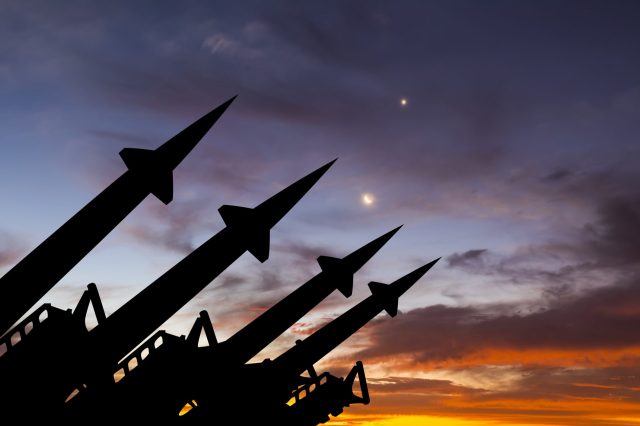
'Perhaps the greatest challenge to acquiring the Bomb would be psychological.' Photo: Getty/Anton Petrus





“Two dog sleds won’t do it!” In typically forthright language, Donald Trump stuck two fingers up to Denmark’s defense of Greenland — even as he ramps up the rhetoric around annexing the island wholesale. He now threatens Denmark and its allies with new tariffs. Combine this recent aggression with Trump’s long-standing claims that Europe is “decaying” from the inside, and it’s little wonder that Scandinavian leaders have been contemplating new ways of achieving self-reliance. In fact, the Nordics are beginning to ask themselves whether America really risk New York to save Stockholm in a nuclear showdown with Russia. And, if not: is it time for a Scandinavian nuclear deterrent?
“Everything should be on the table in this situation,” proclaimed the leader of the Swedish Democrats, a member of the nation’s governing coalition. Similar views are being aired in the press. “The umbrella is gone,” writes one of Sweden’s largest daily newspapers, referring to the American nuclear deterrent, urging Stockholm to consider acquiring nuclear weapons itself.
This might seem surprising, not least given the long-standing Nordic reputation for gentle diplomacy. In truth, though, Sweden is an ideal candidate for joining the nuclear club, quite aside from the nuclear-armed opponent on its doorstep. Boasting one of the most sophisticated arms industries in Europe, a robust civilian nuclear power sector, and indeed an abortive scheme to build a bomb during the Cold War, Sweden has everything it needs to go nuclear — even though Nordic proliferation could be the death knell for the whole Nato alliance.
If America’s commitment to Europe no longer seems credible, the Nordics also can’t rely on partners closer to home. Certainly, the Nato goal of raising allied defense spending to 5% of GDP seems distant, while the continent’s stagnant economies, burdened by ballooning welfare schemes, show little appetite for higher defense budgets. Spain is emblematic of this attitude, with Madrid spending just 1.28% of GDP on its military. Calls to raise this level to 5% were dismissed by Pedro Sánchez, Spain’s Prime Minister, as “disrespectful”, and who instead pledged not to cut a single cent from welfare spending. Italy is in a similar position, while even France, the strongest proponent of European strategic autonomy, is unable to mend its bloated pension system.
In other words, the Nordic countries find themselves alone, menaced by a threat they view as existential. For most other European countries — with the exception of Poland and the Baltics — the Russian danger feels remote. Few expect Putin’s tanks to roll into Berlin or Rome. The Nordic countries, on the other hand, see Russia as a clear and present danger, and for good reason. Swedish intelligence has long warned of Moscow targeting Swedish territorial integrity. Norway reports that Russian aircraft have violated its airspace for the first time in a decade, that preparations for sabotaging its water system could be underway, and that Russian GPS-jamming is making an airspace incident increasingly likely. Just two weeks ago, Finland caught a ship suspected of sabotaging undersea cables in the Baltic. The pressure, in short, is rising, pushing the Nordics to consider more drastic security options.
And internally, too, Sweden has reasons to go nuclear. The expertise accumulated in its civilian nuclear sector — control over the fuel cycle, reactor physics, supply chains — provides a solid foundation for military development. Another advantage is Sweden’s world-class manufacturing base. Unlike much of Europe, it never embraced the idea of a post-industrial society, and its defense sector is among the most modern and well-rounded around, producing everything from submarines to fighter jets. Saab has extensive experience with aviation, missile systems, and command and control; BAE Systems Bofors provides deep expertise with warheads, and explosives.
This engineering know-how dovetails with Sweden’s broader financial health. Of course, a military nuclear program is an expensive undertaking. Yet bucking the EU’s trend, Sweden has already increased its defense budget by 28% since 2023, with plenty of space for more. That makes Stockholm, alongside the other Nordics, financial outliers. They’re not gerontocracies laden with debt. Their pension systems, unlike those crushing Southern Europe and France, were prudently designed to adjust to changing demographic and economic conditions. Just as important, their fiscal health is stable. Financing a nuclear project would not be an insurmountable financial burden.
These economic strengths are also echoed elsewhere. In recent months, after all, Sweden has become something of a monetary safe haven, with a convenience yield lower than Switzerland’s. In layman’s terms, markets are eager to buy Swedish government bonds even at very low yields, effectively paying a premium to park capital in this famously stable jurisdiction. Borrowing to finance a nuclear program would therefore not be a problem for Sweden, especially if it shared the burden with the other Nordics.
As one Norwegian researcher bluntly declares, now that the US has lost the will to defend Europe, the only solution is a northern alliance equipped with a nuclear deterrent. Former Danish defense minister Jeppe Kofod has also proposed a Nordic defense union with the Bomb at its core. Commentators in the Swedish press are themselves discussing the idea, though whether Scandinavian jealousies can be tempered to create a joint nuclear umbrella remains an open question.
Yet perhaps the greatest challenge to acquiring the Bomb would be psychological. Sweden’s national identity is closely tied to pacifism, and Stockholm has long been an outspoken supporter of the Nuclear Non-Proliferation Treaty (NPT). One could argue, however, that trading ideological commitments for national survival is not an unreasonable price to pay. Nuclear states do not fight with each other. As the deterrence theorist Thomas Schelling famously put it, the threat of the Bomb leaves something to chance, making one nuclear power extremely reluctant to roll the dice against another nuclear state.
All the same, the pursuit of a nuclear deterrent would be a radical development. The theorist of nuclear proliferation Jacques Hymans argues that it was not the NPT that prevented nuclearization around the world — but rather the absence of determined elites. Go-getting leaders like Charles de Gaulle or David Ben-Gurion are scarce. Still, existential threats, of the sort that Israel once faced, are precisely what inspire leaders to eschew dependence on a distant ally.
Sweden has an instructive record of policy independence. During the pandemic, for instance, it diverged from the Western consensus by rejecting lockdowns. In the Cold War, security concerns led Stockholm to explore the development of nuclear weapons. From 1947 onwards, the country’s ministry of defense saw the nuclear option as the most reliable way to stave off the Soviet threat. A decade later, the push for a Swedish deterrent accelerated as the military pressed for its development — most notably Supreme Commander Nils Swedlund, who despised political bargaining and viewed the issue as key to Swedish security.
As Tony Jonter explains in his book on Sweden’s earlier effort to build the Bomb, political elites ultimately halted the project, which was opposed by the peace movement, feminists, and parts of the military. Yet as Jonter discovered later, it’s unclear whether the program was truly cancelled — or instead driven underground. Certainly, parts of the military remained skeptical about the effectiveness of the NPT and regarded nuclear weapons as a necessary backup. These rumors persisted for years. As late as 1994, The Washington Post noted that Sweden had preserved structures and components essential for producing nuclear weapons.
One can speculate whether a Nordic nuclear umbrella — perhaps also including Germany — is even viable. A similar structure has never been tried in the past, and the path of overt proliferation is probably a non-starter. Building a bomb in full view of the world would almost certainly provoke a military response from Moscow.
Yet as Sweden’s Cold War experience suggests, another scenario could involve following the Israeli model of nuclear opacity: developing a deterrent in secret while signaling its existence ambiguously once acquired, in a way that shapes adversaries’ behavior. Even here, of course, Israel could not have secured its own bomb without the tacit consent of the Nixon administration, and it remains an open question whether a Trump administration would follow a similar path here. “Immediately after the Cold War, one of the biggest instincts of the United States was to stop smaller countries from getting nuclear weapons, and that interest is still there,” says Sumantra Maitra, a consultant and expert on international relations. “I don’t think the Americans would be very happy to have Swedes with their fingers on the nuclear button, just like we didn’t want post-Soviet countries to have nuclear weapons.”
A third option, then, would be to imitate Japan. Over the years, Tokyo, through both official and unofficial channels, has made clear that it retains the technical capability to build a bomb, and the credible threat of nuclearization has been sufficient to extract firm security commitments from the United States. Latent capability, a so-called “technical deterrent”, could persuade Washington to provide the kinds of guarantees it now seems reluctant to offer.
De Gaulle once remarked that nuclear weapons make alliances obsolete. This is not quite true, as the Japanese example shows. Yet the Nordic pursuit of the Bomb would unequivocally mean one thing: Nato is just a façade, obscuring a reality of sovereign states with varying interests, defense constraints, and threat perceptions. Whatever happens next, anyway, the frantic fluidity of Northern Europe’s security environment means that the time to choose is now — if the choice hasn’t already been made. The rising threat level, coupled with the Nordic countries’ penchant for contrarian decision-making, suggests they are ready to follow in Japan’s footsteps. Either way, Europe’s future will increasingly be decided in its north, dog sleds or not.
