




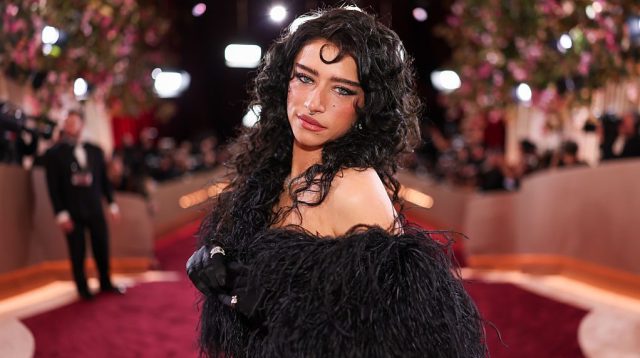
'A'zion is undeniably a nepo baby. She is also an excellent actress.' (Christopher Polk/Penske Media/Getty)





“This isn’t blackfishing, and anyone should do anything they want with their personal appearance and their body, but—”. Like the frantic toll of church bells alarming medieval villages of a coming invasion, the snarks of TikTok have begun preparing their followers to round on, and cancel, an up-and-coming female celebrity.
Odessa A’zion, star of Marty Supreme and Rachel Sennott’s HBO series I Love LA, is a name of which you may only be vaguely aware. A raven-haired 25-year-old, daughter to the voice actress Pamela Adlon (aka Bobby Hill from cult animation King of the Hill) and the filmmaker Felix Adlon, is undeniably a nepo baby. Unfortunately for the peanut gallery, she is also an excellent actress. But no matter — the bitchfinder-generals of social media are determined to hate her anyway. She is, after all, a “jew mid”, “zionist nepo baby”, “jew psyop”, “IDF plant” according to the not at all spiteful public square. This young actress — despite having no association with Israel or Middle Eastern politics beyond the crime of simply being Jewish — has been so viciously targeted by the terminally online for her assumed beliefs that she had to announce on her public Instagram story that she was, as she put it, “not a zio”. A healthy and normal pop culture indeed.
A’zion’s list of crimes is growing by the hour. There’s the “not quite blackfishing” accusation cowardly couched by the TikTok creator Georgie James, the logic of which goes that by dyeing and curling her hair, A’zion is attempting to look more, ahem, “Mediterranean” and ethnically “ambiguous” in order to muscle in on the social cachet of biracial Hollywood superstars. Then there was the Wigcident, as I am now calling it. During a red carpet interview last month, A’zion was asked if her hair was real. Evidently taking the red-carpet gratitude olympics too far (“I feel so blessed,” mewled everyone and her dog at the Golden Globes on Sunday), she said: “You think I can afford a wig like that? And wear it all the time? I’ve heard wigs can go up to like 20 or $30,000… are you fucking kidding me?” Cue a slew of armchair critics spitting feathers over her famous family and cinematic success, accusing her of playing mock-humble. Yes, she may have over-egged the pudding — but given how neurotic her fanbase seems to be, can you really blame her for trying to prostrate herself?
What a load of bad-faith nonsense this promising talent has had to field already. She’s been on the scene for all of five minutes but is already having to apologize for her Jewishness, withstand a purity test on Palestine and discuss the state of her finances. We are a million miles from the Hollywood of former decades, when stars like Johnny Depp and Sigourney Weaver would work with dodgy directors like Roman Polanski without facing any real stick — or when monsters like Harvey Weinstein were able to make the most of the casting couch as part of a smug open secret. A startling overcorrection has taken place which nastily guns for those whom fans once most adored: the young stars on the rise, the interesting new talents tasting well-earned fame and doing exciting things on screen. It seems all that has been swept away in favor of a sort of equal-opportunity fandom, where admiration is constantly tempered by jealousy and suspicion that a starlet might be the wrong kind of success story.
Even A’zion’s Marty Supreme co-star is not immune. Timothée Chalamet, despite being perhaps the world’s most celebrated young actor, is getting similar accusations — notably, rounding on his Jewish heritage. Under a tweet celebrating Chalamet’s success in the Golden Globes — he won best actor in a musical or comedy — the eye-rolling goes turbo: “Why do you think he has been pushed so hard,” writes one anonymous account; another intones: “He’s a huge star in Hollywood getting an unreal push from the media. Lol ya it’s probably a safe bet he’s Jewish.”
Clearly, antisemitism is in the water. In this climate, the successes of someone talented can be conveniently wafted off as the product of in-group plotting and industry-planting, calling on ancient conspiracy theories heard more often in the wake of October 7. But the focus on Jewishness is just one — and perhaps the most noticeable — of a range of modern refrains which make insecure audiences feel better about someone else’s achievements. The fact is that any perceived advantage — beauty, family, even ambition — renders fame undeserved in this pitiful age of envy. Think of the purportedly feminist outcry at Sydney Sweeney’s breasts, or the sudden shocked realization that many famous actors also have famous parents (a state of affairs as old as the film industry itself), or indeed the backlash against Chalamet saying, while accepting an award no less, that he was determined to be “one of the greats” last year. In 2026, the worst thing a celebrity could be is satisfied and successful — which is why another wave of spite broke out when Chalamet declared his love for Kylie Jenner at the Critics’ Choice Awards. And if you’re asking yourself why Chalamet seems always to be at the scene of the crime, here’s your answer: he is the most successful.
None of this tall-poppy scything benefits a soul, least of all the arts themselves. But the frequency and vitriol of online dogpiles seems likely only to increase; they are, after all, built into the algorithms of social media. For a generation of Zillennial underachievers too nervous and inept to conduct a job interview, let alone lift an Oscar, the best justification for your failure to thrive is the same as any toddler’s complaint: It’s just not fair! Couple that with the delicious dopamine loop of liking and retweeting a vindictive post about someone whose life you’d very much rather have, and the well of celebrity culture is hopelessly poisoned.
You might not give a fig about the consequences of this, but the pool of talent in the entertainment industry may well go the way of that in politics: dismal and packed with dopey masochists — after all, who else would put up with the abuse? For a rational adult to succeed in the hypercritical pop culture of 2026, they have to be willing to swallow the most bitter of pills and perform continual meekness, forever on the right side of social media’s obsessions. The result? Zara Larsson, the Swedish pop star, posting a bizarre Instagram story last week reeling off all the groups she “loves” which, you’ll be glad to know, includes… “criminals”. In trying to appease the peanut gallery, celebrities can only ever look like clowns. It’s high time we remembered why we used to elevate people in the first place, with the only test that really matters: are they any good?
