




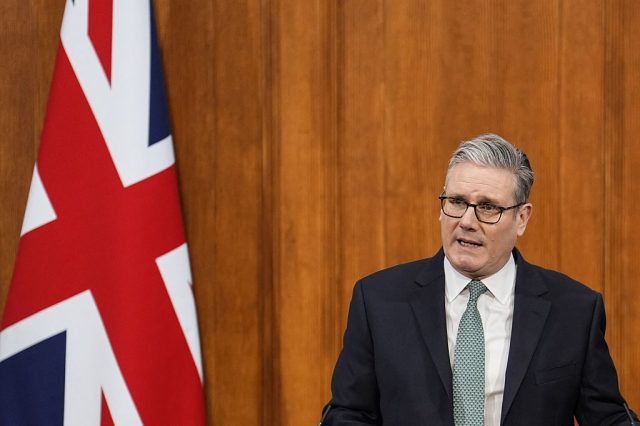
Starmer's majority has not made his premiership secure. (Jordan Pettitt / POOL / AFP via Getty Images)





Before a historic general election loss in 1983, Gerald Kaufman, an old Labour wag, described the party’s hard-Left manifesto, a 39-page document promising unilateral nuclear disarmament and the nationalization of failing carmakers, as “the longest suicide note in history”. By contrast, over the weekend the Labour leadership authored one of the shortest and most perfunctory suicide notes in political history: the announcement of an 8-1 decision by the ruling National Executive Committee (NEC) to block Andy Burnham from standing for parliament in Gorton and Denton.
And so the starting gun on a Labour civil war, and perhaps the end of Starmerism, has been fired via an arcane administrative decision rather than all-out rebellion over policy. It would be a fitting conclusion. Nothing will define Starmer’s premiership better than his near-total lack of a defining project and his singular devotion to proceduralism in lieu of a political vision.
We must not, of course, rule out a 14th policy U-turn on the part of this government. These have tended to occur when Number 10 has attempted to enact technocratic reforms that seem lab-designed both to alienate the electorate and disturb the progressive moralism of Labour MPs: think of the winter fuel debacle, ID cards, disability benefit cuts, the farm tax, and much else besides.
In each case, the strategic Machiavels of Downing Street apparently chose pure masochism. A policy announcement would be made out of nowhere, immediately burning bridges and political capital; the resulting furor would become memetic, with the policy held as indicative of the Government’s detachment from ordinary voters; thanks to widespread public opposition, it would be dropped, but only once all the damage had been done, obviating the potential benefits of full implementation while doing nothing to repair the Government’s popularity.
It’s not impossible that the Burnham snub will, in this grand tradition, be overturned following internal party outcry. A reverse ferret would require a new emergency meeting of the NEC to wave the Mancunian candidate through. Burnham, more likely than not, and more than any other possible Labour candidate, would saunter to victory in the Gorton and Denton contest. And yet this latest example of willfully ham-fisted internal NEC bureaucracy in the service of a flailing, decrepit administration will represent a different challenge entirely for Number 10.
Everyone knows why Burnham has been blocked, but our Prime Minister cannot admit it. If he were truly honest, he would have drafted a statement along the lines of: “after less than two years in office, defined by serial failure to connect with voters or my own party, I’m scared of welcoming back a potential challenger. Burnham has a vocal register that goes beyond my preferred tone of pained, nasal miserablism, and as such could destroy my Prime Ministerial career.” Burnham would threaten not just Starmer, but Nigel Farage: the country’s top pollster has concluded that he would be the most difficult Labour opponent for the Reform leader. Yet the party line is that if Labour moves Burnham away from his mayoral role, thus triggering a mayoral by-election, it risks losing two elections in one.
In other words, even the face-saving explanation for blocking Burnham is deeply ignominious. The fact that initiating a Greater Manchester Mayoral by-election is being briefed as “politically dangerous” for the Labour Party should ring alarm bells: this is the Labour Party, worried about losing a Mayoral by-election in Greater Manchester. For those new to British politics, the edge-of-the-Pennines land of Oasis, the Happy Mondays and torrential rain is perhaps the safest of red citadels in the entire country. But rather than the movement of a solid Labour metropole into the status of a marginal battleground provoking the thought that there may be some need for a change of direction at the top, the Labour Right has instead concluded it’s best to simply dig in.
Make no mistake: this is the beginning of the end. Starmer and a coterie of sycophants have now openly shown their hand: they are directionless, fearful, weak, panicked. But the Prime Minister should be commended for achieving something rare, even unheard of, in British politics: uniting diametrically opposed Labour factions against him and his advisers. Corbynites, Blue Labour and the “soft Left” are apoplectic, while Wes Streeting, an ambitious Blairite, is being as vocal as he can be within the confines of his cabinet position. Angela Rayner, Ed Miliband, Lucy Powell (big beasts, in contemporary Labour terms) — all have come out batting for Andy. A party insider tells me that Blue Labour’s small band of parliamentarians — a supposedly powerful element of the Starmerite coalition — “are furious”. A backbencher tells me that the NEC’s decision is “mad, weak, and will end badly”.
“If you asked me to put money on an outcome,” one Corbynite says, “I don’t think I could.” “A whole series of dominoes could fall in totally bizarre ways.” For what it’s worth, here’s my prediction: members, activists, trade union leaders and MPs will make noise over Burnham’s exclusion, noise which will die down in the coming days and weeks. The decision won’t be reversed, meaning that the most popular possible candidate will be excluded from the ballot. A less convincing candidate will take his place: a second-rate lobbyist, third-sector email-sender or corporate communications professional. They will hand the seat of Gorton and Denton to a populist insurgent in a Reform teal tie. The principal beneficiaries in the Commons will be one of Angela Rayner or Streeting, either of whom could use the row as a springboard to challenge Starmer. In that event, they are unlikely to have trouble finding the 80 MPs needed to trigger a leadership election. Starmer’s decision to block Burnham, then, may have prevented his most plausible leadership rival from returning to national politics.
But it will prove a Pyrrhic victory. Rayner and Streeting will be emboldened. Rayner, politically speaking, would offer a similar political prospectus to Burnham, but she is burdened by her recent tax scandal. Streeting, meanwhile, while pivoting Leftwards in a bid to woo members, is pure Davos Labour: Tony Blair Institute policy papers, public sector marketization, AI utopianism, and accommodation with fiscal and monetary orthodoxy. Of the three, Burnham had the more obvious diagnosis for the country’s ills: his “four horsemen” of privatization, deindustrialization, austerity and Brexit would be remedied by some old-fashioned soft Leftism. That means tax-and-spend, public ownership, European rapprochement. Much of this would come unstuck after collision with the realities of contemporary statecraft. But the chances of the vision being realized under the easy charm of British politics’s foremost BBC 6 Music dad, is now dramatically reduced.
I don’t mean to present a paean to the lost future of an Andy Burnham ascendancy. There’s much of his carefully crafted public persona that’s easy to poke holes in. His “King-of-the-North”, everyman, football-lad schtick grates among SW1 insiders who recall a fresh-faced Cambridge graduate joining the team as a budding Blairite spad in the halcyon days of New Labour. They remember a health minister who voted for the Iraq War and for the happily enforced marketization within “Our NHS”. They remember him running unsuccessfully, to be Labour leader on a platform of fiscal rectitude. Since then, he’s flirted with Corbynism and positioned himself as a tribune of left-behind regions against an effete Westminster elite. His inchoate offer of “Manchesterism” trumpets the benefits of public ownership in local and perhaps national governance. But Manchesterism is based on little except his successful record in enacting a piece of obscure Tory legislation that allowed a re-regulation of Manchester’s buses under an authority resembling Transport for London. This isn’t bad policy in itself, but one can’t create a comprehensive and convincing ideological “-ism” around your implementation of Theresa May’s 2017 Bus Services Act.
All this is true. But in politics, truth is secondary to perception. And the truth is that Andy Burnham is perceived as a vastly more likable, relatable and convincing politician than Keir Starmer. He passes the pint test. He’ll be licking his wounds this week, plotting a way forward, no doubt. The hope that the NEC decision will quieten leadership speculation is delusional: all the party’s ruling body has done is hasten the inevitable, handing several rounds of ammunition to their opponents. The barrage will be too much to withstand as they come under fire in Gorton. But with Burnham outside of parliament, for now, it’ll be up to others to put the final nail in Starmerism’s coffin.
Jonny Ball is a Contributing Editor at UnHerd. He formerly wrote under the name Despotic Inroad.
 DespoticInroad