




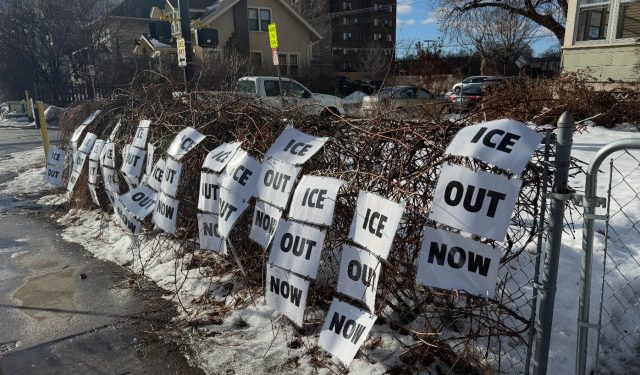
An ordinary neighborhood has been transformed. Credit: Ryan Zickgraf





It took the effort of multiple ICE agents to knock a 20-something woman named Sammee into a snowbank outside Minneapolis’s Bishop Henry Whipple Federal Building on Tuesday afternoon. The spectacle was absurd: a squad of roughly 20 federal officers surged across the street to confront a few dozen protesters, many of them chanting a simple refrain: “Quit your job.” For some unknown reason, Sammee was one of the first people singled out.
This was Sammee’s first real action as a protester since moving to Minneapolis from Duluth a few years ago. “I just cannot in good conscience just sit home and do nothing while these people are terrorising my neighbours, my community,” she told me. On Monday, her first day picketing ICE’s local headquarters, she came unprepared and got pepper-sprayed in the face at this exact spot with only sunglasses to protect her eyes, and soon felt the pain of chemical burns on her skin. She returned the following day clad in a rainbow-striped ski suit and bright orange goggles placed over her silver-rimmed glasses for protection.
She’s tougher than she looks because of a roller derby hobby, a sport that trains you to stay upright when momentum is working against you. So when ICE agents failed to knock her down, more piled in, throwing her down into the filthy snow piled along the curb. As she lay there, they yelled at her to get back up, even as they continued to shove her back down like grade-school tormentors. The moment she rose to her feet, she received a dose of harsh pepper spray to the face that got partially deflected by her anti-ICE sign.
“Do it again!” she responded in a fearless taunt. The agent who sprayed her looked nervously at his colleagues for guidance on how to respond. “If you look in their eyes, a lot of them look fucking scared,” Sammee told me. “I think they’re just genuinely afraid of the crowd, even though they’re the ones being violent toward us.”
She expected to be handcuffed and detained inside the federal building, but ICE instead escorted two of her fellow picketers past the gates and into detention; they’d likely be released back onto the street in a matter of hours. Minutes later, Sammee and her fellow protesters returned to screaming obscenities at unmarked black trucks full of masked ICE agents, who sometimes cursed at them, in turn.
Most interactions between protesters and federal agents in Minneapolis play out this way. By and large, they aren’t a matter of life and death. They’re more like a Tom and Jerry cartoon pitting an outmatched-but-fearless provocateur and a mean-but-incompetent bully. But since another white female activist who sought to observe or impede agents, Renee Good, was shot and killed by agents last week in a similar scenario, there’s an ominous cloud of danger hovering over these encounters. Yet Sammee managed to keep an unwavering smile on her face while recounting the story about how she just been assaulted by ICE.
But for how long? These days, the happy-go-lucky Midwestern demeanour that defines this place seems like the exception rather than the rule. What’s clear in my time touring the southern part of the city is that the weight of five years of stressful events, including the Trump administration’s Operation Metro Surge, a targeted deployment of ICE and border agents to Minneapolis, has taken an enormous psychic toll.
Federal officials have billed it as the largest deportation operation ever undertaken in America, and have characterised last week’s deadly encounter with Good as a self-defence shooting, a version contested by local leaders and eyewitnesses and many Minnesotans who’ve watched the video of the incident.
Residents I spoke with also insist that Trump is employing ICE to sow chaos here to provoke a violent reaction and footage dramatic enough to justify escalation. One longtime local described it bluntly after showing me a video taken by his neighbor of ICE agents throwing gas and flashbang grenades on his block from out their car windows: “They’re trying to provoke people into confrontation,” he said. “They want the bad stuff to happen so they can send in more people, call it a civil war.” For his part, Trump has encouraged political protesting in Iran — “Iranian Patriots, KEEP PROTESTING – TAKE OVER YOUR INSTITUTIONS!!!” he posted on Truth Social — but demonises it in Minneapolis, dismissing it as “unrest that anarchists and professional agitators are causing.”
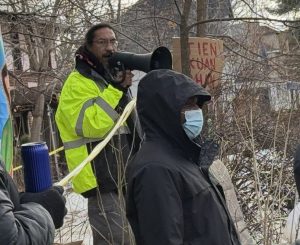
Collectively, Minneapolis is pissed and scared. But most of all, the city’s tired in a world-weary way. Even the signs hung on houses or held in protesters’ hands reflect this attitude. The gentle virtue signaling of “In This House” signs of the early 2020s are gone, replaced by blunt or angry ones reading simply “Fuck Ice,” “Ice Out Now,” or “No Trespassing.” What this city really needs right now is a cigarette or a drink, preferably both.
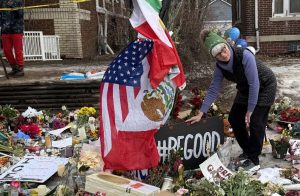
This feeling is most pronounced in south Minneapolis’s leafy Powderhorn neighbourhood. The street where Good was killed by ICE and the intersection where George Floyd died sit at the heart of a cluster of largely residential blocks a few miles south of downtown that took shape in the early 20th century as a streetcar suburb of single-family homes, duplexes, and low-rise apartments. It’s home to institutions like the Minneapolis Institute of Art.
Over the decades, this area evolved into one of the city’s most economically and racially diverse neighbourhoods, drawing middle-class artists, working families, and immigrants, while anchoring a vibrant local culture around Powderhorn Park. But it’s not a place historically accustomed to being the center of the universe. “Minnesotans generally like things quiet — shut up, get to work, get things done. It’s a very German Lutheran mindset,” said John Davis, a resident who embraced that low-key lifestyle when he moved here from New York City three decades ago.
Yet, Powderhorn is now a living-history museum of the current decade. Walking here as an outsider feels like an act of dark tourism, a term that describes sightseeing of destinations known for death, disaster, horror, or misery. Within a few square miles, you can trace nearly every pressure point of the 2020s. Five years ago, the neighbourhood became globally recognisable, almost overnight, when George Floyd’s killing at 38th and Chicago transformed an ordinary intersection into a hub of protesting and riots, and a pilgrimage site. Streets were closed, helicopters circled, and fires burned close enough that people kept hoses ready, just in case. Residents adjusted as best they could. Some embraced the transformation, but others merely tolerated it or were disgusted by it. “I was so distraught about (the Floyd protests),” said an elderly woman who asked not to be identified. “We shopped at places where people were stealing TVs and burning buildings, and we said this is not what Minnesotans do!”
Then came the long tail. The pandemic dragged on. Schools went remote, then hybrid, then back again. Teachers went on strike for multiple weeks in 2022. Businesses closed or limped along. In October 2025, a gunman shot through the windows of Annunciation Catholic Church during Mass, killing two children, ages 8 and 10, and injuring 17 other people, including 14 children. The neighbourhood began to resemble something like normalcy when the ground shifted and Trump announced on Jan. 6 that he’d deploy as many as 2,000 federal agents to the area for a sweeping crackdown tied in part to allegations of fraud involving Somali residents.
Residents here — immigrants and activists, along with everyone else — have been under the constant threat of low levels of violence, random catch-and-release-style kidnapping, tear gassing, and other forms of lawlessness from federal law enforcement for more than a week. You can walk down Powderhorn sidewalks and sometimes spot what looks like blood marking the ice, but is actually leftover reddish-hued chemicals from non-lethal weapons discharged by ICE.
Federal officers are also sending agents into the parking lots of churches and schools; they’re marching into Targets to detain people. It often feels improvisational, reactive, and thin-skinned. Locals here were already on edge, but the slaying of Good has escalated those nervous feelings into a kind of existential dread. “Y’all, they’re shooting white ladies in the face in the street! What’s going to happen next?” exclaimed a black pastor to his flock at an evangelical church. Some churches, schools, restaurants, and other institutions have spent the last week closed or partially closed, and others are alerting their patrons or members when federal agents are nearby.
Peter Vircks, a professional saxophonist, described Powderhorn as an open wound that cannot heal. “Everyone’s feeling like they’re in limbo, waiting for the next thing to happen,” he said. For Vircks, that next thing happened on January 9 after the killing of Good. He was walking his dog on 28th Street, where his teenage son goes to Roosevelt High, when he stumbled upon the aftermath of an incident in which armed US Customs and Border Patrol officers entered school property during dismissal, roughed up people (including students), handcuffed two staff members, and fired pepper spray and pepper balls on bystanders.
“It’s really beyond the pale,” Vircks told me. “It’s not a suburban campus. It’s a neighborhood. Grandmothers and grandkids.” Former Minnesota Gov. Jesse Ventura, a Roosevelt graduate, agrees. He arrived at the school shortly after Vircks to condemn ICE. “We’re a third-world country now,” he told a Fox News affiliate. “You want to know why? Because in third-world countries, they have the military doing their police work in the cities.”
Vircks’s son was not involved in the Roosevelt clash with ICE and hasn’t talked much about it — or about anything, really. “My wife is convinced he’s angry at adults for screwing up his world. Between riots, the strikes, murders, a kid can’t do anything about it — he can’t even vote.” Vircks is an adult and a voter, but even he feels exhausted and helpless in the new status quo. He has trouble sleeping because of the bright stadium lights illuminating the park across the street from his house since last week, and the constant din of helicopters hovering overhead. During the George Floyd protests, he was worried about his property, to the point of regularly dumping water on his woodpile to keep rioters from setting it ablaze. But the ICE invasion feels different because there is no end in sight, he says, and no authorities to appeal to.
“They say to email or call your representatives. But that seems like screaming into the void. You try to live your everyday life, pay your mortgage, and then you add this on top of it?” he said. Today, for his job as a professional musician, he’s supposed to write an upbeat pop song. But how?
Not everyone I encounter is as open as Vircks or as chipper as Sammee. Multiple Minnesotans tell me they aren’t talking to anyone, much less the media. Can you blame them? This city has already served as a battleground once this decade — symbolic and literal — and understands how quickly local tragedy can be nationalised, flattened into content, and weaponised by people who don’t have to live with the consequences. When this season finally passes, the deeper question will linger: how much cumulative strain can a neighbourhood absorb before something essential gives way? Not a riot or a revolution, but a collapse of the quiet civic trust that binds communities together.
Minneapolis will certainly endure the winter of ICE, but the deeper, more permanent damage may not be seen until the season’s deep freeze melts away and spring arrives.
