




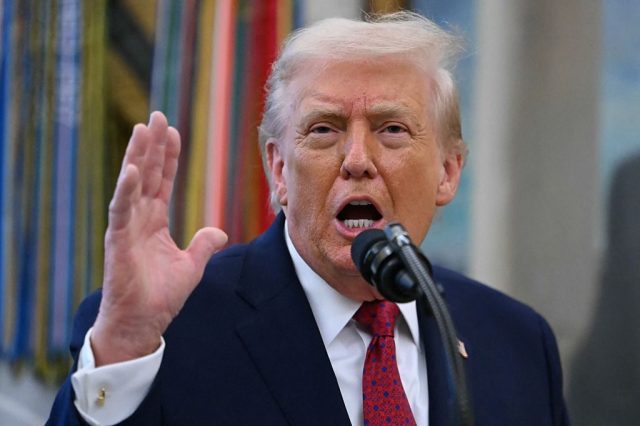
The strike on Iran's nuclear capabilities gives Trump more leverage. Photo: ANDREW CABALLERO-REYNOLDS / AFP via Getty Images





Iran is protesting again. Once more the videos circulate: women tearing off their headscarves, youths chanting slogans in the street, and regime thugs fleeing. Hashtags trend, analysts expound and the familiar question is asked: is this it?
Anyone who has spent a career covering Iran understands two things: first, that the Islamic Republic does not fall because X is excited; and second, that these protests must be considered not in isolation but as part of a larger cycle of resistance that, in its modern incarnation, has periodically strafed the regime since 2009’s Green Revolution.
The latest unrest did not begin with students or political activists but with shopkeepers: mobile phone and electronics traders in Tehran, among those hit hardest by the currency’s latest plunge. In Iran, economic collapse is visceral. It is experienced in shuttered storefronts, disappearing capital, and the drawn-out humiliation of a middle class being slowly crushed. Time and again, economic shock has supplied the initial fuel for unrest. This moment is no different.
From those commercial districts, anger bled outward — first into surrounding streets, then beyond the capital altogether. As has often happened before, material grievances quickly gave way to political denunciation. What is less predictable is whether rage can be converted into sustained pressure. Iran today is battered by inflation, corroded by corruption, and exhausted by a cost-of-living crisis with no obvious end.
Still, though, history counsels caution. Following the contested re-election of President Mahmoud Ahmadinejad in 2009, millions flooded Tehran’s streets. The movement possessed visibility, leadership, and a claim to legitimacy. It mobilized the urban middle class at scale. And it failed.
Its weakness lay not in its numbers but in its reach. The movement never truly broke out of the major cities. It did not sink roots in provincial or working-class Iran. More importantly, it failed to irretrievably split the system’s coercive core. Yes, the movement’s leaders, Mir-Hossein Mousavi and Mehdi Karroubi, were from the establishment, but they were dealt with expertly. This was the regime’s genius: it didn’t kill or even imprison them. It just kept them confined to their homes without even a working internet connection. The two men became not martyrs but irrelevant. The movement didn’t collapse; it withered.
This is a regime born of revolution. It absorbed the lesson that protests are most dangerous when mishandled — and that selective restraint can sometimes be as effective as selective brutality.
The demonstrations of winter 2017–2018 lacked the global impact of 2009 but unnerved the authorities in a different way. They were driven by economic anger and ignited far from Tehran, beginning in the conservative city of Mashhad before spreading across regions and social strata. The pattern returned with greater ferocity in November 2019, after a surge in fuel prices. The state’s response was ferocious. It killed hundreds; it locked up thousands. It endured.
The killing of Mahsa Amini in custody in 2022 triggered another eruption — this time cultural as much as political. The “Women, Life, Freedom” protests spread rapidly. Their moral force was undeniable. But once again, the system absorbed the shock. The challenge was serious; the damage was contained.
So where does the present unrest sit within this pattern? Participation has not yet broadened into a genuine cross-class movement. The unrest, while geographically wider than Tehran, is still limited compared with earlier episodes. And most importantly, there is no sign of elite defection or security force disintegration.
Western observers routinely mistake visibility for power. But what matters far more than viral imagery is whether labor action spreads; whether oil, transport, or municipal services are disrupted (striking oil workers played a crucial role in the downfall of the Shah in 1979); whether clerical and military elites begin to wobble. None of this is happening yet.
This does not mean the regime is secure. It means that so far, even after the hammering it took at the hands of Israel last June, it remains structurally intact.
There are, however, two variables that could make all the difference. The first is that Iran is in the grip of a severe and structural water crisis — not a temporary drought but an ecological reckoning born of decades of mismanagement and over-extraction. This is a pressure absent from earlier protest cycles — and one the state cannot simply baton away. Protests linked to water scarcity have already flared in Khuzestan and Isfahan. Unlike financial collapse, water shortages do not discriminate. Farmers, laborers, and urban residents are all exposed. More than this, you can terrorize people demanding civic rights back into their homes; those dying of thirst have nothing to lose.
The second variable is Washington. When Iranians took to the streets in 2009, Barack Obama, with typical stentorian pomposity, warned the Mullahs: “the world is watching you.” Early this morning, on the Truth Social platform, US President Donald Trump had a different message: “If Iran shots [sic] and violently kills peaceful protesters, which is their custom, the United States of America will come to their rescue. We are locked and loaded and ready to go. Thank you for your attention to this matter! President DONALD J.TRUMP”
This is a major, possibly existential, problem for the regime. The Mullahs have long preferred selective executions and torture over mass violence, but if even that option is slipping away, they are in real trouble. If Trump announces that the US is “locked and loaded”, the regime must take it seriously. The remnants of its nuclear program are proof of that.
And it’s a message that every Iranian has heard. If people begin to believe they can protest without fear of sweeping state brutality, the regime’s options are sharply limited.
Early this morning, I spoke with a friend inside Iran. “God bless Donald Trump!” he messaged me, only half-joking. “We have no idea what’s coming next, but the anger is greater and the fear is less,” he added. “We’ve lived like this for decades. We are totally sick of it. It’s time for it to go!”
Is it different this time? I ask him. “We don’t know,” he replies. “But now we have the US president behind us! This has never happened before. The regime can murder us, but it cannot take on America.”
He continues: “These bastards will fall eventually. Now maybe we have the best chance we ever did.”
Whether this latest unrest becomes just another chapter in Iran’s long history of dissent, or is indeed something genuinely transformative, still depends on the same unforgiving factors: geographical reach, social convergence, and elite fractures. But one thing is undeniable: the Iran story now has a new leading man, and it’s not an Iranian general, a mullah, or even a protester. It’s Donald Trump.
David Patrikarakos is UnHerd‘s foreign correspondent. His latest book is War in 140 characters: how social media is reshaping conflict in the 21st century. (Hachette)
 dpatrikarakos