




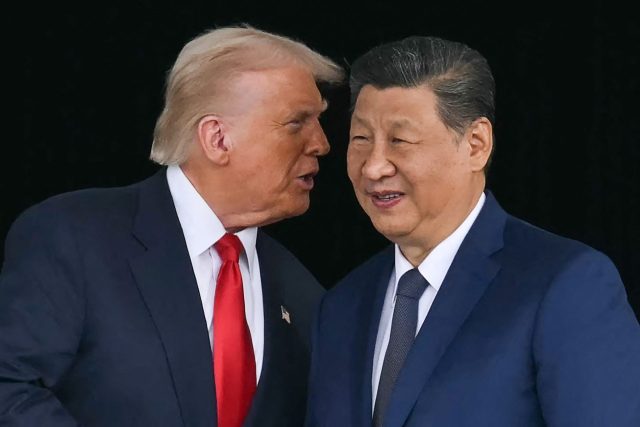
Trump and Xi's first face-to-face meeting in six years in October 2025 (Andrew Caballero-Reynolds/ Getty).





Alberto Fujimori, the dictatorial former president of Peru, was nicknamed “el Chino” (the Chinese one) during his time in office in the Nineties, despite his ethnic background being Japanese. It was a careless designation, but wasn’t meant as a snub — after all, the Peruvian people had voted for him in the 1990 election over the Nobel Prize-winning novelist and ardent privatizer Mario Vargas Llosa. Instead, the nickname reflected a hazy understanding of Asia in South America. The two regions have not traditionally been close.
Today, however, they have far more in common. China is now the major trading partner of most South American states, which marks a substantial change from the 20th century when the US dominated bilateral trade with the region. Brazil sold 110 million tons of soy beans to China in 2025, while Chinese firms are building a new metro line in the Chilean capital Santiago, and in 2024 opened a brand new port near Lima. Overall, South American-Chinese trade in 2024 topped half a trillion dollars.
In the wake of Nicolás Maduro’s rendition, many have been asking whether the incident marks a major blow for China’s prospects in South America. One of Beijing’s representatives was in talks with Maduro mere hours before Delta Force came calling. Beijing won’t be thrilled about Maduro’s loss, but his presence probably isn’t critical to its influence in the region. American oil companies are proving skeptical about investing in Venezuela’s decrepit oil infrastructure, but China has readily made much longer-term investments there and in other South American countries. Beijing has long believed that in the 21st century, real power lies in tech infrastructure — and it shows.
Under Maduro, Venezuela committed on a grand scale to Chinese Huawei systems to run 5G. Huawei and other Chinese players have also moved into cloud computing in recent years, and have penetrated much of South America. It is not yet clear whether America’s new arrangements with Venezuela’s interim leader, Delcy Rodríguez, will change all this. There are alternative 5G providers in operation in Venezuela, but it will be hard — and costly — to remove Chinese infrastructure that has already been installed.
That infrastructure includes energy as well as communications. South America has shifted decisively toward renewables: over 60% of its electricity generation is from renewables (including hydropower), and more than 90% of the region’s solar and wind equipment is from Chinese producers. Meanwhile, Chinese EVs have more than a quarter of the market in Chile, Ecuador and Uruguay, and their presence is growing fast in the continent’s other markets.
Will the Trump administration demand that South America abandon its current dependence on Chinese infrastructure, electric vehicles and green energy? And if so, will the US help pay for an alternative in a region where consumers want cheap, efficient products here and now? American taxpayers might not be delighted to hear that Venezuelan oil revenues, if they ever arrive, are spent on subsidizing cloud computing in Caracas or Buenos Aires.
If the Americans allow China to remain the region’s infrastructure giant, then many in Beijing will be fine with the loss of Maduro. In the long term, tech dominance assures China leverage in Venezuela regardless of who sits in the presidential palace. If arresting a head of state is America’s way of showing its dominance in a key region, then influencing everything from business to energy infrastructure might be Beijing’s way of doing the same thing. China has multiple opportunities to adapt and find new opportunities in a region where it’s indisputably a major economic player.
Meanwhile, Trump’s success in decapitating the Venezuelan leadership has revived his enthusiasm for talking about taking Greenland. In an interview with the New York Times, he suggested that Russia and China might take over Greenland if America didn’t get there first. Yet this implies that China’s Arctic plans are further advanced than is really the case.
In 2018, China declared itself a “near-Arctic state” — the word “near” is carrying a lot of weight in that formulation. China’s interest in the far north is rooted in a historical sense, developed over the past century, that the country is surrounded by enemies and that an alliance of adversaries might cut off important sea routes to China by blocking the Strait of Malacca. It’s hard to imagine that many powers would actually seek to provoke China, now a military superpower, in that way. But Beijing has long sought alternative ways to supply itself if one key route is cut off. The warming waters of the Arctic provide one possible pathway. China has invested in new icebreaker ships and has sought increased status in the Arctic Council, the international body where issues relating to the region are discussed.
This is still a policy for the 2030s and beyond, but the thinking started years ago. In 2018, China introduced the term “Polar Silk Road”, describing its interest in sea routes from northern Chinese ports across the Arctic waters to the Atlantic and beyond, though the phrase hasn’t caught on in quite the same way as its more famous Belt and Road Initiative. A few prescient Western researchers have been tracking China’s increased interest in the Arctic, and Greenland in particular, for some years now, including Eyck Freymann, who co-wrote, with Calvin Heng, an important paper for the Belfer Center of the Harvard Kennedy School on the Arctic intentions of Asian powers. As they point out, the Arctic is one of the areas where greater cooperation between Russia and China, which is certainly real in a broad sense, is still fragile. Other analysts point out that Russia has a very strong sense of the Arctic as part of its own identity. A greater Chinese presence there would cause significant anguish among the Russian nationalists who both inspire and goad Putin online.
The aspiration to expand beyond China’s traditional Asian position is influenced in part by three Western figures who have been prominent in its thinking on geopolitics over the past few decades: Mahan, Mackinder and Monroe. Alfred Thayer Mahan, one of the most prominent naval theorists of the 19th century, argued that control of the oceans through a powerful navy was central to dominance in the global economy; Sir Halford Mackinder maintained that control of the “World Island” of Eurasia was central to any power’s search for global dominance. US president James Monroe’s doctrine of hemispheric dominance has come into prominence this month because of its recasting as the “Donroe Doctrine”, but Chinese thinkers have been debating an “Asian Monroe Doctrine” since at least the Thirties, when Japan’s empire sought to dominate the continent.
China has little obvious interest in classic territorial dominance over Greenland, though mineral rights are another matter. But a new approach to global politics, one that enables Beijing to push its case around disputed islands and maritime routes in Asia, will be of great interest. It has had longstanding disputes with other maritime powers over islands in the East and South China Seas: Vietnam, the Philippines, and Japan. In the longer term, the precedents set by the Donroe Doctrine might yet lead online Chinese nationalists, many of whom love a bilingual pun, to start agitating for dominance in the South China Xi.