




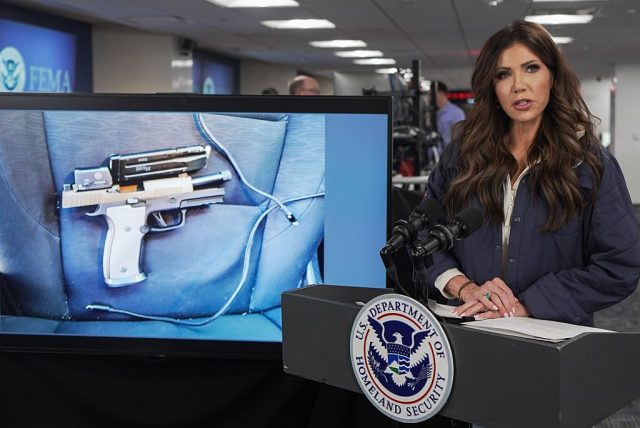
Kristi Noem speaks in front of a monitor displaying Pretti's alleged gun. Credit: Getty





Within hours of US Border Patrol agents shooting Alex Pretti in Minneapolis on Saturday, the federal government had published a photo online of the gun the anti-ICE protester and nurse was allegedly carrying. The sight of the weapon — a SIG P320 pistol — gave me a jolt. I immediately knew that, in addition to all the partisan fighting that was about to consume my timeline, a long-running debate among gun enthusiasts would soon hit the mainstream.
The SIG P320 is a source of endless controversy in gun circles. From shooting ranges to online forums, wherever gun guys gather, there are strong opinions on this pistol. If you aren’t a gun guy, you might mistake the dispute as a matter of brand loyalty: think Ford versus Chevy, Pepsi versus Coke. And the SIG debate is that, in part, but it’s also far more than that.
The issues go a lot deeper, and the backstory reveals something about gun culture in America, and how it’s crossing the political divide from red to blue.
But to get something out of the way upfront, to save my fellow gun nuts a bunch of scrolling through this essay so they can figure out where I stand on The Issue: I’m a die-hard SIG guy with a small yet primo collection of raced-out DA/SA pistols to prove it. But I don’t touch the P320, nor do I recommend it to anyone.
There are exactly two things a loaded firearm absolutely must do with 100% reliability. First, it must go bang every time the shooter intends for it to do so. Second, it must never go bang when the shooter does not intend for it to do so. There is zero room for error in either of these two requirements, which, incidentally, is the reason why electronically authorized “smart guns” — which identify the user before permitting the gun to fire — have never taken off in the market and probably never will.
The Beretta M9 that the US Army issued to troops up until 2017 as a standard sidearm struggles to meet requirement No. 1, for example. For starters, the M9 had basic mechanical problems, at least initially. A 1988 Government Accountability Office report detailed significant quality and safety shortcomings: namely, slide failures and frame cracks. But the M9 and guns like it also have what we might think of as a user-interface problem that can prevent them from going off even when the gun is working exactly as designed. I’m speaking of the challenge posed by the presence of a manual safety mechanism.
Even a perfectly functioning pistol can fail to fire when a shooter intends for it to do so, if that shooter has forgotten to flick off the safety before pulling the trigger. This safety issue is well-known for all guns that have manual safeties. When I took my concealed-carry class, the two veteran Austin Police Department detectives who taught it spent time scaring us with stories of dead cops whose corpses were found with their trigger fingers swollen from desperately squeezing a trigger that was never going to fire, because they “missed the throw” of the safety lever in the stress of a shootout.
The instructors told us these horror stories to stress the importance of training yourself to the point that your body reflexively flicks the safety off when bringing the gun up; you shouldn’t even have to think about it. But what about those of us who just don’t have time to ingrain the safety flick so deeply into our muscle memory that our thumb will automatically do it, without fail, under life-or-death levels of stress? What about new recruits?
Training is one way to address this issue. Another is to simply remove the safety, which is essentially what striker-fired pistols like the Glock and the Smith & Wesson M&P ultimately did. (The Glock does have a tiny little safety built into the trigger, so that when you pull the trigger you’re pulling the safety, but it’s basically like not having a safety. Note also that you can get versions of these pistols with a manual safety, but this isn’t a popular option and is typically only selected in situations where a department still requires the safety.)
Striker-fired pistols became popular over the past few decades with police and special forces because they nail our requirement No 1: every time the trigger is pulled, these light, partially plastic handguns go bang. They may not have the ergonomics and heft of a nice Colt 1911. But these “plastic-fantastic” shooting appliances have proved to be extraordinarily reliable. And most important, they’re dead-easy to use under pressure, because you don’t have the added step of manually disengaging the safety before engaging the target.
Which brings us back to Pretti’s handgun. In January 2017, the US Army announced that the SIG P320 had won the bid to become the branch’s next standard-issue service pistol. This announcement brought the Army into the striker-fired era, and was a huge victory for SIG Sauer over rival firms like Beretta and Glock.
The P320 is more than just a striker-fired pistol. It’s a modular weapon system — a “platform” that lets buyers mix and match the parts so that the same gun can be configured in more than one size and capacity.
This concept of a gun as a “weapon system” or “platform” was pioneered by the AR-15, which an executive at high-end AR maker Daniel Defense once told me is like “Legos for grownups”. In recent years, Glock has also evolved in a similar direction, with an ecosystem of aftermarket parts so extensive that it’s possible to build a complete “Glock” out of entirely non-Glock parts from other manufacturers.
The P320 fully embraced this hacker ethos and incorporated it into its design. From the point of view of federal firearms law, the “gun” is legally whatever part of the firearm has the serial number on it. In the case of the P320, the serial number is engraved on a small metal frame that houses the trigger and the core mechanical parts — all of which can be swapped out, or the frame itself can be moved around into different-sized grips and matched with slides and barrels of different lengths.
So when you buy a P320, you’re essentially buying a fully assembled gun kit that’s designed to be disassembled and reassembled in a variety of configurations for applications like concealed carry, home defense, or military use.
As with its striker-fired cousins from other makers, there was little question that the P320 would go bang every time the shooter pulled the trigger. But about two years after the gun’s 2014 debut in the civilian market, rumors began cropping up of troubling incidents: to wit, a number of users claimed that their P320 had fired a round without the trigger being touched. By the time the gun won the Army contract, the uncommanded-discharge allegations were widely known, but not necessarily widely believed, in the gun community.
YouTube videos began circulating, as the “bro scientists” went to work proving or disproving the reports of uncommanded discharges rolling in from firearm classes, police departments, and gun stores.
The specific allegation is that if the gun is dropped — or even bumped or jostled just right — the internal mechanism that holds the spring-loaded firing pin striker will disengage and the gun will go off, even though the trigger hasn’t been touched. Accusations of such flaws have plagued other striker-fired pistols on and off through the years, including the Glock. But with the P320, there is such a great quantity of smoke that it seems pretty reasonable to many to assume there’s a fire, too.
If the uncommanded-discharge reports were true and indicative of some sort of design flaw, then this would be bad. Very bad. It would be bad for SIG, obviously, but also bad for the legions of shooters who had rushed out to buy a modern, modular handgun billed as a garage tinkerer’s dream.
To decide if the P320 has a real problem, you can spend hours watching YouTube videos and forming your own opinion. I’ll just say that for me, as for many other gun enthusiasts and SIG partisans, the mere fact of the controversy is enough to keep us away from the P320. There are many other great handguns out there, and even SIG has a solid alternative in the P365 family of striker-fired pistols. (I own and shoot one of these.)
Why does this controversy matter within the broader debate over the Pretti shooting? First, as I said above, the P320 is absolutely going to bang if a finger or anything else gets inside the trigger guard and applies the required few pounds of pressure to the trigger. As you can probably guess, these kinds of negligent discharges resulting from improper gun handling happen all the time with striker-fired guns. They happen when someone is reholstering the weapon and a piece of clothing gets caught in the trigger guard. And they can certainly happen when someone is amped up in a high-pressure situation and has grabbed the weapon — either his own or someone else’s — and unthinkingly placed his finger on the switch.
If Pretti’s gun went off at any point — and there’s an ongoing dispute over whether it did — then it was most likely because the officer holding it accidentally pulled the trigger.
The second, more disturbing, and admittedly far more remote possibility is that this was an uncommanded discharge. That is, the ICE officer who removed the SIG from Pretti bumped the gun in such a way that it went off at exactly the wrong moment, causing confusion among his comrades, and costing the protester his life.
Whatever the truth, the discharge — whether it did or didn’t happen, or what role the peculiarities of the P320 ultimately played — should be part of a careful probe of what took place. That is, if we ever get such a probe. What’s most surreal for me, as a longtime shooter and on-and-off gun-industry reporter, is the fact that this very Republican-coded “gun-guy” controversy has now bled over into the blue side of my feed.
We now have the spectacle of a Left-wing concealed carrier sucked into the long-running SIG P320 controversy, and whose right to carry that gun at that protest is being defended by both the arch-gun-restrictionist lawmaker Gabby Giffords and the National Rifle Association. What a time to be alive.
