




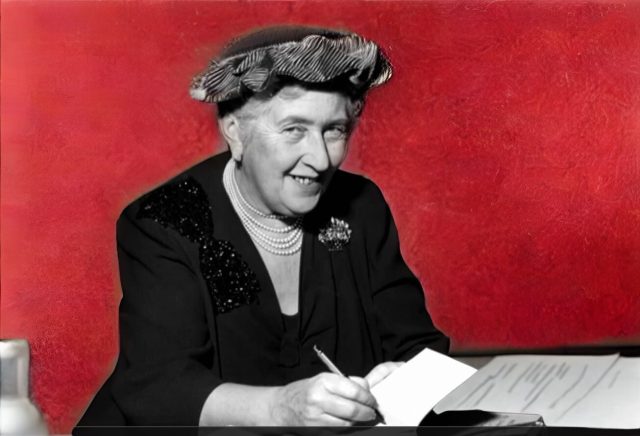
The Queen of Crime.(Credit: Hulton Archive / Getty)





“The crime novel,” said Bertolt Brecht, “like the world itself, is ruled by the English.” Well, he was right on the first count, but the British crime novelists in the Twenties and Thirties — the period dubbed the Golden Age of Detective Fiction by Brecht’s fellow-communist John Strachey — might have disagreed over who was really running the world. They suspected another agenda altogether. “Bolshevist gold is pouring into this country for the specific purpose of procuring a Revolution,” says Mr Carter, a senior figure in the security services in Agatha Christie’s The Secret Adversary (1922).
Christie, who died 50 years ago this month, is internationally recognized as the Queen of Crime. Indeed she’s legally recognized as such — the phrase has been trademarked by her estate, and anyone else billed under the title is likely to receive a cease-and-desist letter (“astonishingly pitiful,” said Val McDermid, when she was warned off in 2022). She’s the world’s biggest-selling fiction writer (she is estimated to have sold between two and four billion books) and one of the most adapted: virtually every one of her 66 crime novels has made its way onto screen, stage or radio. Netflix’s adaptation of The Seven Dials Mystery is only the latest. Traditionally, these adaptations were cozy affairs. More recently they’ve tried to be edgy, but few have played to the political content of the original books, particularly those of her younger days. Which is a shame, if only because at a time when conspiracy theories are again depressingly common, it’d be good to remember how prevalent — and how wrong — they were a century ago.
The Secret Adversary (1922), her second novel, sees a charming couple of amateurs, Tommy and Tuppence, thwart an international conspiracy to bring down Western civilization. It was written at a time of economic unrest. There had been a serious downturn in 1921 — “one of the worst years of depression since the Industrial Revolution,” wrote the Economist — accompanied by a wave of strikes: more than twice as many working days were lost to industrial action as in any previous year. More alarmingly, there were fears of unemployed ex-servicemen being inspired by the revolutions in Russia and Ireland. Meanwhile, the Liberals were being supplanted by the seemingly inexorable rise of the Labour Party.
In Christie’s story, Mr Carter explains that, however disastrous a Labour government would be, they’re not the real problem. Nor even are the communists. There’s someone further back in the shadows. “The Bolshevists are behind the Labour unrest – but this man is behind the Bolshevists.” No one knows his identity. “But one thing is certain, he is the master criminal of this age.”
Similarly, in The Big Four (1927), Hercule Poirot fights the cabal behind “the worldwide unrest, the labour troubles that beset every nation, and the revolutions that break out in some”. Their scope is global. “In Russia, you know, there were many signs that Lenin and Trotsky were mere puppets whose every action was dictated by another’s brain.” As Poirot says, “Their aim is world domination.”
This was characteristic of the popular fiction of the time. The biggest thriller hero of the Twenties was Bulldog Drummond, who battled his supervillain enemy over a succession of novels, plays and films by Sapper (the pen name of H.C. McNeile). Again, there’s an international organization controlling Left-wing politics in Britain. “Ever since the war you poisonous reptiles have been at work stirring up internal trouble in this country,” Drummond says to a Labour MP in The Black Gang (1922). “Not one in ten of you believe what you preach: your driving force is money and your own advancement.”
The idea of the Labour Party being fellow travelers was common. Dorothy L. Sayers, another billed as a Queen of Crime, presented in Clouds of Witness (1926) the Soviet Club in London, where there’s much excitement over the presence of the Labour leader, who “is going to make a speech about converting the Army and Navy to communism”.
Maybe this recurring theme might be seen as an attempt to understand the otherwise incomprehensible scale and horror of the First World War and its social impact. When things had gone so far wrong, there was a need to believe there might be an underlying cause of the discontent. “Behind all the world’s creeds, Christianity, Buddhism, Islam and the rest, lay an ancient devil-worship,” argues the charismatic villain in John Buchan’s The Three Hostages (1924). Now that “the War had cracked the veneer everywhere, the real stuff was showing through”, most obviously in the rise of communism. He intends to exploit the moral disorder so that he can seize power.
Fanciful, of course, risible even. But the idea of the hidden hand manipulating politics did have an impact, preparing the ground for real-life developments. The fall of the first Labour government in 1924 was triggered by accusations about the influence wielded by the Communist Party of Great Britain. In the subsequent election campaign, the Daily Mail produced the evidence — a letter supposedly sent by Grigori Zinoviev, Russian head of the Communist International, instructing the CPGB “to stir up the masses of the British proletariat”. There was a clear chain of command, it was alleged. “Moscow issues orders to the British Communists,” wrote the Mail, “the British Communists in turn give orders to the Socialist government, which it tamely and humbly obeys.”
It was entirely untrue — and the Zinoviev letter itself was a forgery — but the suspicion that there was some kind of Bolshevik influence was well established by now. The accusation of loyalty to an outside power was precisely what the thrillers of Agatha Christie and Sapper had warned against, and their many readers recognized the danger. The result was that Liberal voters deserted to the Tories in their droves, determined to keep out the socialists so that, although Labour increased its share of the vote, its number of MPs fell. The lesson was learned, and come the General Strike of 1927, the Trades Union Congress (TUC) was quick to deny any external influence, telling the press that a check sent from Moscow, “for some thousands of pounds”, had been returned uncashed.
Thereafter, the focus on communist subversion faded a little, merging into a much older suspicion of Russia. Ngaio Marsh’s A Man Lay Dead (1934) featured a secret Russian brotherhood “of amazing antiquity” which, in the days of Peter the Great, “practiced various indecent and horrible rites, based on a kind of inverted monasticism”. More recently, it had turned itself into a pro-Soviet political organization, even if it did retain its fondness for “erotic performances and mutilations”.
In The Devil Rides Out (1934), Dennis Wheatley went further and identified the real-life mastermind who had caused the war. “The monk Rasputin was the evil genius behind it all,” explains our hero. “He was the greatest Black Magician that the world has known for centuries. It was he who found one of the gateways through which to let forth the four horsemen that they might wallow in blood and destruction.”
More generally, though, detectives and thriller-heroes turned their attention elsewhere. Following the Wall Street Crash in 1929 and the ensuing Depression, there was a fashion in crime fiction for uncaring financiers and rapacious businessmen. These seemed more pressing threats to the nation’s well-being. Popular literature was popular precisely because it reflected the fears and concerns of its readers.
In Leslie Charteris’s The Smart Detective (1933), Simon Templar (aka the Saint) is visited by a woman who works for “Oppenheim who owns the sweat shops”. She outlines the system: “I work with fifty other girls in an attic in the East End. We work ten hours a day, six days a week, sewing. If you’re clever and fast you can make two pieces a day. They pay you one shilling a piece.” Oppenheim, by contrast, has just bought a collection of emeralds for a quarter of a million pounds. “It’s just one of those things that makes you feel like turning communist sometimes.” Variations on the theme were to be found in the likes of Arthur Wynne’s Death of a Banker (1934), John Rhodes’s Death of the Board (1937), Nicholas Blake’s There’s Trouble Brewing (1937) and Gathorne Cookson’s Murder Pays No Dividends (1938).
And in Agatha Christie’s One, Two, Buckle My Shoe (1940), where Alistair Blunt is head of “the greatest banking firm in England”. On him rests the economic stability that had kept the country free in an age of dictators. He is, says another character, “the answer to their Hitlers and Mussolinis and all the rest of them”, and Blunt tends to agree: “I’ve done something for England, M. Poirot. I’ve held it firm and kept it solvent. It’s free from dictators – from Fascism and from Communism.”
But this is the Queen of Crime in her mature years, and the message is more subtle than in the earlier conspiracy thrillers. However sound his economics, Blunt is a murderer, and tries to persuade Poirot that he cannot be held to account. If he’s arrested, he says, “a lot of damned fools would try a lot of very costly experiments. And that would be the end of stability – of common sense, of solvency. In fact, of this England of ours as we know it.”
The fate of the nation is at stake, and it’s left to Poirot to restate the essential principle that underpins Christie and most of the Golden Age. “I am not concerned with nations, Monsieur,” he says sternly. “I am concerned with the lives of private individuals who have the right not to have their lives taken from them.” Ultimately, of course, it’s that humanity, the value of the individual, that has ensured Christie’s continuing popularity.
Alwyn W. Turner is a cultural and political historian. His latest book is A Shellshocked Nation: Britain Between the Wars.
 AlwynTurner